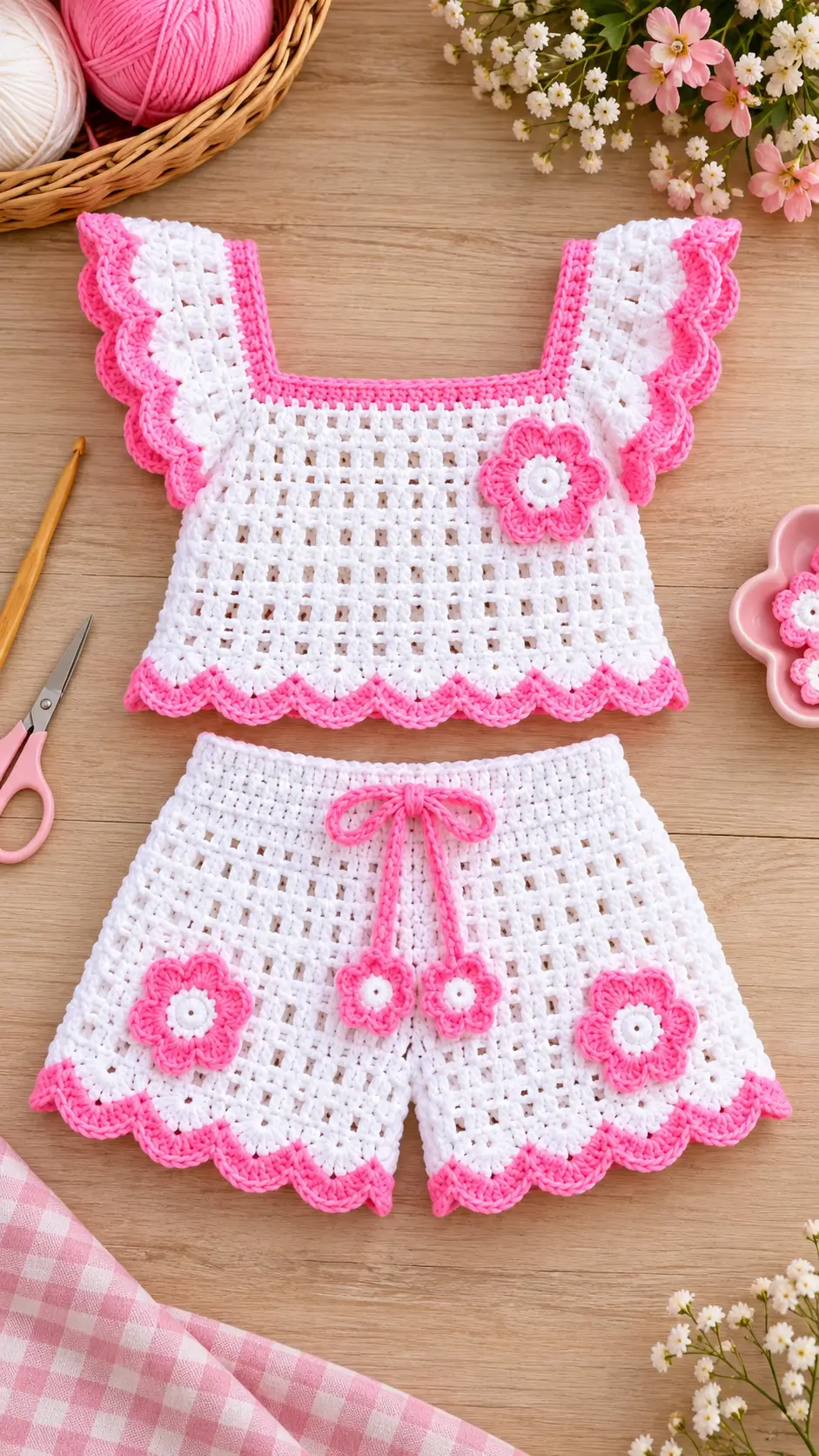
Five pink scallops across each shorts leg define this design before the basic silhouette does. This pink and white crochet top and shorts set combines a mesh crop top, high-waisted shorts, flower appliqués and contrasting borders. Use sport/DK cotton with a 3.5 mm hook and work from body measurements for the correct size. The intermediate-level construction is particularly useful when you want one coordinated summer project instead of separate top and shorts patterns.
The Design: What Makes This Crochet Set Different
The square neckline needs firm edging because the open mesh below it has considerably more lateral movement than dense single crochet. A compact pink border controls that stretch while making the neckline visually match the shorts drawstring.
The shoulder sections use another structural decision: ruffles are attached to broad straps instead of acting as straps themselves. That keeps the load-bearing section stable while the pink shells remain decorative. On the shorts, a dense upper section supports the waistband before the fabric changes into openwork.
The most common mistake with a crochet crop top and shorts design is treating every decorative border as independent. Here, the same pink accent repeats at the neckline, shoulder ruffles, top hem, shorts hems and flowers. That repetition is what makes the flower crochet outfit read as a single design.
Project Info at a Glance
| Skill Level | Time | Finished Size | Hook | Best For |
|---|---|---|---|---|
| Intermediate | Approx. 15–25 hours | Made to measurements; S reference waist 66 cm | 3.5 mm | Summer co-ord / beach layer |
A comparable shorts design publishes 66 cm as its relaxed small waist, increasing to 76 cm for medium and 86.5 cm for large. A 3.5 mm hook is also commonly used for sport-weight cotton shorts and lightweight crochet summer sets.
Materials and Tools
Yarn
- White — sport/DK cotton or cotton blend — approximately 300–350 g.
- Bright pink — same yarn weight — approximately 50–100 g for borders, ruffles, flowers and drawstring.
- White for flower centers — use a small amount from the main yarn allowance.
A complete adult crochet top-and-shorts set may require around 400 g of yarn. Treat this as a planning quantity rather than an exact requirement because garment size, gauge and yarn construction affect consumption.
Tools
- 3.5 mm crochet hook
- Yarn needle
- Scissors
- Flexible measuring tape
- 4 or more locking stitch markers
- Blocking mat and pins
- Optional narrow elastic for the waistband
Abbreviations
- ch — chain
- sc — single crochet
- hdc — half double crochet
- dc — double crochet
- sl st — slip stitch
- st/sts — stitch/stitches
- sp — space
- sk — skip
- RS — right side
- WS — wrong side
- rep — repeat
Invisible decreases are not required for this garment because shaping is controlled through measurements, increases, seams and openwork placement rather than amigurumi-style decreases.
Gauge and Sizing
Make a washed and dried gauge swatch before calculating the foundation chains. A useful reference for sport-weight cotton is approximately 18.5 stitches × 15 rounds per 10 × 10 cm in half double crochet. Your own washed gauge takes priority.
For the top, measure the bust circumference, desired crop circumference and shoulder-to-hem length. For the shorts, record the waist, fullest hip, rise and desired inseam.
The waistband should fit the actual waist rather than being copied from a fixed stitch count. This measurement-based approach also makes the pattern easier to adapt between sizes.
Pattern — Step by Step
Crop Top Front
Yarn: white.
Calculate the required front width with this formula:
Target front width in cm × stitches per cm = starting stitch count.
Round the result to a number compatible with the mesh repeat.
Row 1: Ch to calculated width. Dc in fourth ch from hook and across.
Row 2: Ch 3, turn, dc across.
Row 3: Ch 3, *dc in next 2 sts, ch 1, sk 1;* rep across, finishing with dc as needed.
Row 4: Ch 3, dc in each dc and each ch-1 sp across.
Rows 5 onward: Alternate the open mesh arrangement with solid stabilizing rows until the panel reaches the lower underarm.
The photographed top uses repeated vertical openings rather than completely solid fabric. Keep the mesh columns aligned. A missed chain space becomes increasingly visible as additional rows are added.
For the upper chest, continue across the center while shaping the sides to the desired underarm width.
Finish when the front reaches the base of the square neckline.
Fasten off.
Crop Top Back
Yarn: white.
Make the back to the same finished width as the front. Work the lower mesh section to match the front row for row.
The back is not visible in the reference photograph, so a rectangular back panel provides a practical construction method.
Seam the side edges from the hem to the underarm, leaving enough opening for comfortable arm movement.
Shoulder Straps — Make 2
Yarn: white.
Join white yarn to one upper front corner.
Row 1: Ch 2, hdc across the required strap width.
Row 2: Ch 2, turn, hdc across.
Repeat Row 2 until the strap reaches the corresponding back edge without stretching.
Pin both straps before sewing. Their lengths should be tested on the wearer because a difference of only 1–2 cm can noticeably alter the neckline depth.
Fasten off. Leave approximately 25 cm for sewing.
Pink Strap Ruffles — Make 2
Yarn: bright pink.
Join pink yarn along the outside edge of a completed white strap.
Row 1: Sc evenly along the strap edge.
Row 2: Ch 1, *sl st in next st, sk 2 sts, 5 dc in next st, sk 2 sts;* repeat along the edge. Modify only the final repeat when necessary.
Repeat along the second shoulder strap.
Square Neckline Border
Yarn: bright pink.
Join the pink yarn at a back neckline corner.
Round 1: Sc evenly around the complete neckline, placing additional stitches only where required to turn the corners without puckering.
Round 2: Sc in every stitch.
Fasten off and block the neckline flat.
If the neckline flares outward, too many stitches have been picked up around the border. If it contracts or puckers, increase the number of picked-up stitches.
Top Scalloped Hem
Yarn: bright pink.
Join pink yarn at one side seam.
Round 1: Sc evenly around the lower edge. Adjust the final stitch count to a multiple of 6.
Round 2: *Sk 2, 5 dc in next st, sk 2, sl st in next st;* repeat around.
Fasten off.
Using the same shell repeat on the top and shorts creates the matching scalloped border visible in the reference design.
Shorts Waistband
Yarn: white.
Measure the wearer’s waist at the position where the waistband will sit.
Chain enough stitches to equal that circumference according to the washed gauge. Join the foundation without twisting.
Round 1: Ch 1, hdc around. Join.
Round 2: Ch 1, hdc around. Join.
Round 3: Ch 2, dc around. Join.
Round 4: Ch 2, *dc in next 3 sts, ch 1, sk 1;* repeat around to form openings for the drawstring.
Round 5: Dc in every dc and ch-1 space.
Continue in hdc or dc until the waistband measures approximately 5–7 cm.
Narrow elastic can be added inside the waistband when more recovery is required.
Shorts Hip Section
Yarn: white.
Continue directly from the waistband.
Increase evenly across selected rounds until the garment reaches the required hip circumference. Check the fabric with a measuring tape instead of relying on a universal stitch count.
Once the required hip measurement is reached, work without further increases until the piece reaches the required crotch depth.
Add extra stitches at center front and center back only when the wearer’s rise measurement requires additional shaping.
Shorts Legs — Make 2
Divide the total lower-body stitches into two equal leg sections.
Join the crotch opening with a short chain bridge when required for the chosen fit.
For each leg:
Round 1: Join white at the inner leg and work dc around.
Round 2: Ch 3, *dc in next 2 sts, ch 1, sk 1;* repeat around.
Round 3: Dc in every dc and ch-1 space.
Rounds 4 onward: Repeat the mesh arrangement until the desired leg length is reached.
The shorts shown in the reference have a loose lower-leg silhouette. Keep enough circumference after dividing the crotch to prevent the leg openings from becoming fitted.
Shorts Scalloped Borders — Make 2
Yarn: bright pink.
Round 1: Sc evenly around the leg opening. Adjust the stitch count to a multiple of 6.
Round 2: *Sk 2, 5 dc in next st, sk 2, sl st in next st;* repeat around.
Fasten off.
Begin and finish the repeat near the inner leg so the joining point remains less visible when the shorts are worn.
Large Five-Petal Flower Appliqués — Make 3
Yarn: white and bright pink.
The reference design places one large flower on the crop top and one on each side of the shorts.
With white yarn:
Round 1: Make a ring and work 10 sc into it. Join with sl st. (10)
Change to pink.
Round 2: Work one petal across each pair of center stitches: ch 2, 3 dc into the attachment area, ch 2, sl st into the next anchoring stitch. Repeat until 5 petals have been formed.
Fasten off, leaving approximately 25 cm for sewing.
Use the same 3.5 mm hook and garment yarn when you want the flowers to remain proportional to the photographed design.
Drawstring
Yarn: bright pink.
Measure approximately twice the finished waist circumference and add another 20–30 cm for tying.
Chain to this measurement.
Row 1: Starting in the second chain from the hook, sl st through every chain.
Fasten off.
Thread the finished cord through the waistband openings. Position both ends at the center front.
Small Drawstring Flowers — Make 2
Yarn: white and bright pink.
Use the same five-petal construction as the large appliqués, but shorten the petals or work fewer double crochets in each petal.
Attach one flower firmly to each end of the drawstring.
The flowers function as decorative cord ends rather than structural fasteners.
Assembly
- Block the front and back top panels to the calculated measurements before joining them.
- Seam the top side edges while keeping the mesh columns aligned at both underarms.
- Pin the white shoulder straps to the back and test the neckline depth before sewing them permanently.
- Add the pink strap ruffles after confirming that both straps carry equal tension.
- Work the pink neckline and lower scalloped border, then block the completed top again.
- Finish the shorts crotch and check that both leg openings contain equal stitch counts.
- Add the pink scalloped border to each shorts leg, beginning the repeats close to the inner leg.
- Position the three large flowers: one near the upper chest and one toward each outer shorts leg.
- Thread the pink cord through the waistband and attach one small flower to each cord end.
- Weave all tails through matching stitches on the wrong side, trim them and complete the final blocking.
The completed project contains one crop top, one pair of shorts, three large flower appliqués, two small drawstring flowers and coordinated pink scalloped borders.
7 Technical Tips for Better Results
- Prevent mesh-column drift: Place a marker in the first mesh opening of every repeat row. Moving a chain space by one stitch creates a diagonal line that becomes increasingly visible.
- Check waistband stretch: Measure the waistband again after at least 5 cm of fabric has been completed. A foundation chain can lengthen once the weight of the shorts is added.
- Match the shoulder straps: Measure both straps to within 5 mm before attaching them. One longer strap will lower one side of the square neckline.
- Control ruffle flare: Pin each ruffle at quarter points before completing the attachment. Excess edge stitches can make the shoulder shells twist outward.
- Block the flowers first: Bring all three large flowers to the same finished diameter before sewing. Attaching unblocked flowers can pull the surrounding mesh out of shape.
- Check the scallop multiple: Make each leg’s foundation border divisible by 6 before beginning the shell round. An incomplete repeat produces a visibly narrower final scallop.
- Secure yarn tails: Weave structural tails through at least 4–5 cm of matching stitches and reverse direction once. Avoid trimming a tail directly beside a seam or flower attachment.
Conclusion
Block the flowers and scalloped borders before judging the final proportions because both details can change width after washing. The next practical step is to make a 10 × 10 cm swatch, wash it, record the stitch gauge and calculate the top and shorts foundation measurements from the wearer rather than copying an unverified photo size. Save the finished pink and white crochet top and shorts set to Pinterest and share the completed version on Instagram with #PinkFlowerCrochetSet. Record any sizing changes with the project so a second version can reproduce the same fit. Which detail would you repeat in another colorway: the five-petal flowers or the pink shoulder scallops?