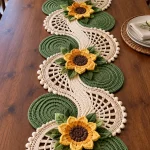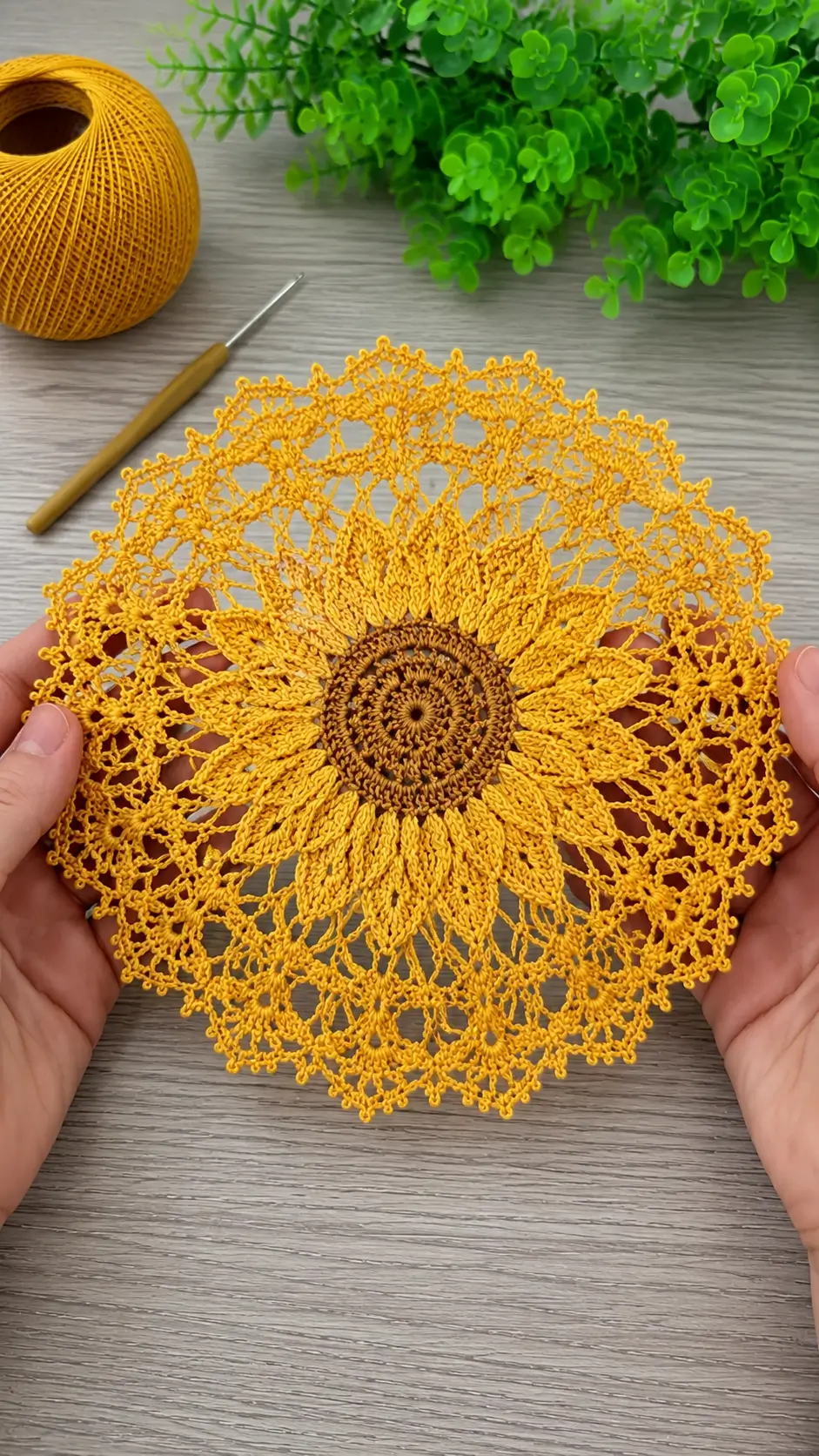
Sunflowers fail fast when the center is too small. The petals look weak, the lace ring takes over, and the whole sunflower crochet doily pattern loses its flower geometry. This version uses size 10 crochet thread, a steel hook around 2 mm, and intermediate thread-crochet control to build a doily roughly 28 to 32 cm wide. It works well as a table centerpiece, tray liner, or wall-mounted floral accent.
The Design: What Makes This Sunflower Different
A sunflower doily has three structural zones, not one. First comes the compact brown center. It has to read as a seed head, so the rounds stay dense and slightly raised. Then the petals take over. They need length, but they also need spacing, because overcrowded petals collapse into a ruffle instead of a flower. The last section is the lace ring. That outer ring carries the diameter and gives the piece its finished spread.
This sunflower lace doily uses pointed petals rather than rounded ones because narrow petal tips preserve the radial layout once blocked. The openwork edging also matters. A dense border would compete with the petals, while a lighter one frames them. A common mistake in a crochet sunflower doily is adding petal height without increasing the center enough to support it.
Project Info at a Glance
| Skill Level | Time | Finished Size | Hook | Best For |
|---|---|---|---|---|
| Intermediate | 7–9 hours | Approx. 28–32 cm across | 2.0 mm steel hook | Centerpiece, decor mat, framed lace art |
Materials and Tools
Thread
- Golden yellow crochet thread — size 10 — about 55 to 60 g — mercerized cotton
- Medium brown crochet thread — size 10 — about 10 to 15 g — mercerized cotton
Tools
- 2.0 mm steel crochet hook
- Tapestry needle
- Fine scissors
- Rustproof pins
- Blocking mat or padded board
- Spray bottle or starch
Abbreviations
MR = magic ring, ch = chain, sl st = slip stitch, sc = single crochet, hdc = half double crochet, dc = double crochet, tr = treble crochet, dtr = double treble crochet, sp = space, rep = repeat, rnd = round, picot = ch 3 and sl st in first ch.
Invisible decrease is not standard in this doily. Stitch placement accuracy matters more than reduction technique because most shaping is built with chain spacing and grouped stitches.
Pattern Notes
Work in joined rounds unless noted. The center, petals, and outer lace are built as one piece. Count every petal base before moving into the outer ring. Small count drift in thread crochet becomes visible immediately after blocking.
Pattern — Step by Step
Brown Center
Yarn: brown
- Rnd 1: MR, ch 2, 12 dc in ring. Join. (12)
- Rnd 2: Ch 2, 2 dc in each st around. Join. (24)
- Rnd 3: Ch 2, *dc in next st, 2 dc in next; rep around. Join. (36)
- Rnd 4: Ch 1, sc in each st around. Join. (36)
- Rnd 5: Ch 2, working in front loops only, *dc in next 2 sts, 2 dc in next; rep around. Join. (48)
- Rnd 6: Ch 1, sc in each st around. Join. (48)
- Rnd 7: Ch 2, back loops only, *dc in next 3 sts, 2 dc in next; rep around. Join. (60)
- Rnd 8: Ch 1, sc in each st around. Join. (60)
- Rnd 9: Ch 2, *dc in next 4 sts, 2 dc in next; rep around. Join. (72)
- Rnd 10: Ch 1, sc in each st around. Fasten off brown. (72)
Sunflower Petals
Yarn: yellow
- Rnd 11: Join yellow in any st. Ch 1, *sc in next 3 sts, ch 7, skip 1 st; rep around. Join. (18 ch-7 loops)
- Rnd 12: Sl st into first loop, *work (sc, hdc, 3 dc, tr, 3 dc, hdc, sc) in loop; sl st in next 3 base sts; rep around. (18 petals)
- Rnd 13: Working behind petals, join in first skipped area. Ch 8, sc behind next petal; rep around. (18 back loops)
- Rnd 14: In each loop work (sc, hdc, 4 dc, dtr, 4 dc, hdc, sc). Join. This creates the longer petal layer.
- Rnd 15: Working behind the second petal layer, ch 5, sc in each valley between petals around. Join.
- Rnd 16: In each ch-5 sp work (sc, ch 3, dc, ch 3, sc). Join.
The petals should sit in two visible layers, with the second layer extending farther than the first. Pin two opposite petals before checking symmetry.
Transition Lace Ring
- Rnd 17: Sl st into first ch-3 sp, ch 6, sc in next ch-3 sp; rep around. (36 arches)
- Rnd 18: In each arch work (sc, ch 4, sc). Join.
- Rnd 19: Ch 5, sc in next center gap around.
- Rnd 20: Ch 6, sc in next gap around.
- Rnd 21: In each arch work (sc, ch 3, picot, ch 3, sc). Join.
- Rnd 22: Ch 5, sc in every next center point around.
Outer Floral Lace
- Rnd 23: In each arch work (sc, 3 dc, ch 2, 3 dc, sc). Join.
- Rnd 24: Sl st into ch-2 sp, ch 7, sc in next ch-2 sp; rep around.
- Rnd 25: In each ch-7 arch work (sc, hdc, 5 dc, picot, 5 dc, hdc, sc). Join.
- Rnd 26: Ch 4, sl st between motifs, ch 4; rep around to create net spacing.
- Rnd 27: In each ch-4 sp work (sc, ch 3, sc). Join.
- Rnd 28: Ch 5, sc in next ch-3 sp around.
- Rnd 29: In each arch work (sc, hdc, 2 dc, picot, 2 dc, hdc, sc). Join.
- Rnd 30: Final edging: *sl st in next point, ch 3, picot, sl st in same point, sl st to next valley; rep around. Fasten off.
Assembly
- Weave in the brown center tail first.
- Weave in the yellow join at the back of the petal base.
- Check that all 18 petals are separated cleanly before blocking.
- Pin the center flat without stretching it.
- Pin every long petal tip at equal distance from the center.
- Pin the shorter inner petal points between the outer ones.
- Pin each major lace arch in the outer ring.
- Pin each picot point on the edging individually.
- Lightly mist or starch the doily.
- Dry fully before removing pins.
The doily is complete when the center remains round, the petals stay distinct, and the outer edging repeats evenly without twisting.
7 Technical Tips
- Count the petal loops at Round 11 twice. If you land at 17 or 19 instead of 18, the lace ring will drift and the flower will not read centered.
- Keep the brown center firm. A loose center expands during blocking and reduces the apparent petal length by several millimeters.
- Do not pull the yellow petal stitches tight at the tips. Tight treble tips curl inward and make the flower look spiky rather than botanical.
- Pin every petal tip separately. Skipping alternate petals during blocking causes one side of the doily to open wider than the other.
- Use the same thread weight for both colors. A thicker brown center creates a ridge that lifts the petal base and distorts the transition ring.
- Check the outer lace after every arch round. One missed chain in the openwork section throws off the final picot count immediately.
- Weave tails through dense stitch groups only. Open mesh is not enough to lock short thread tails, especially after washing or starching.
Conclusion
This sunflower crochet doily pattern depends on proportion more than novelty. The brown center sets the scale, the petals carry the motif, and the lace ring finishes the diameter without overpowering the flower. Work the center cleanly, verify the petal count before the transition rounds, and block with measured spacing at every point. Photograph the finished piece flat against a pale wood or dark matte surface for Pinterest, then post a close crop of the petal layers to Instagram. Use the tag #SunflowerDoilyPattern. One useful next step is testing the same pattern with a darker center and slightly shorter petals. Does this sunflower look better to you with 18 petals or 20?