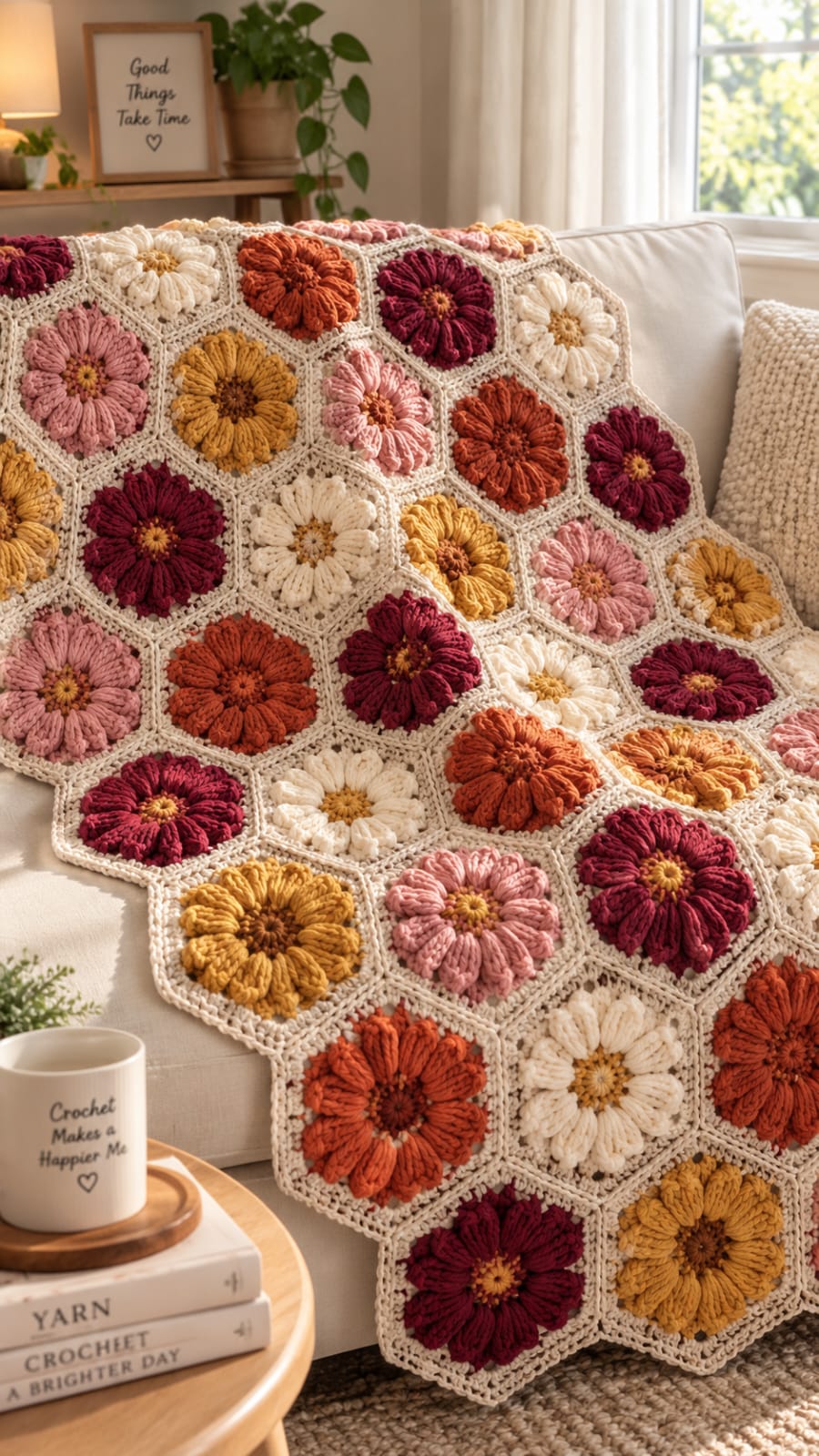
Twelve raised petals change a standard crochet hexagon into a flower with enough depth to dominate each honeycomb cell. This 3D flower hexagon crochet blanket pattern combines burgundy, terracotta, mustard, blush pink, and ivory flowers inside matching cream hexagon frames. Worked with DK or light worsted yarn and a 4.0 mm hook, the modular construction produces a richly textured throw with a distinctive stepped perimeter.
What Makes This Flower Hexagon Blanket Different
The blanket is built from six-sided motifs rather than conventional granny squares. That decision changes the complete geometry: motifs interlock in offset rows, joins meet at three-way intersections, and the outer edge naturally forms points and valleys.
Each motif contains a large dimensional flower with approximately 12 elongated petals. The petals occupy most of the hexagon rather than leaving a wide background area, which creates the dense floral surface visible across the blanket.
A consistent cream frame is worked around every flower. It separates burgundy, rust, mustard, pink, and ivory blooms while making the joining seams part of the design.
The most common construction problem with this type of crochet flower hexagon blanket is uncontrolled petal height. Oversized puff stitches can pull the center inward and prevent the cream frame from lying flat.
Project Information
| Skill Level | Construction | Motif Size | Hook | Yarn |
|---|---|---|---|---|
| Intermediate | Joined hexagon motifs | Approx. 16–18 cm point-to-point | 4.0 mm | DK / light worsted |
The final dimensions depend on motif count and arrangement. Hexagons measuring approximately 16–18 cm point-to-point can produce a medium throw when arranged in alternating offset rows. Adding or removing complete rows changes the dimensions without altering the individual flower construction.
Materials and Tools
Yarn
- Burgundy — DK/light worsted — dimensional flower motifs.
- Terracotta or rust — DK/light worsted — dimensional flower motifs.
- Mustard gold — DK/light worsted — dimensional flowers and selected centers.
- Blush pink — DK/light worsted — dimensional flower motifs.
- Warm ivory — DK/light worsted — flowers and selected centers.
- Golden brown — DK/light worsted — contrasting flower centers.
- Cream — DK/light worsted — hexagon framing rounds, joins, and finishing edge.
Cream requires the largest continuous quantity because every motif contains several framing rounds and the same color is used for joining. Keep the flower colors within one yarn family or choose yarns with closely matched thickness and fiber behavior.
Tools
- 4.0 mm crochet hook
- Yarn needle
- Scissors
- Locking stitch markers
- Blocking mats
- Rust-resistant blocking pins
- Tape measure
Abbreviations
- MR — magic ring
- ch — chain
- sc — single crochet
- hdc — half double crochet
- dc — double crochet
- tr — treble crochet
- sl st — slip stitch
- st/sts — stitch/stitches
- sp — space
- ch-sp — chain space
- yo — yarn over
For a puff stitch, yarn over, insert the hook into the indicated space, pull up a loop, and repeat until the required loops are on the hook. Yarn over and draw through the accumulated loops, then secure the puff with one chain.
3D Flower Hexagon Crochet Blanket Pattern
Make the motifs individually and block them before joining. The instructions below create an original image-inspired hexagon with 12 dimensional petals and a cream six-sided frame.
Flower Center
Use golden brown, mustard, rust, or another selected center color.
Round 1
Make an MR.
Ch 1 and work 12 sc into the MR.
Pull the ring firmly closed and sl st to the first sc. (12 sts)
Round 2
Ch 1.
Work 2 sc in each stitch around.
Sl st to the first sc. (24 sts)
Fasten off the center color.
Raised Flower Petals
Change to burgundy, terracotta, mustard, blush pink, or ivory.
Petal Foundation Round
Join the flower yarn in any stitch.
Ch 1 and sc in the same stitch.
Ch 4, skip 1 stitch, sc in the next stitch.
Repeat around.
Finish with a sl st to the first sc. (12 ch-4 petal spaces)
Petal Round
Sl st into the first ch-4 space.
Work the following into the same space:
sc, hdc, 3 elongated dc, hdc, sc.
One petal is complete.
Repeat the same sequence in each of the remaining ch-4 spaces.
At the end of the round there should be 12 raised petals.
Sl st at the base of the first petal.
Fasten off.
Pull each petal toward the front of the work. Keep the bases close to the center while allowing the middle section of each petal to rise above the surrounding fabric.
Hexagon Foundation
Use cream yarn.
Hexagon Round 1
Join cream yarn behind any petal.
Ch 3.
Work dc stitches evenly around the back of the flower.
Divide the 12 petals into six groups of two petals each. Between every second petal, work (2 dc, ch 2, 2 dc) to establish one hexagon corner.
Continue around until six corner spaces have been created.
Sl st to the top of the beginning ch-3.
Hexagon Round 2
Ch 3.
Dc in each stitch across the first side.
In the next corner ch-2 space work (2 dc, ch 2, 2 dc).
Repeat across all six sides.
Sl st to the beginning ch-3.
Hexagon Round 3
Ch 1.
Sc in every stitch across each side.
At every corner work (sc, ch 2, sc).
Repeat around all six sides.
Sl st to the first sc.
Hexagon Round 4
Ch 3 and dc in each stitch across the side.
At every corner work (2 dc, ch 2, 2 dc).
Continue around all six sides.
Sl st to the beginning ch-3 and fasten off.
The blocked motif should measure approximately 16–18 cm point-to-point. Add another cream expansion round only if every motif in the blanket receives the same additional round.
Burgundy Flower Hexagon
Use golden brown or mustard for the center and deep burgundy for all 12 petals. Complete the surrounding hexagon in cream.
Burgundy is one of the darkest colors in the palette, so distribute these motifs across the entire blanket rather than grouping them in one area.
Terracotta Flower Hexagon
Use a dark rust or brown center with terracotta petals. Complete all cream framing rounds exactly as written for the main motif.
Do not alter the number of cream rounds to correct a slightly smaller flower. The flower itself can vary in diameter while the outer hexagon dimensions need to remain consistent.
Mustard Flower Hexagon
Use a brown or rust center and mustard-gold petals.
Maintain the same 12-petal construction. Mustard yarn can visually expose gaps between petals more clearly than darker yarn, so keep all petal bases evenly spaced around the center.
Blush Pink Flower Hexagon
Use a mustard or rust center with blush-pink petals.
Work the petal stitches at the same height as the burgundy and terracotta versions. Changing tension for a softer color can accidentally create a smaller motif even when the stitch count remains identical.
Ivory Flower Hexagon
Use mustard or golden brown for the center and warm ivory for the petals.
The cream frame should remain distinguishable from the flower. If the two yarn colors are too similar, select a warmer ivory for the petals and a cooler natural cream for the hexagon border.
Planning the Hexagon Layout
Block every motif before planning the final color arrangement. Hexagons require an offset layout, so the second row sits partly between the motifs in the first row.
Place the burgundy, terracotta, mustard, pink, and ivory flowers across the blanket in an irregular repeating sequence. Avoid vertical columns of one color. The photographed design works because strong burgundy motifs are interrupted by lighter ivory, mustard, and pink flowers.
Keep approximately equal visual weight across both halves of the blanket. A cluster of three dark flowers in one corner can make the opposite side appear unfinished even when the total motif count is balanced.
Photograph the final arrangement before beginning the joining process.
Joining the Crochet Hexagons
Use cream yarn for every seam so the joins merge with the outer rounds of the motifs.
Arrange the hexagons with corresponding sides touching. Each straight side must contain the same number of stitches before joining.
Place two motifs with wrong sides together if you want the joining ridge visible on the front. Place right sides together for a less prominent seam.
Insert the hook through the corresponding corner spaces and make a slip stitch.
Continue with one slip stitch through each matching pair of stitches across the side.
Finish at the next corner.
Add the next motif according to the photographed layout and continue building the honeycomb structure.
At intersections where three hexagons meet, avoid making multiple knots in the same corner space. Carry the joining yarn through the intersection or weave the tails in opposite directions.
Maintaining the Stepped Outer Edge
This blanket does not require half-hexagon fillers. Leaving full motifs along the perimeter creates the distinctive pointed and recessed outline visible in the design.
Before adding the finishing edge, inspect every outer point and valley. Each point should have one complete corner space, while every valley occurs where two angled motif sides meet.
The finishing round must treat these locations differently. Outer points require additional stitches; inward valleys require controlled decreases or tightly placed joining stitches.
Cream Finishing Edge
Edge Round 1
Join cream yarn at an outer hexagon corner.
Ch 1 and sc evenly along the first motif edge.
At an outward point work (sc, ch 2, sc) into the corner space.
Continue with sc along the next edge.
When reaching an inward valley, work one sc into the first corner space, skip the seam intersection, then work one sc into the next corner space.
Continue around the complete perimeter.
Sl st to the first sc.
Edge Round 2
Ch 1 and sc in every stitch.
At outward points work (sc, ch 2, sc).
At inward valleys work sc2tog across the stitches immediately before and after the valley.
Continue around.
Sl st to the first sc and fasten off.
The finished edge should follow the honeycomb silhouette rather than attempting to convert the blanket into a rectangle.
Assembly and Finishing
- Complete all burgundy, terracotta, mustard, blush-pink, and ivory flower centers and petals.
- Add identical cream framing rounds to every flower to convert each motif into a six-sided hexagon.
- Block every motif to approximately 16–18 cm point-to-point.
- Arrange the motifs in offset honeycomb rows and distribute the five flower colors across the complete blanket.
- Photograph the arrangement before moving any motifs from the layout.
- Join neighboring hexagons with cream yarn, matching every stitch along the corresponding sides.
- Inspect all three-way intersections and secure any loose joining tails before adding the perimeter.
- Work the first cream finishing round while adding stitches at outer points and controlling the inward valleys.
- Complete the second finishing round and weave each remaining tail through several stitches on the wrong side.
- Block the assembled blanket, aligning the hexagon seams and shaping every raised petal before allowing the fabric to dry.
The completed blanket should retain its honeycomb structure, dimensional flower surface, cream geometric grid, and intentionally stepped outer silhouette.
7 Technical Tips for Flower Hexagon Blankets
- Flower centers forming holes: Pull the magic ring completely closed before starting the second round. An opening wider than approximately 5 mm becomes more noticeable once the 12 petals radiate away from the center.
- Petals becoming different lengths: Pull every elongated double crochet to approximately the same height before completing the stitch. A variation of more than 5 mm can make one side of the flower appear heavier.
- Hexagons turning into circles: Mark all six corner spaces before beginning the cream expansion rounds. Missing one corner removes the straight side structure required for clean honeycomb joining.
- Motifs cupping around the flower: Keep the cream foundation stitches loose enough to sit behind the raised petals. A foundation round pulled tightly around the flower base causes the outer hexagon edges to lift.
- Joining seams becoming crooked: Match each stitch with the corresponding stitch on the neighboring hexagon. Even one skipped stitch along a side shifts the next three-way intersection away from its correct position.
- Outer valleys puckering: Reduce stitches at inward corners rather than treating them like outward points. Adding corner increases inside a valley creates excess fabric and produces a visible ruffle.
- Petals flattening during blocking: Pin the cream hexagon frame rather than the raised flower. Shape each petal by hand and leave approximately 5–10 mm of natural height above the background.
Adjusting the Blanket Size
The blanket can be resized by changing the number of complete hexagons. Because the rows are offset, width and length do not increase by exactly one motif diameter each time a new row is added.
For a smaller lap blanket, remove complete motifs from both the width and length while preserving the staggered row structure. For a larger throw or bed covering, add full offset rows.
Lay out the proposed arrangement before making every motif. This gives a more reliable finished-size estimate than multiplying the point-to-point measurement by the number of motifs because neighboring hexagons overlap geometrically when joined.
If a rectangular outer silhouette is required, half-hexagons can fill selected gaps. The image-inspired version deliberately leaves those spaces open to retain the stepped honeycomb edge.
Managing the Five-Color Flower Palette
Burgundy provides the strongest contrast against the cream frame. Space these motifs across the entire project, using ivory and blush flowers between darker areas.
Terracotta introduces a warmer middle value, while mustard provides a brighter transition between rust and ivory. Avoid repeating the same sequence in every row. Controlled irregularity produces a more natural floral distribution.
Flower centers can also vary within a limited palette. Mustard works against burgundy and ivory petals, while rust or brown centers pair effectively with mustard and blush.
Keep the cream frame identical on every motif. That single repeated color is what allows five different flower shades to function as one blanket rather than separate blocks.
Keeping Dimensional Petals Consistent
Make one completed flower hexagon as a reference motif before producing the remaining pieces. Measure both the outer hexagon and the diameter of the raised flower.
Compare new motifs with the reference every few pieces. If the petals gradually become taller, check the height of the loops used for the elongated stitches. If the hexagon becomes smaller, check the tension of the cream framing rounds separately.
Do not judge motif dimensions from the flower alone. A terracotta bloom may appear larger than an ivory flower because of color contrast even when both contain identical stitches.
Blocking the Finished Blanket
Block the individual motifs before joining and perform a second light blocking after assembly. The first blocking controls hexagon dimensions; the second aligns the joined rows and perimeter.
Lay the completed blanket flat. Start by aligning the central seams, then work outward toward the edges.
Pin each outward hexagon point individually. Shape the inward valleys without stretching them into straight lines because the stepped silhouette is intentional.
Keep pins out of the dimensional flower petals. Arrange the petals by hand, lifting compressed sections and separating neighboring petals where necessary.
Allow the blanket to dry completely before folding or placing it over furniture.
Finishing the Flower Hexagon Blanket
Check every three-way intersection after the final blocking and reinforce any joining tail that has shifted toward the surface. The cream seams should remain flat while the 12-petal flowers project above them, preserving the contrast between geometric construction and dimensional texture.
This 3D flower hexagon crochet blanket pattern can be scaled with additional full motifs while retaining the burgundy, terracotta, mustard, blush, and ivory palette. Record the final motif count and color map before making another size. Photograph the blanket flat to show the honeycomb arrangement, then share the finished project on Pinterest or Instagram with #3DFlowerHexagonBlanket.
Which flower color would you repeat most often in your hexagon layout: deep burgundy, terracotta, mustard, blush pink, or ivory?