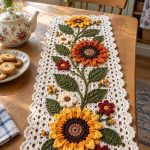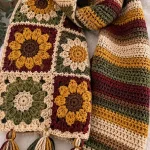
Six dimensional flower squares interrupt the stripes of this sunflower granny square scarf, so the scarf has to solve two different gauge problems before the pieces can meet cleanly. This sunflower granny square scarf crochet pattern uses worsted yarn, a 4.5 mm hook, floral motifs, striped panels, cream joining rounds, and four large tassels. The construction suits an intermediate crocheter familiar with clusters, color changes, and joining motifs.
The Design: What Makes This Sunflower Scarf Different
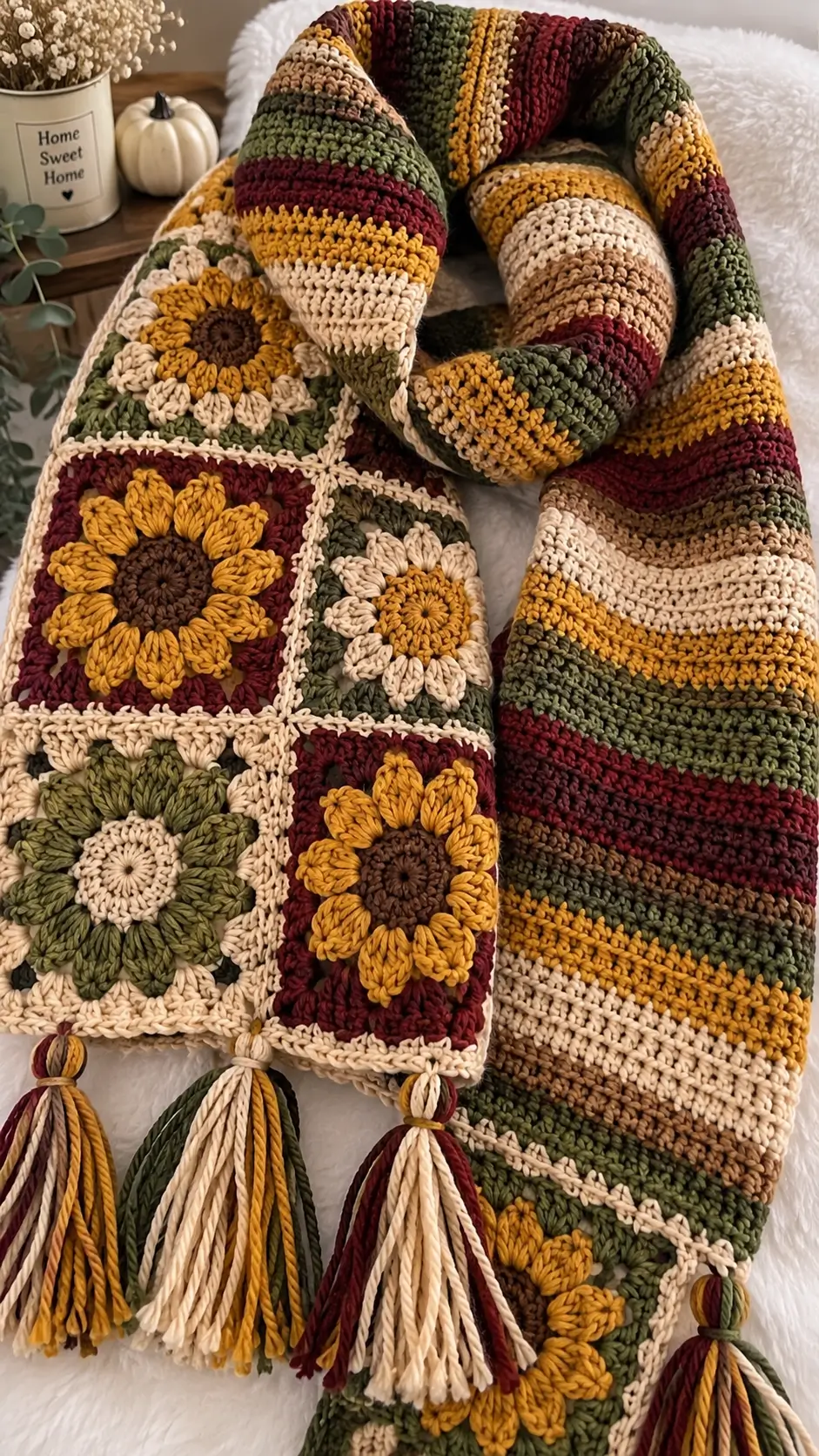
The scarf combines two distinct crochet structures. One section is assembled from dimensional flower granny squares, while the other uses dense horizontal stripes in olive, mustard, burgundy, cream, and brown. Keeping those sections at equal widths is the main construction requirement.
The flowers also vary in color. Some use mustard petals with dark brown centers, while others reverse the visual emphasis with cream or olive petals. This makes the crochet sunflower scarf look less repetitive without changing the basic square dimensions.
A cream border separates the darker autumn colors and creates a consistent joining edge. The four oversized tassels repeat every major color used in the scarf.
The most common failure point in a granny square scarf pattern of this type is joining unblocked squares. Even a 1 cm difference between motifs can pull the finished scarf sideways.
Project Info at a Glance
| Skill Level | Square Size | Hook | Yarn Weight | Construction |
|---|---|---|---|---|
| Intermediate | Approx. 13 × 13 cm | 4.5 mm | #4 Worsted | Motifs + striped panels |
Materials and Tools
Yarn
Choose five colors of the same yarn line whenever possible. Equal fiber content and thickness make it easier to keep the flower squares and striped sections at the same width.
- Olive green — #4 worsted — main background and stripe color
- Mustard/gold — #4 worsted — sunflower petals and stripes
- Burgundy — #4 worsted — square backgrounds and stripes
- Cream — #4 worsted — borders, petals, joins and stripes
- Brown/tan — #4 worsted — flower centers and stripes
Published 13 cm sunflower squares use approximately 10–30 yards of worsted yarn per motif, depending on the exact construction. Buy additional yarn for the long striped sections, borders, joining seams, and four tassels.
Tools
- 4.5 mm crochet hook
- Tapestry needle
- Scissors
- Locking stitch markers
- Blocking pins
- Blocking mat
- Measuring tape
- Cardboard tassel template
Abbreviations
- MR — magic ring
- ch — chain
- sc — single crochet
- hdc — half double crochet
- dc — double crochet
- tr — treble crochet
- sl st — slip stitch
- st/sts — stitch/stitches
- sp — space
- puff — puff stitch
- cluster — cluster stitch
- RS — right side
An invisible decrease is made through the front loops of two consecutive stitches before completing a single crochet, although decreases are not normally required in the flat scarf panels.
Gauge and Finished Measurements
A practical target for this project is a blocked granny square measuring approximately 13 × 13 cm. Published sunflower granny-square patterns achieve this size with #4 worsted yarn and a 4.5 mm hook.
Exact finished scarf length can be adjusted. Instead of changing the flower squares, add or remove rows from the striped sections. Keep the scarf width equal to the blocked width of the granny-square panel.
Make one complete flower square first. Block it, measure it, and use that measurement as the width target for every striped section.
Sunflower Granny Square Scarf Crochet Pattern
Sunflower Square With Mustard Petals
Colors: brown center, mustard petals, burgundy or olive background, cream border.
Round 1: With brown, make an MR. Ch 3 and work 15 dc into the ring. Join with sl st. You should have 16 stitch positions including the beginning chain.
Round 2: Work one puff stitch into each stitch around, placing a ch 1 between puff stitches. Join at the end of the round. You should have 16 puff sections.
Round 3: Join mustard into any ch-1 space. Work one petal cluster into each space with ch 1 between clusters. Repeat around to create 16 dimensional petal sections.
Fasten off mustard.
Round 4: Join the selected background color into a space between petals. Begin converting the circular flower into a square by using shorter stitches along each side and treble crochet groups at the four corners.
A practical corner group is 3 tr, ch 3, 3 tr. Use dc and hdc groups between corners so the flower gradually becomes square rather than developing four pointed extensions.
Round 5: Continue around in the background color. Work evenly across each side and place the required additional stitches into each corner space.
Round 6: Join cream. Work sc evenly around all four sides with 3 sc in each corner.
Fasten off and weave the ends into matching colors.
Cream-Petal Flower Square
Colors: mustard center, cream petals, olive background, cream border.
Work the same structural sequence as the first flower square, but change the palette.
Round 1: Make the center in mustard.
Round 2: Continue the textured center in mustard or brown.
Round 3: Change to cream and form the dimensional petal clusters.
Round 4: Join olive green and convert the circular flower into a square.
Round 5: Continue in olive until the square reaches the same dimensions as the mustard sunflower square.
Round 6: Join cream and work an even border around the square.
Fasten off.
Olive-Petal Flower Square
Colors: cream center, olive petals, cream background.
This variation appears near the lower portion of the photographed scarf.
Round 1: Work the circular center in cream.
Round 2: Build the textured center while maintaining an even circular shape.
Round 3: Join olive and make the petal clusters around the center.
Round 4: Change to cream. Use graduated stitch heights to begin squaring the flower.
Round 5: Continue the cream background, placing increases only at the four corners.
Round 6: Work a final cream border.
Block to exactly the same dimensions as the other flower squares.
Make the Remaining Flower Squares
Make enough motifs to reproduce the visible six-square floral panel or adjust the number for the required scarf length.
The photograph alternates flower colors instead of repeating six identical sunflowers. Use mustard petals on several motifs, cream petals on others, and olive petals on at least one square.
Keep the final cream border identical on every square. This creates a common visual frame and makes joining considerably easier.
Joining the Granny Squares
Block every square before joining.
Arrange the motifs into a long rectangular panel. The scarf in the photograph uses a narrow arrangement rather than a blanket-width grid.
Place two squares with their edges aligned.
Using cream yarn, join through corresponding stitches with slip stitches or single crochet. Work from one corner to the next without skipping edge stitches.
Add the remaining motifs in the planned order.
After all squares are connected, work a cream border around the complete floral panel. This final border helps correct minor variations between individual motifs.
Striped Scarf Panel
Colors: olive, mustard, burgundy, cream and brown.
Measure the finished width of the blocked granny-square panel.
Chain until the foundation reaches the same width.
Row 1: Ch 1 and work sc across.
Rows 2–4: Continue in the first selected color.
Change color at the end of a row.
Work bands of different depths rather than making every stripe identical. The photographed scarf mixes narrow and broad sections, which prevents the fabric from looking like a regular five-color repeat.
A sample sequence is:
- Olive — 4 rows
- Mustard — 3 rows
- Cream — 4 rows
- Brown — 3 rows
- Burgundy — 4 rows
- Olive — 3 rows
- Mustard — 2 rows
- Cream — 4 rows
Repeat the colors in a different order as the panel grows.
Measure the width every 10–12 rows. If it begins narrowing, check tension before continuing because a long scarf exaggerates even small gauge changes.
Continue until the striped section reaches the planned length.
Second Striped Section
Make another striped section for the opposite end if reproducing the long mixed construction visible in the photograph.
Use the same stitch and width but alter the color sequence. Avoid making both ends exact mirror images unless a symmetrical scarf is preferred.
The photographed design uses olive, burgundy, mustard, cream, and brown repeatedly, but the widths of individual bands change throughout the scarf.
Fasten off when the required length is reached.
Attaching Striped and Floral Sections
Block the striped panels before assembly.
Place one striped end against the short edge of the granny-square panel.
The stitch counts may differ because the two fabrics use different constructions. Match the corners first, then place stitch markers at the center and quarter points.
Join the pieces in cream, distributing any difference between stitch counts across the seam.
Do not place several skipped stitches at one point. That concentrates the adjustment and creates a visible pucker.
Repeat for the opposite section.
Outer Border
Join cream yarn along one long edge.
Work sc evenly along the scarf, keeping the edge flat.
At transitions between granny squares and striped panels, insert the hook into structural stitches rather than loose color-change loops.
Work the same edging along the opposite side.
If required, add one additional sc row to both long edges.
Fasten off and weave in the yarn tails.
Large Multicolor Tassels — Make 4
Colors: olive, mustard, burgundy, cream and brown.
Cut a piece of sturdy cardboard approximately 15–18 cm tall.
Wrap strands of all five yarn colors around the cardboard approximately 25–35 times, depending on the desired tassel thickness.
Thread a separate strand under the wrapped yarn at the top and tie firmly.
Cut through all loops at the opposite end.
Remove the yarn bundle from the cardboard.
Wrap another strand around the tassel approximately 2–3 cm below the top to form the tassel head.
Tie firmly and hide the ends inside the bundle.
Trim the lower edge so all strands finish at an equal length.
Repeat until four matching tassels are complete.
Assembly
- Block every flower square to the same dimensions before joining any motifs.
- Arrange the six floral squares and photograph the layout before moving them to the work surface.
- Join adjacent square edges with cream yarn, matching every corner and corresponding border stitch.
- Block the completed flower panel again and record its exact width.
- Make the striped panels to that measurement rather than relying on the starting chain alone.
- Pin the striped sections to the flower panel and mark the center and quarter points of each seam.
- Join the striped and floral sections with cream yarn while distributing any stitch-count difference evenly.
- Work matching cream edging along both long sides and check that neither edge pulls inward.
- Attach one multicolor tassel securely to each outer corner of the scarf.
- Trim the tassels to equal length, weave in every remaining tail, and complete the final blocking.
The finished scarf should have equal long edges, flat flower motifs, smooth transitions between striped and granny-square sections, and four tassels hanging at matching lengths.
7 Technical Tips for a Sunflower Granny Square Scarf
- Stop the sunflower center from cupping. Puff and cluster stitches add considerably more bulk than ordinary double crochet. If the center rises into a bowl before the background round begins, reduce tension rather than trying to flatten it with the border.
- Block every motif to the same measurement. A difference of 1 cm between adjacent squares is enough to make a narrow scarf edge visibly uneven. Pin each finished motif to the same 13 × 13 cm template before joining.
- Keep dark tails out of cream stitches. Burgundy and brown yarn ends can show through a light border. Weave each dark tail back through stitches of its original color before beginning the cream round.
- Count petal positions. Missing one cluster shifts the spaces used to convert the circular flower into a square. Count the petal sections before cutting the flower color.
- Control the panel seam. The striped fabric and granny-square edge may contain different stitch counts. Divide both edges into four equal sections with markers and distribute adjustments between those points.
- Check scarf width repeatedly. Color changes can alter hand tension, particularly when different dyes or yarn lines are mixed. Measure the striped panel every 10–12 rows against the blocked flower-panel width.
- Anchor each tassel through structural stitches. Attaching a heavy tassel through only one border loop can stretch or break that loop. Pass the attachment strand around several corner stitches before knotting it inside the tassel head.
Conclusion
The construction works because the sunflower motifs and striped panels share one controlled finished width despite using different stitch structures. Make and block one flower square first, then use that measurement to calculate every later section. Keep the cream borders consistent, vary the mustard, olive, burgundy, brown, and cream stripe depths, and reserve enough yarn for four substantial tassels. After assembly, block the entire sunflower granny square scarf crochet pattern flat so the floral and striped sections meet without puckering. Save the finished version to Pinterest or share it on Instagram with #AutumnSunflowerScarf. Would you make all six flowers mustard, or keep the mixed mustard, cream, and olive petals shown here?