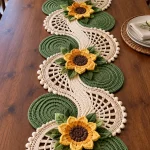
A sunflower’s seed head is wider than its first petal ring, so a convincing crochet version cannot begin with the petals. This sunflower crochet table runner pattern builds three raised centers, layered golden petals, leaves and openwork motifs into a roughly 150 × 35 cm runner. Use worsted cotton or cotton-blend yarn with a 4.5 mm hook. The project suits intermediate crocheters and creates a washable dining-table centerpiece.
The Design: What Makes This Sunflower Runner Different
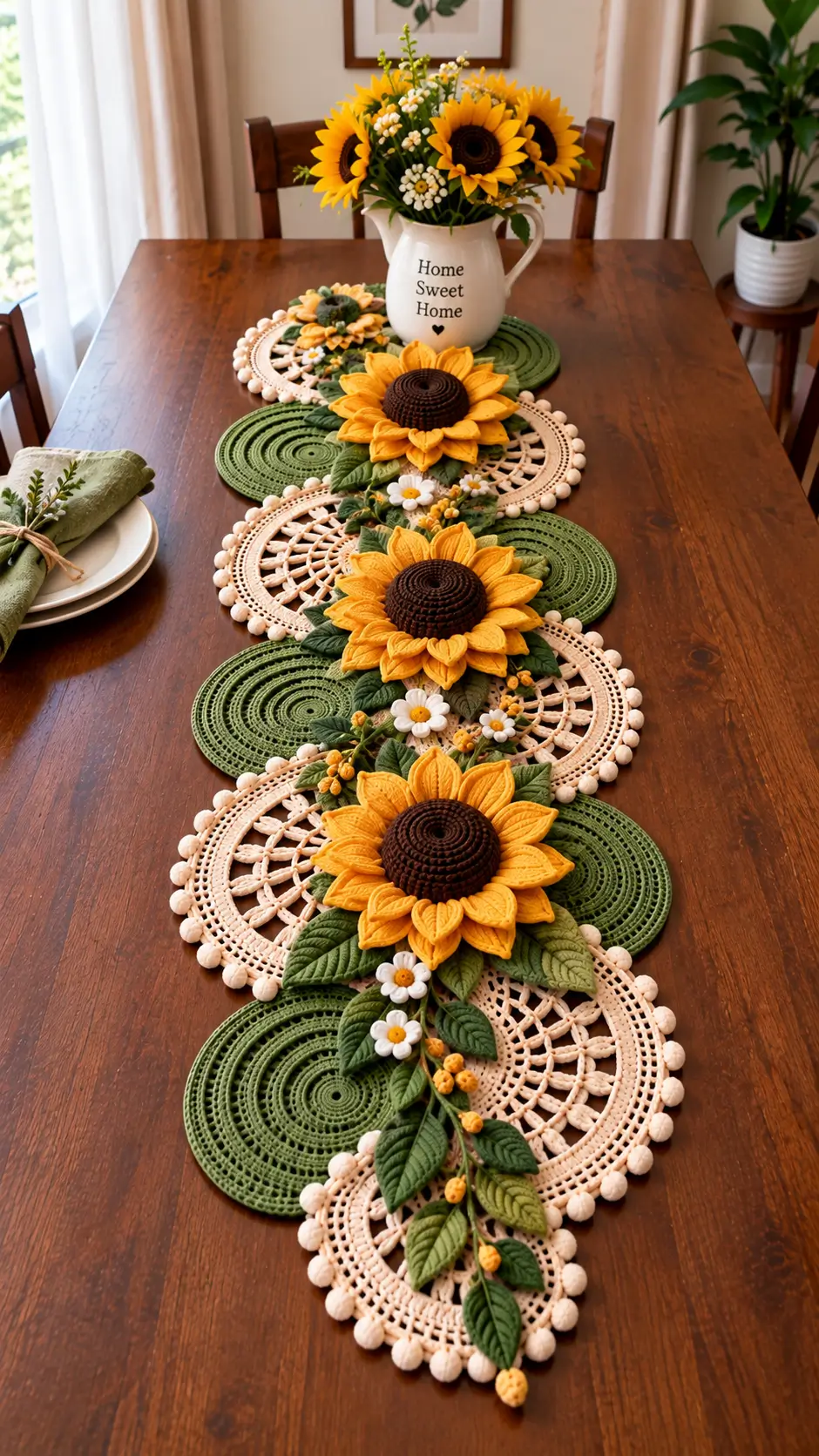
The dominant flowers need three separate structural levels: a slightly domed brown disc, a lower ring of broad petals and a second ring that hides gaps. That hierarchy keeps the sunflower recognizable when viewed from the end of a dining table rather than directly overhead.
Green circular motifs and cream openwork medallions provide the flat structural layer underneath the dimensional flowers. The 3D crochet sunflower pattern components then sit above that foundation instead of carrying the runner’s full lengthwise tension.
Leaves perform another job. Their overlapping tips disguise joins between motifs while visually connecting the three flowers into one crochet flower table runner.
A common mistake is making every component equally thick. Thick foundation circles plus raised flowers create a runner that rocks under serving pieces. Keep the base motifs comparatively flat and reserve heavy stuffing for the brown flower centers.
Project Info at a Glance
| Skill Level | Time | Finished Size | Hook | Best For |
|---|---|---|---|---|
| Intermediate | Multi-session project | Approx. 150 × 35 cm | 4.5 mm | Dining tables, consoles, seasonal displays |
The size, hook and yarn-class benchmark comes from a comparable dimensional sunflower runner using approximately 150 × 35 cm dimensions, worsted #4 yarn and a 4.5 mm hook.
Materials and Tools
Yarn
The following quantities are planning allowances. Actual yarn consumption changes with tension, cotton density, motif size and the number of decorative elements used.
- Golden yellow — worsted #4 — approximately 180–220 g — smooth cotton or cotton-blend yarn
- Dark chocolate brown — worsted #4 — approximately 90–120 g — firm cotton recommended
- Olive green — worsted #4 — approximately 250–300 g — smooth cotton or cotton blend
- Cream/ecru — worsted #4 — approximately 250–300 g — firm cotton for openwork definition
- White — worsted #4 — approximately 20–30 g — for small daisies
- Mustard yellow — worsted #4 — approximately 15–25 g — for buds and daisy centers
Tools
- 4.5 mm crochet hook
- Polyester stuffing
- Tapestry needle
- Locking stitch markers
- Sharp scissors
- Rust-resistant blocking pins
- Blocking mat
Safety eyes are not required because this design contains botanical motifs rather than an amigurumi character.
Abbreviations
- MR — magic ring
- sc — single crochet
- inc — 2 sc in one stitch
- dec — invisible decrease
- sl st — slip stitch
- ch — chain
- hdc — half double crochet
- dc — double crochet
- tr — treble crochet
- BLO — back loop only
- FLO — front loop only
- st/sts — stitch/stitches
For an invisible decrease, insert the hook through the front loops of the next two stitches, pull up a loop, then complete one single crochet through the remaining loops.
Sunflower Crochet Table Runner Pattern — Step by Step
Work continuous spirals where specified. Flat decorative motifs may be joined at the end of each round because their symmetry depends on a fixed starting point.
Raised Sunflower Center — Make 3
Yarn: dark chocolate brown.
R1: 6 sc in MR (6)
R2: inc ×6 (12)
R3: (sc, inc) ×6 (18)
R4: (2 sc, inc) ×6 (24)
R5: (3 sc, inc) ×6 (30)
R6: (4 sc, inc) ×6 (36)
R7: (5 sc, inc) ×6 (42)
R8: BLO 42 sc (42)
R9: 42 sc (42)
R10: (5 sc, dec) ×6 (36)
R11: (4 sc, dec) ×6 (30)
Add a shallow layer of stuffing. The finished center should form a dome rather than a sphere.
R12: (3 sc, dec) ×6 (24)
R13: (2 sc, dec) ×6 (18)
R14: (sc, dec) ×6 (12)
R15: dec ×6 (6)
Fasten off. Leave a 25 cm tail and close the remaining opening.
Inner Sunflower Petals — Make 36
Yarn: golden yellow. Make 12 for each large sunflower.
Foundation: Ch 9.
R1: Starting in second ch from hook, sc, hdc, dc, 2 tr, dc, hdc, 3 sc in final ch; continue along opposite side of foundation chain: hdc, dc, 2 tr, dc, hdc, sc (17).
R2: sl st in first st, ch 1; sc 7, (sc, ch 2, sc) in tip stitch, sc 8 (18).
Fasten off. Leave a 15 cm tail.
Pin 12 petals evenly around each center before sewing. Each petal base should sit underneath the edge of the brown disc so the attachment stitches remain concealed.
Outer Sunflower Petals — Make 36
Yarn: golden yellow.
Foundation: Ch 11.
R1: Starting in second ch from hook, sc, hdc, dc, dc, 2 tr, dc, dc, hdc, sc, 3 sc in final ch; work back along opposite side: sc, hdc, dc, dc, 2 tr, dc, dc, hdc, sc (21).
R2: sl st, ch 1; sc around to the tip, work (sc, ch 2, sc) at the point, then sc down the opposite side (22).
Fasten off. Leave a 15 cm tail.
Position the 12 outer petals behind the inner layer. Offset each outer petal so its point appears between two neighboring inner petals. This arrangement creates the dense double-layer sunflower appearance visible in the finished runner.
Large Crochet Leaves — Make 18
Yarn: olive green.
Foundation: Ch 13.
R1: Starting in second ch: sc, hdc, dc, dc, tr, tr, tr, dc, dc, hdc, sc, 3 sc in final ch; continue down opposite side: sc, hdc, dc, dc, tr, tr, tr, dc, dc, hdc, sc (25).
R2: sc 11, (sc, ch 2, sc) in tip, sc 12 (26).
R3: BLO sc around, working (sc, ch 2, sc) at the tip space (28).
Fasten off. Leave a 20 cm sewing tail.
Fold the leaf lightly along its center line while damp-blocking. Do not stuff the leaves.
Small Crochet Leaves — Make 12
Yarn: olive green.
Foundation: Ch 9.
R1: sc, hdc, dc, tr, dc, hdc, sc, 3 sc in final ch; work along opposite side: sc, hdc, dc, tr, dc, hdc, sc (17).
R2: sc 7, (sc, ch 2, sc) in tip, sc 8 (18).
Fasten off. Leave a 15 cm tail for assembly.
Small White Daisies — Make 8
Yarn: mustard yellow for the center and white for the petals.
R1: With mustard yarn, 6 sc in MR (6).
R2: inc ×6 (12).
Change to white.
R3: (sl st, ch 5, starting in second ch: sc, hdc, dc, hdc, sl st into next base st) ×6 to create six petals.
Fasten off. Leave a 15 cm tail.
Yellow Flower Buds — Make 12
Yarn: mustard yellow.
R1: 6 sc in MR (6)
R2: inc ×6 (12)
R3: 12 sc (12)
R4: dec ×6 (6)
Insert only a small amount of stuffing before closing.
Fasten off. Leave a 15 cm sewing tail.
Green Circular Foundation Motifs — Make 6
Yarn: olive green.
R1: 6 sc in MR (6)
R2: inc ×6 (12)
R3: (sc, inc) ×6 (18)
R4: (2 sc, inc) ×6 (24)
R5: (3 sc, inc) ×6 (30)
R6: (4 sc, inc) ×6 (36)
R7: (5 sc, inc) ×6 (42)
R8: ch 3, dc in same st, then ch 1, skip 1 and dc in next st around. Join.
R9: ch 1, sc in each dc and each ch-1 space around. Join.
R10: ch 5, skip 2 sts, sl st in next st around. Distribute the final repeat evenly where necessary.
R11: Work 5 sc into each ch-5 space around.
Fasten off and weave in the tail. Block every green circle to the same diameter before assembly.
Cream Openwork Medallions — Make 5
Yarn: cream/ecru.
R1: 6 sc in MR (6)
R2: inc ×6 (12)
R3: (sc, inc) ×6 (18)
R4: (2 sc, inc) ×6 (24)
R5: ch 4, skip 1, dc in next st; repeat around.
R6: Work (sc, ch 4, sc) in every ch-space.
R7: sl st into first arch, then ch 6 and sl st into next arch around.
R8: Work 7 sc in each ch-6 arch.
R9: sc 3, ch 5, skip the central stitch of the next arch section; repeat evenly around.
R10: Work 5 sc into each ch-5 space with sc between adjacent arches.
Fasten off.
The finished photograph contains intricate cream lacework. Because the exact stitch architecture cannot be determined reliably from a finished image alone, these medallions reproduce the same openwork function rather than claiming to duplicate every original stitch.
Cream Bobble Edge
Yarn: cream/ecru.
Join the cream yarn to an exposed outer edge of a cream medallion.
R1: sc evenly around.
R2: (sc 4, bobble in next st) around.
To form each bobble, work five partially completed dc into the same stitch. Yarn over and pull through all remaining loops, then ch 1 to close the bobble.
Fasten off after each exposed section rather than carrying cream yarn behind the green motifs.
Connecting Vine
Yarn: olive green.
Chain enough stitches to follow the central axis of the table runner without stretching. For a runner measuring approximately 150 cm, determine the chain length by measurement rather than by a fixed stitch count because individual chain gauge varies.
R1: Starting in the second chain from the hook, sl st in every chain.
Fasten off. Leave a 30 cm sewing tail.
The connecting cord remains almost completely hidden beneath the flowers and leaves. Its job is to stabilize the long arrangement while the overlapping medallions create the visible foundation.
Assembly
- Block all six green circles and five cream medallions separately. Match repeated motifs by diameter before joining them.
- Arrange the foundation into an alternating line approximately 150 cm long. Overlap adjacent circles by roughly 4–6 cm to create the scalloped outline.
- Sew overlapping foundation motifs together on the reverse with matching yarn. Catch primarily the rear loops so joining stitches remain concealed from the front.
- Position the three sunflower centers along the central axis. Place one toward each third of the runner and the remaining sunflower between them. Pin every flower before sewing.
- Attach the outer petal layer first, followed by the inner petals. Sew each raised brown center over the petal bases so the joins disappear underneath.
- Place the large green leaves beneath and between the sunflowers. Aim most leaf tips along the length of the runner instead of directly toward its side edges.
- Add the smaller leaves around exposed joins and open sections. Sewing mainly through the central vein allows the outer edges of each leaf to remain slightly raised.
- Attach the white daisies in irregular groups of two or three. Position mustard buds near these smaller flowers instead of spacing every accent at identical intervals.
- Sew the connecting green vine to the reverse at intervals of approximately 5–8 cm. Check repeatedly that the runner remains flat.
- Weave the remaining yarn tails through matching-color stitches on the reverse. Wet-block the completed runner to approximately 150 × 35 cm and dry it completely on a flat surface.
The completed table runner should have a relatively flat structural foundation with dimensional botanical elements concentrated along its central line.
7 Technical Tips for a Better Sunflower Table Runner
- Control stitch-marker drift. Move the marker immediately after completing the final stitch of every spiral round. A repeated one-stitch shift makes the decrease line spiral visibly across the brown sunflower center.
- Avoid overstuffed flower centers. Keep each brown disc approximately 2–3 cm deep at its highest point. Excess stuffing creates a ball-shaped center and forces the yellow petals against the tabletop.
- Hide the decreases. Work invisible decreases through the front loops during R10–R15 of the brown center. Standard decreases can leave six noticeable gaps around a tightly stuffed dark disc.
- Check the foundation before mass production. Make and block one green circle before crocheting the remaining five. Cupping indicates overly tight tension, while pronounced ruffling means the outer circumference is expanding too quickly.
- Pin every sunflower petal first. Position all 24 petals around a flower before permanently sewing one in place. An alignment error of only half a petal width can produce an obvious empty section when the final petals meet.
- Keep the openwork sections flat. Measure each cream medallion after blocking and keep the diameter consistent within approximately 5 mm. Different medallion sizes cause the assembled runner to twist along its central axis.
- Use long attachment tails. Leave approximately 15–25 cm for petals, leaves and flowers, then weave each tail through at least three changes of direction. Very short tails can pull out when the runner is folded, washed or repositioned.
Finishing and Blocking
Blocking controls the final geometry of this sunflower crochet table runner pattern. Begin with the foundation rather than the dimensional flowers. Pin the green and cream sections into an even alternating outline while keeping the central axis straight.
Do not flatten the stuffed sunflower centers during blocking. Shape the yellow petals individually and keep their pointed ends visible. Leaves can be lightly curved along the central vein so they retain some dimensional definition after drying.
For a dining table, check the underside after blocking. No large knots or loose yarn tails should remain where they could catch against the wood or make the runner sit unevenly.
Adjusting the Table Runner Size
The approximately 150 × 35 cm format works as a reference size, but the modular construction makes the length adjustable. For a shorter table, remove one cream medallion and one green circular motif, then redistribute the flowers so the center sunflower remains close to the midpoint.
For a longer runner, add foundation motifs in alternating colors rather than enlarging every circle. Enlarging individual circles also increases the width and changes the proportions of the sunflower arrangement.
Keep the dimensional flowers proportional to the foundation. If additional length exceeds roughly 30–40 cm, adding another sunflower generally produces a more balanced arrangement than leaving a large undecorated section between existing flowers.
Conclusion
Block one complete green circle and one cream medallion before committing yarn to the full runner; those pieces determine the finished width, drape and motif overlap. Next, make one complete sunflower and compare its diameter with the foundation before producing the remaining flowers. This sequence catches scale problems early and keeps the dimensions close to the 150 × 35 cm target. Save this sunflower crochet table runner pattern to Pinterest and share the completed version on Instagram with #SunflowerTableRunner. For this specific design, decide before assembly whether all three brown sunflower centers will remain identical or whether the middle flower will be slightly larger.