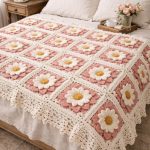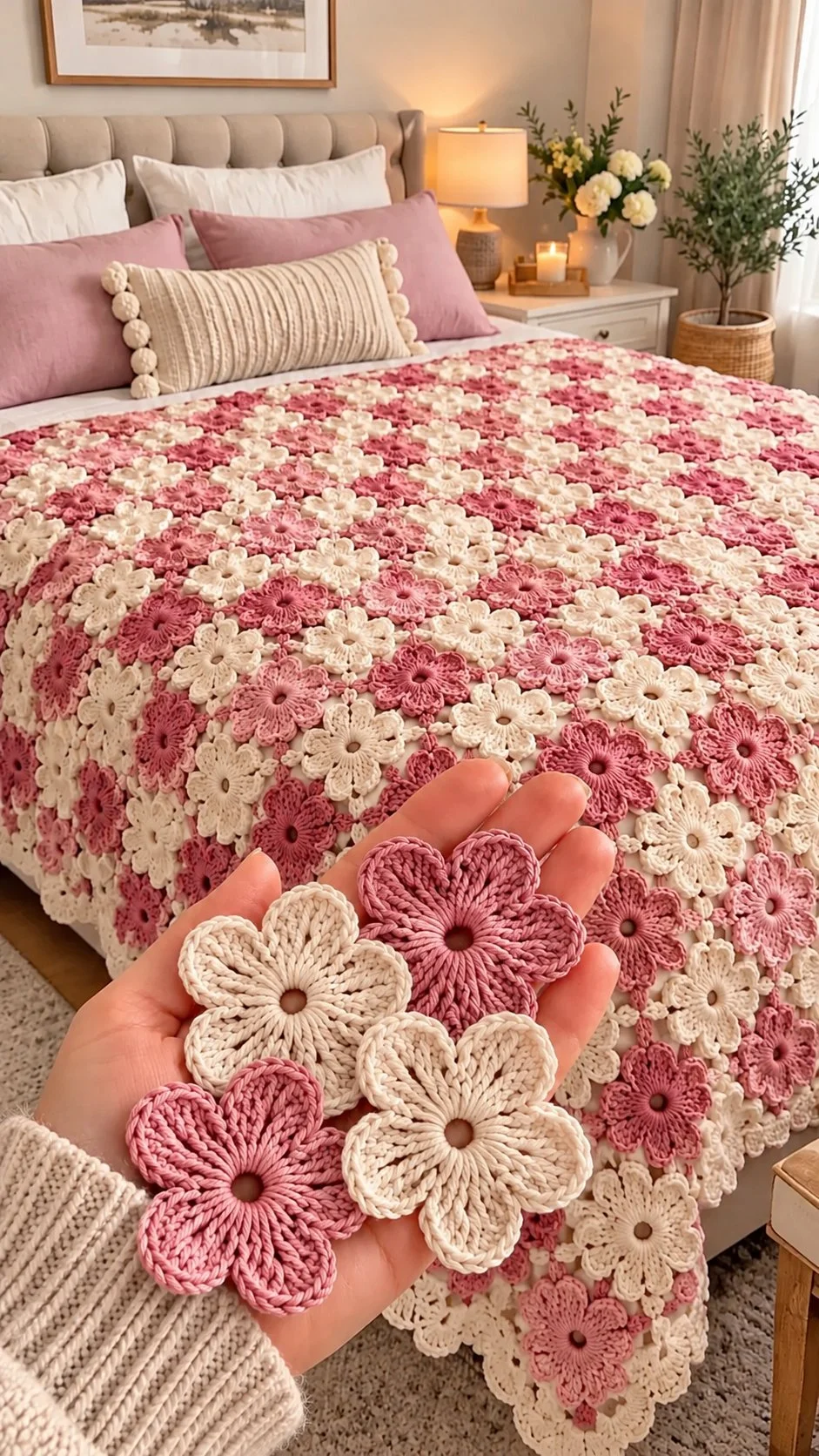
This airy bedspread blooms from simple, repeatable motifs that come together into a soft, inviting blanket for a bed or a generously-sized throw. The project centers on crocheted five-petal flower motifs worked in two harmonious colors—rose-pink and cream/ivory—then joined edge to edge to form a cohesive, color-blocked surface. The result is a light, tactile textile with a gentle floral touch that looks sophisticated in a bedroom or guest room.
What you’re making
- A bedspread composed of small five-petal flower motifs in two colors.
- Motifs are joined securely edge to edge in alternating colors to create a balanced, variegated look.
- A neat floral border finishes the piece, with ends woven in and the fabric gently blocked to lay flat.
Construction overview
- Technique: Crochet motifs built in two colors, joined in the final assembly.
- Composition: Individual four- or six-round motifs depending on your starting counts; then joined in a planned layout to cover the bed.
- Finishing: End weaving and a floral border to enclose the surface.
Pattern at a Glance
- Skill level: Intermediate beginner-ready with supervision; requires comfort with small motifs and joining without tangling yarn.
- Terminology: US crochet terms.
- Construction: Motifs crocheted separately, joined edge-to-edge in alternating colors, border added after assembly.
- Finished size: Optional and size-dependent (see Sizing and Finishing sections). The exact dimensions depend on motif size, number of motifs, and how many rows of joining you choose.
- Yarn weight: Not specified in weight here; use a light-winged weight that suits the chosen hook size and yields a soft drape.
- Hook: Hook size suited to the yarn chosen.
- Main stitch: The five-petal motif is the core unit; each motif is built using a consistent stitch pattern appropriate to the chosen yarn.
- Gauge: Not provided in the core instructions; gauge is less critical for a bedspread but can influence final dimensions.
- Motifs: Small five-petal motifs in two colors (rose-pink and cream/ivory).
- Layout: Edge-to-edge joining in alternating colors; border added after all motifs are connected.
- Joining: Secure edge-to-edge joining to create a flat, cohesive surface.
- Border: A neat floral border completes the piece.
- Seaming: End weaving is required after finishing.
Materials
- Rose-pink yarn
- Cream/ivory yarn
- Crochet hook suited to yarn
- Scissors
- Yarn needle
- Stitch markers
Yarn and Color Notes
- Consider a smooth, even yarn for crisp motif edges; if choosing a slightly fuzzy or textured yarn, be mindful that motif definition can soften.
- Two-color approach (rose-pink and cream) highlights the floral motifs and creates a gentle contrast without overpowering the fabric.
- Solid-color yarns often yield clearer motif shapes; variegated yarns can add interest if used sparingly within the color palette.
Finished Measurements
- The exact measurements depend on motif size, number of motifs, and the extent of joining rows. Because the source pattern provides a modular method (motifs joined edge-to-edge, followed by a border), you can resize by:
- Increasing or decreasing the number of motifs to fit the bed width and length.
- Adjusting the number of joining rounds to alter the bedspread’s overall dimensions.
- Gauge is not fixed in the core instructions; for a rough planning guide, crochet a single motif and measure its diameter, then estimate how many motifs will be needed to cover the bed in your chosen layout.
Gauge
- The instructions do not specify a gauge. If you wish to estimate size, measure one completed motif and calculate how many motifs fit across the bed width and length, then plan the joining rows accordingly.
Abbreviations
- US terms: ch, sc, dc, sl st, etc. (Use the standard US crochet terminology throughout.)
Pattern Notes
- This project uses a motif-based approach. Each flower motif is created in two colors, then joined to neighboring motifs to form a large, flat surface.
- Color changes occur between motifs when weaving or joining; carry color as needed or cut and rejoin depending on comfort with yarn management.
- The border should be added after all motifs are securely joined to keep the final edge neat and uniform.
Special Stitches and Techniques
- Five-petal flower motif: The pattern uses a small, repeatable motif that can be adapted to two colors. The motif’s exact stitches are derived from the provided technical core, focusing on creating petals with a consistent stitch count. If your motif requires a single-row or multi-round construction, keep the stitch counts consistent, and ensure the color changes are carried cleanly.
- Joining motifs: Edge-to-edge joining in alternating colors creates a balanced visual rhythm. Use a seam method that keeps the surface flat and prevents gaps.
Understanding the Construction
- Motifs are crocheted separately in rose-pink and cream/ivory.
- After the motifs are complete, they are joined edge-to-edge in alternating colors to form a large fabric.
- The joining continues until the bedspread reaches the desired size, then a neat floral border is added.
- All loose ends are woven in, and the piece is gently blocked to flatten and even out stitches.
Complete Pattern Instructions
Note: The core pattern text you provided is a compact technical instruction set. The article presents expanded, reader-friendly explanations that remain true to the technical content.
Foundation
- Create a starting motif with the rose-pink and cream threads held separately or alternated as per your chosen motif design. The goal is a five-petal form with a consistent stitch count for each petal.
- Securely join color changes in a way that keeps the motif edges clean.
Motif Construction (per motif)
- Work the five-petal form in pink and cream. The exact stitch sequence per motif should follow a repeatable, consistent approach to ensure uniform petals across all motifs.
- Maintain consistent tension to prevent petal distortion.
- Complete each motif with a firm securing of the final yarn end.
Motif Quantity
- Determine how many motifs you need by measuring the bed width and length and choosing a layout that will cover the surface when motifs are joined edge-to-edge in alternating colors.
- Plan for a border around the assembled surface.
Joining (Edge-to-Edge)
- Join motifs securely edge to edge in alternating colors. Start from a chosen edge and continue joining so that the alternating color pattern is preserved along the entire seamline.
- Ensure that joining stitches are even and lie flat to avoid puckering.
Border
- Add a neat floral border around the entire bedspread once motifs are fully joined.
- Follow a consistent border pattern that complements the motif placement. Maintain flat edges and avoid pulling.
Finishing
- Weave in all ends neatly on both sides of the fabric.
- Gently block the finished bedspread to flatten stitches and even out any minor variances.
- Check that all motifs align correctly and that the border sits evenly around the piece.
Checkpoints
- After completing a row of motifs, measure the width of the growing piece to ensure alignment with your bed width goals.
- The border should lay flat with no ripples or curling; adjust tension before blocking if necessary.
- When joining the last set of motifs, verify that the alternating color pattern aligns across all seams.
Assembly
- The assembly process involves crocheting individual motifs and then sewing or crocheting them together edge-to-edge in the planned color order.
- Orientation matters for a clean look: alternate colors along the joining seams to maintain visual rhythm.
- Start joining from one edge, progressing methodically to the opposite edge, ensuring that all edges align neatly.
Finishing and Blocking
- Weave in all ends securely.
- Gently block the bedspread to open up stitches and even out the fabric drape. A light blocking with steam or a damp cloth can help the piece settle; avoid aggressive stretching that could distort motif shapes.
- After blocking, recheck the border to ensure it lies flat and even along all sides.
Resizing
- How to resize: Because the construction is motif-based with a joining sequence, resize by:
- Increasing or decreasing the number of motifs across the width and length, then adjusting the number of joining rows to maintain the overall look.
- If a fixed finishing size is desired, calculate motif counts to achieve that dimension and adjust border size accordingly.
- The exact counts are not provided in the source; use the motif diameter and desired bed dimensions to compute the necessary motif grid.
Variations
- Color variation: Use two other soft colors with similar contrast for a different mood.
- One-color emphasis: Work all motifs in a single color with subtle shading in the border.
- Larger throw: Increase motif size or reduce the number of joining rows to scale up or down the final surface.
Troubleshooting
- If motifs don’t align after joining: re-check seam counts and ensure color changes follow the intended alternating pattern.
- If borders ripple: check border tension; ensure you’re not pulling the border tighter than the body.
- If ends are visible at joins: weave ends into the adjacent motifs to conceal the transition line.
FAQs
- Can I use a different yarn weight? If you switch yarn weight, recalculate motif size and number to fit the bed. The fundamental pattern relies on consistent motif shapes and secure joining.
- Can I substitute synthetic-based yarns? Yes, but consider the fabric drape and colorfastness; ensure the yarn is suitable for a large flat piece and can handle blocking.
- Is blocking essential? Yes, blocking helps flatten stitches and achieve a uniform surface, especially important for a bedspread with many motifs.
- How to prevent gaps between motifs? Use a joining method that pulls motifs snugly edge to edge; consistent tension in the joining stitches is key.
Final Thoughts
The project boils down to three main steps: crochet individual five-petal motifs in two colors, join them edge-to-edge with alternating colors to form a cohesive surface, and finish with a clean floral border followed by careful blocking. The result is a light, inviting bedspread with a delicate floral motif echoed across the entire surface. The modular nature of the project allows for easy resizing by adjusting motif counts and joining rows, while the two-color motif approach gives a timeless floral feel suitable for many bedrooms. With careful planning, precise joining, and mindful finishing, you’ll have a cozy, decorative bedspread that blends soft color with textured crochet.
Note on sizing and planning
- Before you start, decide the bed’s dimensions and whether you’ll cover the top only or drape over the sides. This will guide you in determining how many motifs you need and how many joining rows to add.
- A practical approach is to crochet a single motif in both colors to confirm finished diameter, then calculate grid layout for the bed’s width and length.
- When blocking, emphasize even edges and a flat border to prevent ripple along the sides.
If you’d like, I can help you lay out a specific motif grid based on the exact bed dimensions you’re aiming for, and suggest a concrete plan for motif counts and border size that will achieve your target finish.