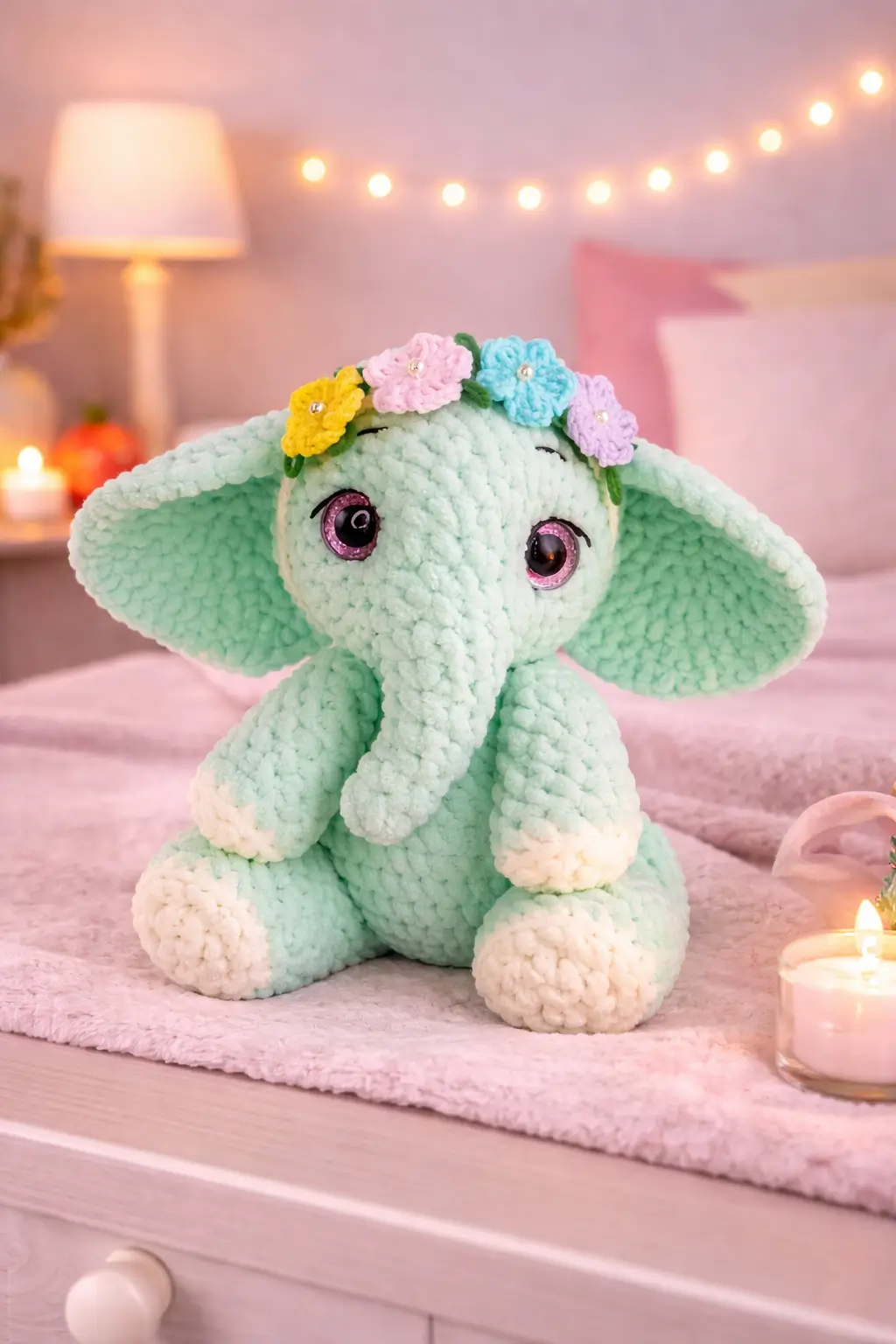
An elephant with a flower crown fails when the ears look small and the crown fights the head shape instead of framing it. This elephant amigurumi crochet pattern gives you a full plush build for the mint elephant in the photo, including head, body, trunk, ears, legs, arms, crown flowers, and leaf details. Current elephant pattern references show finished plush sizes around 12 to 15 inches on larger builds, with published baselines ranging from 3.0 mm to 4.0 mm hooks depending on yarn and style.
The Design: What Makes This Elephant Different
This elephant is built for softness first. The body is round and seated, the legs are short and column-like, and the ears are dramatically oversized so the silhouette reads instantly from the front. That matters more than realism. The trunk is narrow at the tip and thicker at the base, which keeps the face from looking flat. Then the flower crown changes the whole balance. A floral band placed too low crowds the eyes. A crown placed too high looks detached from the character. Current elephant pattern sources show that plush chenille elephants, floral elephants, and beginner-friendly seated elephants are all active pattern types, but they are usually presented separately rather than as one cohesive nursery-style plush. Common mistake: ears that are too stiff. Then the elephant stops looking gentle and starts looking rigid.
Project Information at a Glance
| Skill Level | Time | Finished Size | Hook | Best For |
|---|---|---|---|---|
| Advanced beginner | 2–4 hours | 15 cm / 6 in tall | 4.0 mm | Nursery decor, baby gifts, spring plush displays |
Materials and Tools
Yarn
- Mint green — plush chenille yarn — 90g — Himalaya Dolphin Baby or YarnArt Dolce
- Cream — plush chenille yarn — 20g — for feet accents
- Pink — cotton or velvet scrap — 6g — for flower petals
- Yellow — cotton or velvet scrap — 3g — for flower petals
- Blue — cotton or velvet scrap — 3g — for flower petals
- Lavender — cotton or velvet scrap — 3g — for flower petals
- Green — cotton scrap — 2g — for leaves
Tools
- 4.0 mm crochet hook
- 12 mm safety eyes or glitter eyes
- Fiberfill stuffing
- Yarn needle
- Stitch markers
- Small sharp scissors
- Optional beads for flower centers
Crochet Abbreviations
MR / sc / inc / dec / sl st / ch / BLO / hdc / dc
Use invisible decrease on the face and body-closing rounds only. Standard decreases leave dents that show clearly on plush elephant heads.
Step-by-Step Mint Elephant Crochet Pattern
Work in continuous spiral rounds unless noted.
Head (Make 1)
Yarn: mint green
Source: Standard amigurumi math
R1: 6 sc in MR (6)
R2: inc x6 (12)
R3: (sc, inc) x6 (18)
R4: (2 sc, inc) x6 (24)
R5: (3 sc, inc) x6 (30)
R6: (4 sc, inc) x6 (36)
R7: sc around (36)
R8: sc around (36)
R9: sc around (36)
R10: sc around (36)
Insert 12 mm eyes between R8 and R9, about 10 stitches apart.
R11: (4 sc, dec) x6 (30)
R12: (3 sc, dec) x6 (24)
R13: (2 sc, dec) x6 (18)
Stuff firmly through the cheeks and forehead.
R14: (sc, dec) x6 (12)
R15: dec x6 (6)
Fasten off. Leave 30 cm tail.
Body (Make 1)
Yarn: mint green
Source: Standard amigurumi math
R1: 6 sc in MR (6)
R2: inc x6 (12)
R3: (sc, inc) x6 (18)
R4: (2 sc, inc) x6 (24)
R5: (3 sc, inc) x6 (30)
R6: (4 sc, inc) x6 (36)
R7: sc around (36)
R8: sc around (36)
R9: (4 sc, dec) x6 (30)
R10: (3 sc, dec) x6 (24)
R11: (2 sc, dec) x6 (18)
R12: sc around (18)
Stuff lightly. Keep the lower belly round so the elephant sits flat.
Fasten off. Leave 28 cm tail.
Trunk (Make 1)
Yarn: mint green
Source: Standard amigurumi math
R1: 6 sc in MR (6)
R2: sc around (6)
R3: sc around (6)
R4: sc around (6)
R5: (2 sc, inc) x2 (8)
R6: sc around (8)
R7: sc around (8)
Stuff only the top half lightly. The lower trunk should curve naturally.
Fasten off. Leave 22 cm tail.
Ears (Make 2)
Yarn: mint green
Source: Standard amigurumi math
R1: 6 sc in MR (6)
R2: inc x6 (12)
R3: (sc, inc) x6 (18)
R4: (2 sc, inc) x6 (24)
R5: (3 sc, inc) x6 (30)
R6: sc around (30)
Fasten off. Leave 24 cm tail.
Do not stuff. Flatten slightly before sewing so the ears drape outward.
Arms (Make 2)
Yarn: mint green with cream accent
Source: Standard amigurumi math
R1: 6 sc in MR in cream (6)
R2: inc x6 (12)
R3: change to mint, sc around (12)
R4: sc around (12)
R5: (4 sc, dec) x2 (10)
R6: sc around (10)
Stuff the lower half only.
Fasten off. Leave 18 cm tail.
Legs (Make 2)
Yarn: mint green with cream accent
Source: Standard amigurumi math
R1: 6 sc in MR in cream (6)
R2: inc x6 (12)
R3: sc around (12)
R4: change to mint, sc around (12)
R5: sc around (12)
R6: (4 sc, dec) x2 (10)
R7: sc around (10)
Keep both legs identical. A small height mismatch is obvious in a seated plush.
Fasten off. Leave 20 cm tail.
Flower Petals (Make 4 flowers, 5 petals each)
Yarn: pink, yellow, blue, lavender
Source: Standard amigurumi math
Flower center ring: 5 sc in MR (5)
Petal: *(ch 2, 2 dc in next st, ch 2, sl st in same st)* repeat around 5 times
Fasten off. Leave 12 cm tail.
Make one flower in each color shown.
Leaves (Make 8)
Yarn: green
Source: Standard amigurumi math
R1: ch 5
Row 1: starting in 2nd ch from hook, sl st, sc, hdc, sl st (4)
Fasten off. Leave 8 cm tail.
Cheek Patches (Make 2)
Yarn: pale pink
Source: Standard amigurumi math
R1: 6 sc in MR (6)
Fasten off. Leave 8 cm tail.
Flower Crown Cord (Make 1)
Yarn: green
Source: Standard amigurumi math
R1: ch 26
R2: sl st back across (26)
Fasten off. Leave 14 cm tail.
Assembly Instructions
- Sew the head to the body with the face tilted slightly forward.
- Attach the trunk to the lower center of the face and curve it gently inward.
- Sew the ears high and wide on the sides of the head so they frame the face immediately.
- Attach the arms low on the upper body and angle them inward slightly.
- Sew the legs wide at the front base so the elephant sits flat.
- Add the cheek patches below and outside the eyes.
- Sew the flowers onto the crown cord in alternating colors.
- Add two leaves between each flower pair.
- Wrap the crown across the forehead and stitch it lightly behind the ears.
- Weave every tail at least 4 cm into the stuffing path before trimming.
The mint elephant with flower crown is complete.
7 Technical Tips for Cleaner Amigurumi
- Use a stitch marker on every increase round. Missing one increase before the 36-stitch plateau makes the head asymmetrical, and the flower crown will not sit straight.
- Stuff the head firmer than the body. A soft head collapses behind the eye line and makes the trunk seam sag.
- Insert the eyes before the final decrease rounds. Forcing large eyes into a narrowing head can shift one eye several millimeters off axis.
- Keep chenille tension slightly tighter than usual. Loose plush stitches can expose stuffing near the trunk and eye area.
- Pin both ears before sewing either one. One ear placed even 1 cm lower than the other is obvious on an elephant.
- Use invisible decrease on the face rounds only. Standard decreases leave dents that catch light directly under the eyes.
- Weave tails at least 4 cm deep. Shorter tails loosen first at the ear seams and flower crown points because those areas get handled most.
Conclusion
This elephant amigurumi crochet pattern works because the base plush stays simple while the flower crown carries the decorative identity. Use current elephant references as your size and hook baseline, then refine the final look through ear placement, trunk curve, and crown spacing instead of random stitch changes. Photograph the finished elephant from a front-facing angle so the ears, trunk, glitter eyes, and flower crown all stay visible in one frame. Share it on Pinterest and Instagram with #MintElephantAmigurumi. Will your next elephant keep the pastel flower crown, or switch to daisies and make the whole plush read more spring than nursery?