Introduction
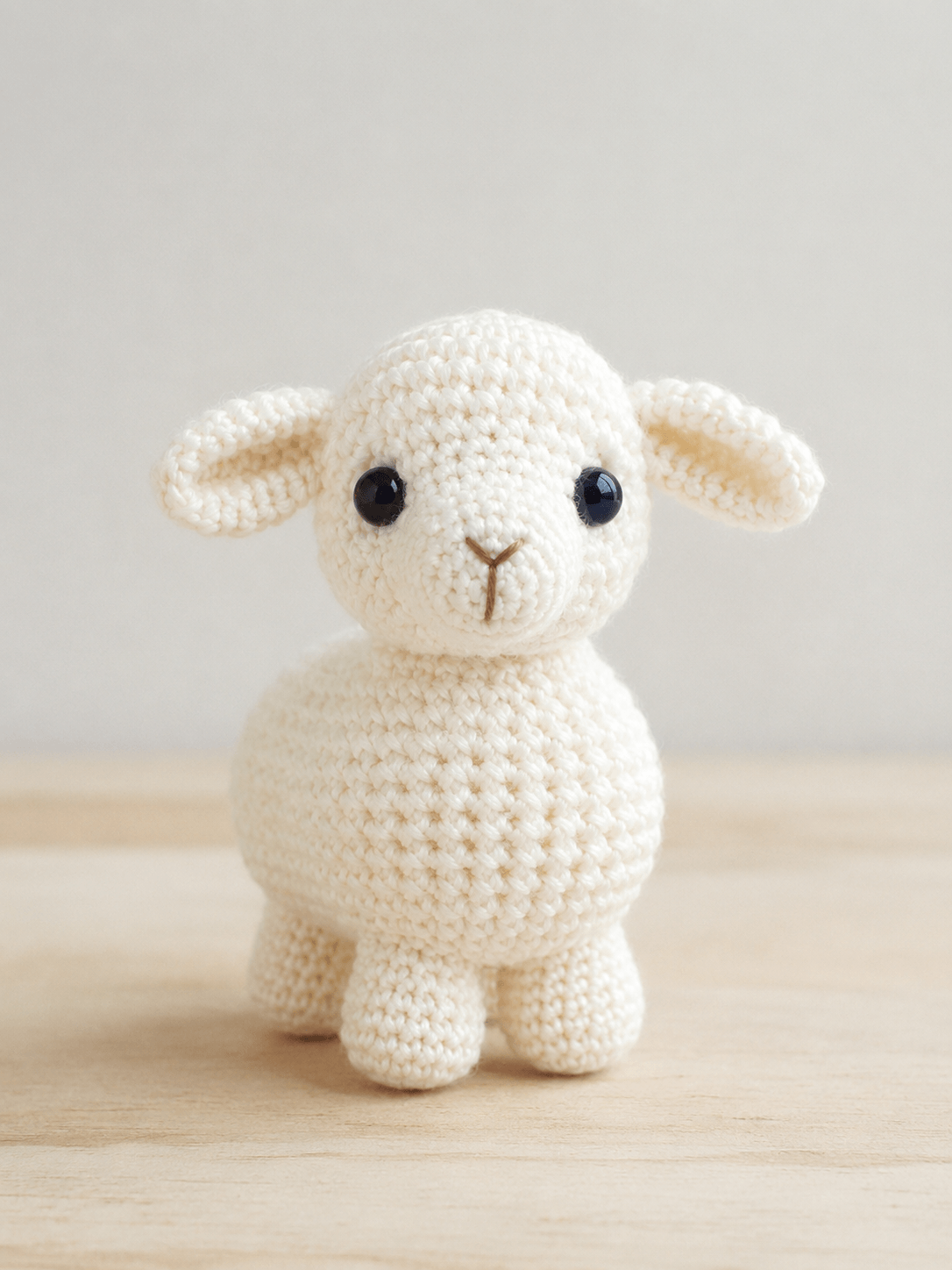
A lamb’s muzzle must project below its broad forehead while both ears remain low and nearly horizontal. This lamb amigurumi crochet pattern builds those proportions with light worsted yarn, a 3.5 mm hook and separate shaped pieces. The finished toy measures about 20 cm and suits an intermediate maker. Its flat-footed four-leg construction gives the figure enough support for shelf display or nursery photography.
The Design: What Makes This Lamb Different
The head uses a 36-stitch spherical base, but the muzzle is added separately rather than formed by extending the head rounds. That decision keeps the forehead wide and gives the nose a controlled forward projection. Each ear begins as a narrow tube and is flattened before sewing, producing the low side-facing shape seen in a young lamb. Four independent legs support the pear-shaped body. Their short length keeps the center of gravity close to the table instead of making the crochet sheep toy look tall or unstable. A frequent error in a baby lamb amigurumi is placing the ears at eye level; that position creates a dog-like silhouette. Attach them higher than the eyes, angle the tips slightly downward and check both sides from the front before sewing.
Project Info at a Glance
| Skill Level | Time | Finished Size | Hook | Best For |
|---|---|---|---|---|
| Intermediate | 5–7 hours | Approximately 20 cm | 3.5 mm | Nursery display, farm sets and photography props |
The finished-height reference and hook selection follow the specifications published for Grace and Yarn’s approximately 8-inch lamb pattern.
Materials and Tools
Yarn
- Warm white — Aran or light worsted — approximately 75 g — Lion Brand Feels Like Butta, Paintbox Yarns Simply Aran or a similar smooth yarn
- Light brown — DK or embroidery yarn — less than 2 g — any tightly twisted cotton for the nose and mouth
A smooth yarn is preferable for this version because the photographed lamb has clearly defined stitches rather than looped or bobbled fleece. Grace and Yarn lists Aran yarn, a 3.5 mm hook and 75–90 yards for a small lamb. A 2024 baby-lamb pattern also pairs worsted yarn with a 3.5 mm hook.
Tools
- 3.5 mm crochet hook
- Two 10 mm black safety eyes
- Polyester fiberfill
- Blunt yarn needle
- Locking stitch marker
- Dressmaking pins
- Scissors
Published lamb patterns in this size range specify 9 mm or 10 mm eyes. Ten-millimeter eyes reproduce the large, glossy eye-to-head ratio visible in the reference image. Safety eyes are not intended for toys supplied to children under three; embroidered eyes are the appropriate substitution for that use.
Abbreviations
- MR — magic ring
- sc — single crochet
- inc — two single crochet stitches in one stitch
- dec — single crochet two stitches together
- sl st — slip stitch
- ch — chain
- BLO — back loop only
- FO — fasten off
For an invisible decrease, insert the hook through the front loops of the next two stitches, yarn over, pull through both front loops, then complete one single crochet.
Pattern — Step by Step
Work in a continuous spiral unless a section states otherwise. Move the stitch marker after every round. The pattern uses a six-stitch magic ring, increase rounds that add six stitches and decrease rounds that remove six stitches.
Head
Yarn: warm white. Original shaping based on standard six-increase amigurumi construction.
R1: 6 sc in MR (6)
R2: inc ×6 (12)
R3: (sc, inc) ×6 (18)
R4: (2 sc, inc) ×6 (24)
R5: (3 sc, inc) ×6 (30)
R6: (4 sc, inc) ×6 (36)
R7–R12: sc around (36)
R13: (4 sc, dec) ×6 (30)
R14: sc around (30)
Place the eyes between R9 and R10, with eight visible stitches between their inner edges. Confirm the muzzle position before fitting the washers.
R15: (3 sc, dec) ×6 (24)
R16: (2 sc, dec) ×6 (18)
Stuff the forehead firmly. Add smaller pieces of stuffing around the eye posts so the surface remains rounded.
R17: (sc, dec) ×6 (12)
R18: dec ×6 (6)
Fasten off. Leave a 15 cm tail, thread it through the front loops of the remaining six stitches and close the opening.
Body
Yarn: warm white. Keep the base broad enough to receive four legs.
R1: 6 sc in MR (6)
R2: inc ×6 (12)
R3: (sc, inc) ×6 (18)
R4: (2 sc, inc) ×6 (24)
R5: (3 sc, inc) ×6 (30)
R6: (4 sc, inc) ×6 (36)
R7–R13: sc around (36)
R14: (4 sc, dec) ×6 (30)
R15–R17: sc around (30)
R18: (3 sc, dec) ×6 (24)
R19–R20: sc around (24)
R21: (2 sc, dec) ×6 (18)
Stuff the lower body firmly and the shoulder area moderately. A packed base supports the legs; a slightly softer neck permits accurate head alignment.
R22: (sc, dec) ×6 (12)
R23: dec ×6 (6)
Fasten off. Leave a 20 cm tail for attaching the body to the head.
Front Legs — Make 2
Yarn: warm white. Build both legs before stuffing so their lengths can be compared.
R1: 6 sc in MR (6)
R2: inc ×6 (12)
R3: BLO sc around (12)
R4–R7: sc around (12)
R8: (2 sc, dec) ×3 (9)
R9–R10: sc around (9)
Stuff the lower two-thirds. Leave the top lightly filled so it can lie against the curved body.
Flatten the opening and crochet 4 sc through both layers (4). Fasten off. Leave a 20 cm sewing tail.
Back Legs — Make 2
Yarn: warm white. These pieces are one round wider through the foot than the front legs.
R1: 6 sc in MR (6)
R2: inc ×6 (12)
R3: (sc, inc) ×6 (18)
R4: BLO sc around (18)
R5: sc around (18)
R6: (sc, dec) ×6 (12)
R7–R9: sc around (12)
R10: (2 sc, dec) ×3 (9)
Fill the foot firmly and the upper round lightly. Shape the base into a shallow oval while adding stuffing.
Flatten the opening and crochet 4 sc through both layers (4). Fasten off. Leave a 20 cm sewing tail.
Ears — Make 2
Yarn: warm white. Folded ears produce the low, side-facing lamb profile documented in several lamb constructions.
R1: 6 sc in MR (6)
R2: inc ×6 (12)
R3: (sc, inc) ×6 (18)
R4–R5: sc around (18)
R6: (sc, dec) ×6 (12)
R7: sc around (12)
R8: (2 sc, dec) ×3 (9)
Do not stuff. Flatten the tube, fold its lower edge in half and place one securing stitch through all four layers.
Fasten off. Leave a 25 cm tail for sewing.
Muzzle
Yarn: warm white. This oval projects from the lower half of the face.
R1: 6 sc in MR (6)
R2: inc ×6 (12)
R3: (sc, inc) ×6 (18)
R4–R5: sc around (18)
R6: (sc, dec) ×6 (12)
R7: sc around (12)
Add a small amount of stuffing. The piece should remain oval rather than becoming a second sphere.
Fasten off. Leave a 30 cm tail for sewing.
Cheek Patches — Make 2
Yarn: warm white. These flat circles are optional and should blend into the head rather than form colored cheeks.
R1: 6 sc in MR (6)
R2: inc ×6 (12)
Join with a sl st. Fasten off and leave a 15 cm tail. Press each circle flat before placement.
Tail
Yarn: warm white. The reference angle hides most of the tail, so use a compact tapered piece.
R1: 6 sc in MR (6)
R2: inc ×6 (12)
R3: sc around (12)
R4: (2 sc, dec) ×3 (9)
R5: sc around (9)
R6: (sc, dec) ×3 (6)
Stuff only the wider end.
Fasten off. Leave a 20 cm tail for attachment.
Assembly
- Place the head above the narrow end of the body and pin it at four points. Sew through one head stitch and one body stitch per pass, adding a second circuit where the neck flexes.
- Center the muzzle below the eyes. Its upper edge should sit one round below the eye line, with equal space on the left and right.
- Sew three-quarters of the muzzle perimeter, add a final small piece of stuffing and close the remaining edge.
- Embroider a shallow brown V at the center of the muzzle. Bring one vertical stitch down from the V and divide it into two short mouth lines.
- Place the optional cheek patches beside the muzzle. Sew them with matching yarn so their outer edges merge into the head surface.
- Pin each front leg beneath the front third of the body. Keep the lower edges level and leave approximately 12 mm between the legs.
- Attach the back legs slightly behind the body’s midpoint. Check the lamb from the front and side before tightening the final stitches.
- Position the ears between head rounds 7 and 9. Set each folded base about five stitches behind the nearest eye and angle the tip downward.
- Sew the tail to the center back between body rounds 10 and 13. Point it slightly upward rather than directly backward.
- Hide every yarn tail inside a stuffed section, reshape the muzzle and press all four feet against a flat surface.
The completed figure should measure approximately 20 cm from the feet to the top of the head.
7 Technical Tips
- Stitch-marker drift: Move the marker immediately after completing the first stitch of each round. A marker left one stitch behind can rotate the eye line by 10–15 degrees over several rounds.
- Soft body base: Pack the lower six body rounds until they resist light thumb pressure. Loose stuffing in this zone causes the back legs to tilt outward.
- Visible decrease bars: Work every decrease through front loops only. A standard two-stitch decrease creates a horizontal ridge that remains visible across the forehead.
- Late eye placement: Fit the eye washers before decreasing below 30 head stitches. The opening becomes too narrow for controlled washer pressure after R15.
- Loose yarn tension: Use a hook at least 0.5 mm smaller than the yarn label’s usual recommendation. Gaps wider than 1 mm expose stuffing around the muzzle.
- Unbalanced pinning: Pin the ears, muzzle and all four legs before sewing any of them permanently. Compare the toy at eye level from the front, both sides and directly above.
- Escaping yarn tails: Weave each tail through at least 4 cm of stuffed fabric before trimming. Pull the surface outward after cutting so the end retracts inside.
Conclusion
Measure the finished lamb from the bottom of the front feet to the crown and record the yarn, hook and final height before making a second version. Those notes make proportion changes measurable rather than approximate. A smaller hook produces a denser figure; a heavier yarn enlarges every component while preserving the round counts. Pin this lamb amigurumi crochet pattern with a front-facing finished photograph, then share the side view on Instagram using #StandingLambAmigurumi. Before beginning another copy, decide one feature: should the ears on your lamb point directly sideways, or should their tips drop below the eye line?
Sources
- Grace and Yarn: Amigurumi Lamb specifications
- Storyland Amis: Baby Lamb materials and eye size
- Jess Huff: Sage the Sheep head and eye-placement reference
- Clover: folded lamb-ear attachment
- Spin a Yarn Crochet: lamb size and yarn reference