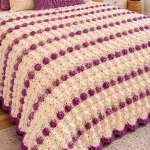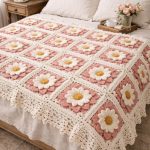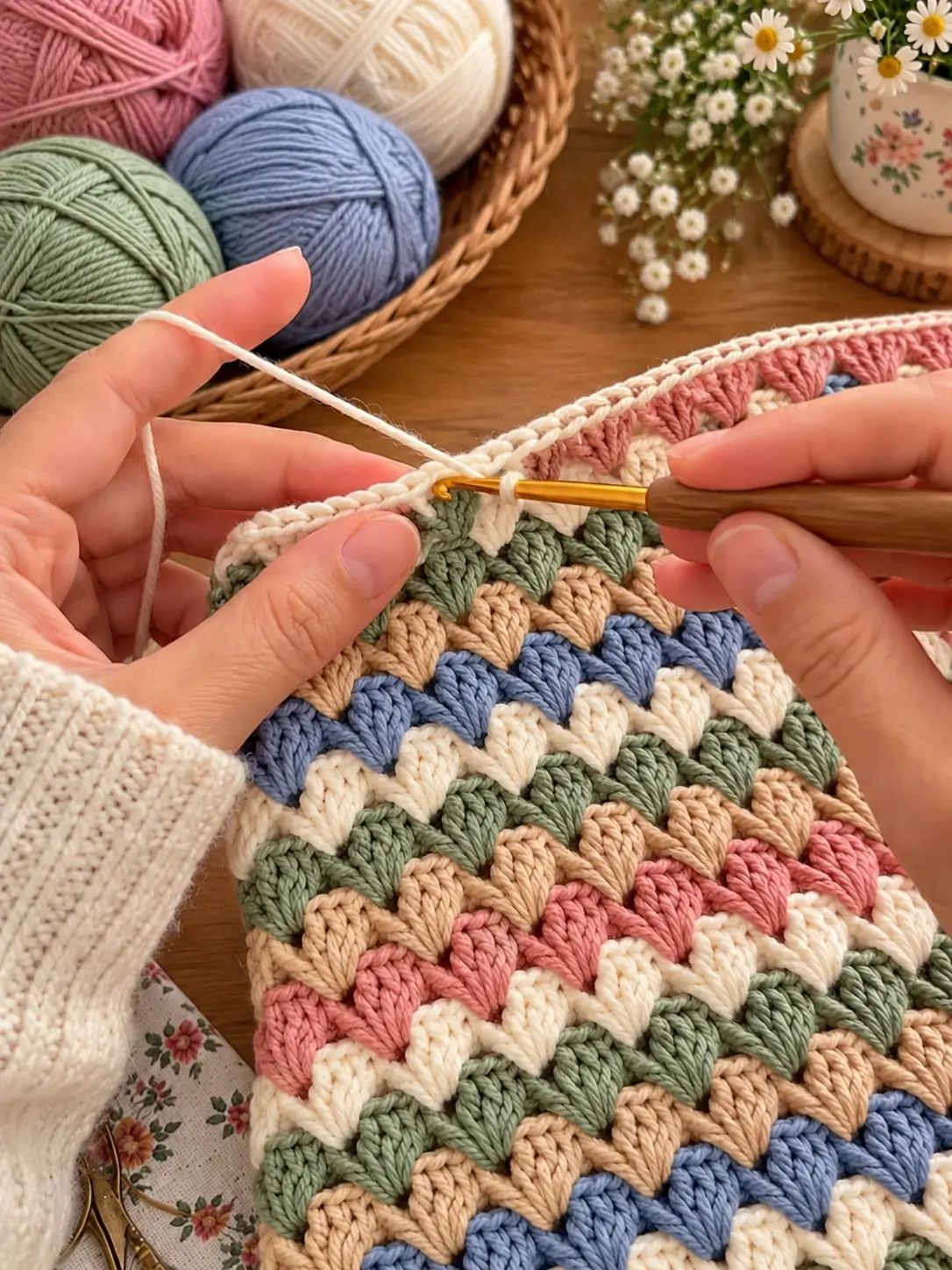
Each tulip in this blanket has to sit directly above the gap between the flowers below it or the diagonal rhythm disappears. This crochet tulip stitch blanket pattern uses raised flower clusters in dusty pink, cream, sage green, beige and soft blue to reproduce the layered floral texture shown in the reference. Use light DK or medium-weight yarn with a 5 mm hook for a flexible blanket, baby blanket, cushion panel or decorative throw.
What Makes This Crochet Tulip Stitch Different
The flower shape comes from stitch placement rather than separate appliqués. Each raised cluster is worked into a defined space, producing a pointed petal shape while the contrasting row beneath remains visible as a narrow separator.
Color placement matters just as much as stitch construction. The reference alternates dusty pink, cream, sage, beige and blue instead of repeating a simple two-color sequence. That makes individual flower rows easier to distinguish.
The third structural feature is alignment. Each new row needs consistent spacing so the clusters form an orderly field rather than drifting sideways. A common failure with a crochet tulip stitch blanket is accidentally adding or losing one repeat at the edges. Count the flower groups after every row.
Project Info at a Glance
| Skill Level | Time | Suggested Size | Hook | Yarn |
|---|---|---|---|---|
| Easy to Intermediate | 12–18 hours for baby size | Approx. 76 × 89 cm | 5 mm | Light DK #3 or Worsted #4 |
A published tulip stitch blanket made with light-weight yarn and a 5 mm hook measures approximately 30 × 35 inches, or 76 × 89 cm. The same stitch can be resized by changing the number of foundation repeats and working additional rows.
Materials and Tools
Yarn
- Dusty pink — Light DK #3 or Worsted #4 — approximately 150–200 g
- Cream — Light DK #3 or Worsted #4 — approximately 150–200 g
- Sage green — Light DK #3 or Worsted #4 — approximately 150–200 g
- Beige — Light DK #3 or Worsted #4 — approximately 150–200 g
- Soft blue — Light DK #3 or Worsted #4 — approximately 150–200 g
These quantities provide a practical allowance for a multicolored baby-size blanket. Actual consumption changes with yarn weight, tension, dimensions and the number of rows assigned to each color.
Tools
- 5 mm crochet hook
- Yarn needle
- Scissors
- 2 locking stitch markers
- Measuring tape
- Blocking mats and pins if required for the selected fiber
Abbreviations
- ch — chain
- sc — single crochet
- hdc — half double crochet
- dc — double crochet
- sl st — slip stitch
- dc5tog — double crochet 5 together
- st/sts — stitch/stitches
- sp — space
- ch-sp — chain space
- rep — repeat
This pattern uses US crochet terminology. Keep cluster stitches slightly relaxed; excessive tension compresses the top of each flower and reduces the pointed petal shape.
Understanding the Tulip Stitch
Several crochet stitches are commonly called “tulip stitch.” The construction used here is the floral version based on repeated spaces and raised flower clusters rather than a solid shell stitch.
The pattern works most cleanly when the foundation is calculated as a multiple of 3 plus 1. This creates regular positions for the flower repeats while retaining an edge stitch on both sides.
For example:
- 31 stitches = 10 repeats + 1
- 61 stitches = 20 repeats + 1
- 91 stitches = 30 repeats + 1
- 121 stitches = 40 repeats + 1
- 151 stitches = 50 repeats + 1
Make a short swatch before calculating a full blanket. Measure the width of ten flower repeats after the fabric has relaxed, then multiply that measurement to determine the number of repeats required.
How to Make the Flower Cluster
The raised tulip effect is created with a dc5tog cluster.
Yarn over, insert the hook into the designated chain space and pull up a loop. Yarn over and pull through two loops, leaving the remaining loops on the hook.
Repeat this partial double crochet four more times in the same space. You should now have six loops on the hook.
Yarn over and pull through all six loops.
Ch 1 to close the cluster.
The completed cluster should form one compact raised flower. Do not work the five double crochets separately; they must share a single closing step to produce the petal shape.
Crochet Tulip Stitch Blanket Pattern
Construction: Work the blanket flat in rows. Change colors regularly to reproduce the striped floral appearance. The sample sequence uses dusty pink, cream, sage, beige and blue.
Foundation
With cream yarn, chain a multiple of 3 + 1 until the chain reaches the required blanket width.
For a swatch, ch 31.
For a baby blanket, begin with enough repeats to reach approximately 76 cm after the first several rows have relaxed.
Do not calculate the finished width from the unstretched foundation chain alone. Crochet the first four to six rows and measure the actual fabric.
Foundation Row
Row 1: Sc in second ch from hook and in every ch across. Turn.
Row 2: Ch 1, sc in every st across. Turn.
The two foundation rows create a stable lower edge and make the first flower row easier to count.
First Flower Foundation Row
Change to sage green.
Row 3: Ch 4. Work dc, ch 2, dc in the first stitch.
Skip the next 2 sts.
Work (dc, ch 2, dc) in the next stitch.
Repeat across the row, maintaining two skipped stitches between each V-shaped group.
Work the final group into the last stitch. Turn.
Each ch-2 space now marks the position of one tulip flower.
First Tulip Flower Row
Change to cream.
Row 4: Ch 2.
Work dc5tog into the first ch-2 space. Ch 2.
Work dc5tog into the next ch-2 space. Ch 2.
Repeat across all ch-2 spaces.
Finish the row with the appropriate edge stitch to keep both sides straight.
Turn.
Count the completed clusters. The number must match the number of V-shaped spaces in Row 3.
Second Tulip Row
Change to soft blue.
Row 5: Ch 3.
Work the new V-shaped stitch groups into the spaces between the cream flower clusters.
For each repeat, work:
dc, ch 2, dc into the designated space.
Continue across, keeping every V centered between the flowers of the previous row.
Turn.
Change to beige.
Row 6: Work one dc5tog cluster into every ch-2 space from Row 5, placing ch 2 between clusters.
Turn.
Third Tulip Row
Change to sage green.
Row 7: Repeat the V-stitch foundation sequence from Row 5.
Turn.
Change to cream.
Row 8: Work one dc5tog cluster in every ch-2 space across. Ch 2 between clusters.
Turn.
Fourth Tulip Row
Change to dusty pink.
Row 9: Repeat the V-stitch foundation row.
Turn.
Continue with dusty pink or change to cream according to the desired stripe arrangement.
Row 10: Work one dc5tog cluster into every ch-2 space across.
Turn.
Suggested Color Sequence
To reproduce the pastel appearance in the reference image, rotate the flower colors rather than repeating the same sequence continuously.
- Dusty pink
- Cream
- Sage green
- Beige
- Soft blue
- Cream
- Sage green
- Beige
- Dusty pink
- Cream
- Sage green
- Beige
- Soft blue
Continue repeating or rearranging these colors until the blanket reaches the required length.
Alternative One-Row Tulip Stitch
Another established version of the tulip stitch uses a shorter repeating sequence rather than separate stem and flower rows. This option produces a denser diagonal texture that is also compatible with the general appearance of the photographed fabric.
For this variation, work a foundation based on the selected stitch multiple.
Pattern Row: Ch 2, work 2 dc in the designated chain space, ch 2, sc into the same space. Move to the next chain space and repeat.
The combination of double crochet, chain stitches and single crochet produces a compact pointed shell. Repeating the same row creates diagonal columns of flower-like clusters.
Use this version if you want a faster one-row repeat. Use the dc5tog version when stronger separation between the flower head and supporting V-shaped stitch is preferred.
Adding the Final Top Edge
Finish after a complete flower row rather than halfway through the two-row color sequence.
Change to cream.
Top Edge Row 1: Ch 1, work sc evenly across, placing stitches into both the clusters and chain spaces as needed to create a straight edge.
Top Edge Row 2: Ch 1, sc in each st across.
Fasten off and leave approximately 15 cm for weaving.
Simple Blanket Border
The photographed fabric shows a narrow cream edge rather than a large decorative border. A compact single-crochet finish keeps attention on the multicolored flower rows.
Join cream yarn at one corner.
Border Round 1: Ch 1 and sc evenly around all four sides. Work 3 sc into each corner.
Along the row ends, distribute the stitches evenly instead of placing a fixed number into every row. The edge must lie flat.
Join with sl st.
Border Round 2: Ch 1, sc in each st around, working 3 sc into the center corner stitch.
Join with sl st and fasten off.
For a slightly more decorative finish, replace the second round with reverse single crochet.
How to Resize the Tulip Stitch Blanket
Baby Blanket
Target approximately 76 × 89 cm. A published tulip stitch baby blanket uses approximately these finished dimensions with light-weight yarn and a 5 mm hook.
Stroller Blanket
Target approximately 75 × 90 cm. Keep the same stitch repeat and adjust only the number of foundation groups and total rows.
Lap Blanket
Target approximately 90 × 120 cm. Make a larger swatch first because the extra width magnifies even small differences in gauge.
Throw Blanket
Target approximately 125 × 150 cm. Published tulip-stitch throw patterns can reach approximately 127 × 152.5 cm when worked with much heavier yarn.
Do not copy the stitch count from a blanket made in another yarn weight. Calculate the width from your own swatch and preserve the required stitch multiple.
Changing Colors Cleanly
Complete the final yarn-over of the last stitch with the new color. This places the new yarn in position before the next row begins and produces a cleaner transition.
Leave approximately 10–15 cm of yarn when cutting each color.
For a blanket with frequent color changes, weave several ends after every six to eight rows rather than leaving every tail until the project is complete.
If the same color returns after only two rows, carry it loosely up the side instead of cutting it. The border can cover the carried strands later.
Keeping the Blanket Edges Straight
Place one locking marker into the first true stitch and another into the final stitch of every row.
Do not treat a turning chain as an extra stitch unless the instructions specifically identify it as one.
Count the flower clusters after each completed flower row. A missing repeat is easier to correct immediately than after another five color changes have been worked.
Measure the blanket width every 10–12 rows. If the fabric gradually narrows, check the first and last chain spaces before changing hook size.
7 Technical Tips for Better Tulip Stitch
- Use a foundation multiple of 3 + 1 for this floral construction. Starting with an incorrect count moves the final V-stitch away from the edge and creates a partial flower at the end of the row.
- Count every flower row before changing colors. One missing cluster causes all subsequent tulips above that position to shift sideways.
- Keep the dc5tog loops approximately the same height. Pulling one partial double crochet tighter than the others produces a twisted flower instead of an even pointed cluster.
- Do not tighten the ch-2 spaces. A chain space that is several millimetres shorter than its neighbors pulls two flowers together and changes the row width.
- Mark both edge stitches. Missing the final edge stitch on consecutive rows produces a visibly diagonal blanket side.
- Check width every 10–12 rows. A change greater than approximately 1–2 cm usually indicates an edge-count or tension problem rather than normal settling of the fabric.
- Weave each color tail through at least 5 cm of matching stitches. Short ends hidden inside open chain spaces can migrate back to the surface during washing.
Yarn Choices for This Pattern
A smooth yarn gives the flower clusters clearer definition than a highly textured or fuzzy fiber. Cotton, cotton-acrylic blends and smooth acrylic yarns are particularly suitable when the individual tulip shapes need to remain visible.
Light DK yarn creates a finer fabric with more flowers across the width. Worsted yarn enlarges each cluster and produces a heavier blanket.
Keep all five colors within the same yarn family when possible. Combining a thin cotton with a thick acrylic changes the height and width of individual flower rows even when the label lists both yarns in a similar weight category.
Color Variations
The dusty pastel palette can be changed without altering the stitch pattern.
- Pink + sage + cream — three-color floral version
- Blue + cream + beige — neutral cool-toned blanket
- Mustard + rust + olive + cream — autumn version
- Lilac + pink + mint + cream — spring palette
- Navy + gray + white — high-contrast three-color version
- Single color — emphasizes texture instead of stripe placement
For the closest match to the reference image, keep cream as a recurring separator and distribute dusty pink, sage green, beige and blue throughout the remaining rows.
Finishing and Blocking
Weave all yarn ends toward the center of matching-color clusters rather than carrying dark tails through cream stitches.
Wash or dampen the blanket according to the yarn manufacturer’s care instructions.
Lay the fabric flat and arrange the corners into right angles. Avoid aggressively stretching the flower clusters because excessive blocking can flatten the raised texture.
Measure the width at the top, center and bottom. The three measurements should be close enough that the side border can remain flat without gathering.
Allow the blanket to dry completely before folding or storing it.
Conclusion
Begin with a small swatch and verify the multiple of 3 + 1 before calculating the full width. Once the flower spacing is correct, repeat the dusty pink, cream, sage, beige and blue sequence while counting every completed cluster row. Add the narrow cream border only after the final width and length have been checked. This approach keeps the floral columns aligned and prevents the sides from gradually narrowing. Save this crochet tulip stitch blanket pattern to Pinterest and share your finished color sequence on Instagram with #PastelTulipStitchBlanket. Which row would you repeat most often in this palette: dusty pink, sage green or soft blue? “`1