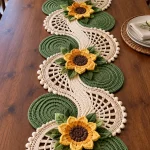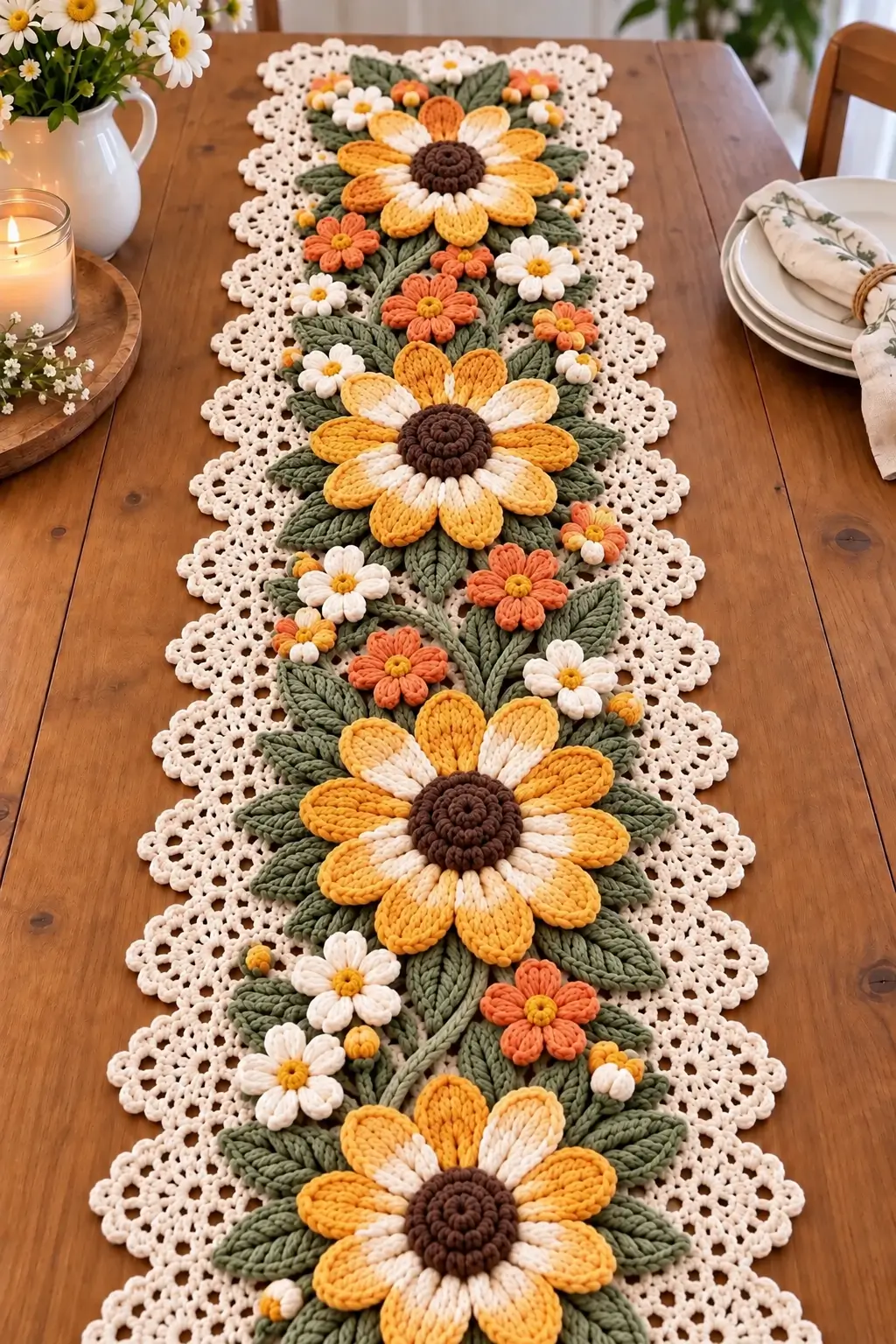
A sunflower head is almost circular, but this runner depends on making those circles behave like a long vine. This crochet sunflower table runner pattern uses brown centers, cream petals, sage-green flower bases, connecting stems, and leaves in several green tones. Made with DK or light worsted cotton and a 4 mm hook, the modular construction is best suited to intermediate crochet. Add or remove complete flowers to adjust the runner for your table.
The Design: What Makes This Sunflower Runner Different
This runner is built from separate botanical motifs rather than a solid rectangular background. Each sunflower has a dense brown center surrounded by pointed cream petals. A larger sage-green layer underneath acts like a second flower and gives each motif enough visual width to form the central line of the runner.
Separate crochet leaves fill the spaces between flowers. Their alternating positions prevent the crochet flower table runner from looking like a simple row of circles. Short crocheted stems connect the components while leaving sections of the wooden table visible.
The main construction problem is rotation. If flowers are connected at only one point, they can turn when the runner is moved. Multiple discreet joins between the green bases, stems, and neighboring leaves stabilize the finished sunflower crochet centerpiece.
Project Info at a Glance
| Skill Level | Time | Finished Size | Hook | Best For |
|---|---|---|---|---|
| Intermediate | 12–18 hours | Approx. 140–160 × 30–35 cm | 4.0 mm | Dining tables, consoles, sideboards |
The dimensions above are a working target for a six-flower version inspired by the photograph. Exact size changes with yarn, tension, blocking, leaf placement, and the number of flower motifs.
Materials and Tools
Yarn
Use one yarn weight throughout the project. Smooth cotton or a cotton-blend yarn gives the leaves enough structure to remain flat while keeping the flower details defined.
- Medium brown — DK/light worsted cotton — approximately 60–80 g — sunflower centers.
- Cream — DK/light worsted cotton — approximately 90–120 g — sunflower petals.
- Sage green — DK/light worsted cotton — approximately 160–200 g — large leaves beneath the flowers.
- Dark forest green — DK/light worsted cotton — approximately 60–80 g — accent leaves.
- Olive green — DK/light worsted cotton — approximately 60–80 g — accent leaves and stems.
Purchase additional yarn if the runner will contain more than six sunflower motifs or needs to extend across a particularly long dining table.
Tools
- 4.0 mm crochet hook
- Tapestry needle
- Sharp scissors
- Locking stitch markers
- Blocking pins
- Blocking mats
- Tape measure
No stuffing or safety eyes are required. Every component is worked as a flat crochet motif.
Abbreviations
- MR — magic ring
- ch — chain
- sc — single crochet
- hdc — half double crochet
- dc — double crochet
- tr — treble crochet
- sl st — slip stitch
- st/sts — stitch/stitches
- sp — space
- rep — repeat
- FO — fasten off
An invisible decrease is not needed because the runner consists of flat botanical motifs rather than stuffed amigurumi components.
Crochet Sunflower Table Runner Pattern — Step by Step
The photographed runner appears to contain approximately six large sunflower units connected into a central vine. This version follows that modular arrangement rather than copying a published commercial pattern.
Make all flower centers first, followed by petals, green bases, decorative leaves, and connecting stems. Block the components before final assembly.
Brown Sunflower Center — Make 6
Yarn: Medium brown
R1: Make MR. Work 10 sc into ring. Join with sl st. (10)
R2: Ch 1, 2 sc in each st around. Join. (20)
R3: Ch 1, *1 sc, inc* around. Join. (30)
R4: Ch 1, *2 sc, inc* around. Join. (40)
R5: Ch 1, *3 sc, inc* around. Join. (50)
R6: Ch 1, sc in each st around. Join. (50)
Fasten off and leave approximately a 20 cm tail if the center will be sewn to the petal layer.
The center should remain flat. If it begins to cup strongly, loosen the working tension before making the remaining centers.
Cream Sunflower Petals — 12 Petals per Flower
Yarn: Cream
Join cream yarn around the outer edge of the brown center.
Petal 1: Ch 6.
Beginning in the second chain from the hook, work:
1 sc, 1 hdc, 2 dc, 1 tr.
Skip approximately 3–4 stitches around the brown center and sl st into the next attachment point.
Repeat the petal sequence around the center until there are 12 evenly spaced petals.
Join with sl st to the first attachment point and fasten off.
Before securing the final petal, spread all 12 petals flat and check the spacing. Crowded petals will overlap heavily after blocking.
Second Cream Petal Layer — Optional
The reference photograph has substantial, slightly raised petals. A second layer can be added behind the first for more depth.
Attach cream yarn behind the first petal layer.
R1: *Ch 6, sl st behind the gap between the next two front petals* around.
R2: Into each ch-6 loop work 1 sc, 1 hdc, 2 dc, 1 hdc, 1 sc.
Fasten off.
The back petals should sit between the front petals rather than directly underneath them.
Large Sage Leaf Base — Make 6 per Flower
Yarn: Sage green
Each sunflower rests over six large pointed green motifs. Make 36 large leaves for a six-flower runner.
R1: Ch 12.
R2: Starting in second ch from hook, work 1 sc, 1 hdc, 2 dc, 4 tr, 2 dc, 1 hdc.
Work 5 dc into the final chain to turn around the tip.
Continue down the opposite side of the foundation chain with 1 hdc, 2 dc, 4 tr, 2 dc, 1 hdc, 1 sc.
Join with sl st near the base.
R3: Ch 1. Sc around the complete leaf, placing 3 sc in the tip stitch.
Fasten off, leaving a 20 cm sewing tail.
The finished leaf should have a clearly pointed end and a broad middle section. Block before assembly if the edges curl.
Assembling Each Sunflower Unit
Arrange six sage leaves in a radial formation with their pointed ends facing outward.
Overlap the lower portions slightly so the six leaf bases form a stable circular platform.
Sew neighboring leaves together for approximately 2–3 cm near their bases. Do not sew the complete sides together because the open spaces between the leaves are part of the design.
Center the cream-and-brown sunflower over the green base.
Sew around the brown center or underneath the cream petals, catching the green layer at regular intervals.
Check from the front before knotting the yarn. The brown center should sit approximately in the middle of the six green points.
Repeat until all six sunflower units are complete.
Dark Green Decorative Leaves — Make 10
Yarn: Dark forest green
R1: Ch 11.
R2: Starting in second ch from hook, work 1 sc, 1 hdc, 2 dc, 3 tr, 2 dc, 1 hdc.
Work 5 dc into the final chain.
Continue along the opposite side with 1 hdc, 2 dc, 3 tr, 2 dc, 1 hdc, 1 sc.
R3: Ch 1 and sc around. Place 3 sc at the tip.
Fasten off and leave a 15–20 cm tail.
Olive Green Decorative Leaves — Make 10
Yarn: Olive green
Follow the same construction as the dark green decorative leaves.
For variation, make several leaves one chain shorter:
Small leaf foundation: Ch 10.
Work the stitch sequence proportionally, keeping sc and hdc near the base, dc and tr through the widest section, and multiple dc stitches at the tip.
Fasten off and leave a sewing tail.
Mixing two leaf sizes prevents the outer vine from forming an unnaturally uniform border.
Openwork Leaves — Optional Variation
Several leaves in the photograph have visible openings. Use this version when you want more negative space around the runner.
R1: Ch 12.
R2: Sc in second ch, ch 1, skip 1, hdc in next, ch 1, skip 1, dc in next, ch 1, skip 1, tr in next stitches toward the tip.
Work several stitches into the final chain to turn.
Mirror the eyelet sequence down the opposite side.
R3: Sc around the outer edge, working into both stitches and chain spaces. Place 3 sc at the point.
Fasten off.
The open spaces should remain small enough that the leaf retains its pointed outline after blocking.
Crochet Connecting Stems
Yarn: Sage or olive green
The stems connect the flowers without creating a solid background.
Short connector: Ch 15.
Beginning in the second chain from the hook, sl st in every chain. Fasten off.
Medium connector: Ch 20, then sl st back across every chain.
Long connector: Ch 25, then sl st back across every chain.
Use different lengths according to the gaps between flowers and decorative leaves.
For a thicker stem, work sc rather than sl st across the foundation chain.
How to Arrange the Sunflower Table Runner
Do not permanently join the motifs immediately after crocheting them. The complete composition should be arranged first.
Place the six sunflower units in a single loose line along the center of the table. They do not need to form a perfectly rigid row. Slight alternating angles make the arrangement resemble a botanical vine.
Leave approximately 3–6 cm between neighboring green bases. The connecting stems will bridge these spaces.
Position dark green and olive leaves on alternating sides. Some leaves should point diagonally toward the ends of the table, while others can sit nearly perpendicular to the central line.
Avoid placing identical colors directly opposite one another throughout the runner. Controlled irregularity makes the foliage appear more natural.
Assembly and Finishing
- Block all six sunflower units and the individual decorative leaves before joining the runner.
- Place the six flowers along the table or a blocking mat in the final order.
- Measure the complete arrangement and adjust flower spacing before sewing anything permanently.
- Attach the first connecting stem between flower one and flower two, sewing through the back of the green base motifs.
- Continue joining the remaining sunflower units while checking that the central line remains approximately straight.
- Position dark green leaves beside the connecting stems and pin them before sewing.
- Add olive leaves to the opposite side and use smaller leaves to fill unusually large gaps.
- Sew each decorative leaf at both its base and one additional point near the lower third so it cannot rotate freely.
- Weave all yarn tails through stitches of the same color and trim only after checking the front of the runner.
- Block the complete runner to its final dimensions, aligning the flowers and reshaping every pointed leaf.
The completed runner forms a connected chain of dimensional sunflower motifs with an irregular border of green leaves and visible table surface between the components.
7 Technical Tips for a Better Sunflower Runner
- Keep every brown center flat. A center that cups by more than approximately 5 mm can make the completed flower rock on the table. Check each center before attaching its petals.
- Count all 12 cream petals. An 11- or 13-petal flower creates visibly uneven spacing when placed beside correctly proportioned motifs. Mark the first petal before working around the center.
- Block the green bases before assembly. Curled points can shorten the apparent diameter of one sunflower by several centimeters. Pin all six points at equal distances from the center.
- Do not attach leaves at only one stitch. Single-point attachment allows the leaf to rotate whenever the runner is moved. Secure approximately 1–2 cm of the leaf base or add a second hidden tack.
- Keep the flower spacing between roughly 3 and 6 cm. Excessive gaps make the connecting chains visually dominant. Very small gaps cause the green bases to overlap heavily.
- Weave tails into matching colors. A brown yarn tail carried through a cream petal can remain visible through the stitches. Keep at least 4–5 cm of each tail inside the corresponding color section.
- Measure the runner before the final joining pass. Six motifs that are individually only 5 mm larger than planned can add several centimeters to the completed arrangement. Check the total length against the intended table before securing every connector.
How to Adjust the Runner Length
The modular construction makes length adjustment easier than it would be with a single rectangular crochet panel.
For a small coffee table or console, make three or four sunflower units. A standard dining-table runner can use five or six. Longer tables can accommodate seven, eight, or more flowers.
Do not calculate length from the diameter of one sunflower multiplied by the number of motifs. Neighboring green leaves overlap visually, while the spaces and connecting stems add length elsewhere.
The more reliable method is to crochet one complete sunflower unit first. Block it, measure its diameter, and place paper markers on the table representing the remaining flowers. This establishes the approximate final length before the full yarn quantity has been committed.
Choosing Yarn for a Crochet Flower Table Runner
Cotton is particularly suitable for this construction because the finished motifs need to remain relatively flat. It also provides clear definition around the pointed leaves and individual petals.
DK cotton creates a lighter runner with smaller motifs. Light worsted cotton increases the scale and gives the leaves more body. If worsted yarn is substituted, test a single flower before making the complete set.
A 4.0 mm crochet hook is a useful starting point for DK or light worsted cotton. Published sunflower runner designs vary considerably in construction: examples range from fine size-10 thread worked with a 1.75 mm hook to heavier DK or worsted designs using hooks around 3.5–4.5 mm.
The correct hook is therefore the one that produces a flat center and leaves firm enough to hold their points without creating a stiff board-like fabric.
Sunflower Color Placement
The photograph uses a restrained botanical palette rather than the standard bright-yellow sunflower combination.
Brown remains concentrated in the flower centers. Cream replaces traditional yellow for the petals, making the green foliage more prominent. Sage forms the largest leaves immediately behind each flower.
Darker forest green and olive are reserved for the outer decorative leaves. That distribution creates depth without requiring complicated stitch changes.
For the closest visual result, avoid making every leaf from exactly the same green yarn. At least three green values produce a more defined vine: pale sage, medium olive, and dark forest green.
The same pattern can also be worked with dark brown centers, golden petals, medium green flower bases, and olive outer leaves for a more traditional sunflower palette.
How to Block the Sunflower Motifs
Block the components before assembly and then block the complete runner once more after joining.
For each sunflower, pin the brown center first. Arrange the cream petals at equal intervals around it. Next, pull the six sage points outward until the base looks balanced.
Individual decorative leaves should be pinned at the base, widest section, and tip. Avoid stretching one side farther than the other because an asymmetric leaf will remain noticeable once attached to a straight connecting stem.
After assembly, lay the complete runner on blocking mats. Position the six sunflower centers along the intended central axis, but retain small variations in the angle of the foliage.
Allow the runner to dry completely before removing the pins.
Keeping a Dimensional Runner Practical
A floral runner can become too thick for table use if every layer is heavily raised. Keep the brown centers flat and avoid stuffing them. The cream petals may overlap slightly, but their attachment points should remain thin.
Reserve the strongest three-dimensional effect for the edges of the petals and leaves. Plates, serving dishes, or decorative objects placed near the central line then have a more stable surface.
If the runner will sit beneath serving pieces regularly, make the optional second petal layer only on flowers positioned near the two ends. The central flowers can remain single-layered.
Another option is to keep the complete runner decorative and remove it before placing hot cookware on the table. Crochet cotton should not be treated as a substitute for a heat-rated trivet.
Conclusion
Arrange every sunflower before making the permanent joins; the spacing between motifs determines the final shape as much as the crochet itself. Pin the six flower units along the intended center line, distribute the three green tones, then connect the motifs from the middle toward both ends. After the final blocking, measure the runner and record the dimensions before making another version. This crochet sunflower table runner pattern can then be shortened or extended simply by changing the number of complete flower units. Save the finished layout to Pinterest and share your version on Instagram with #SunflowerVineTableRunner. Would you keep the cream petals shown here or change the next runner to traditional golden-yellow sunflowers? “`0