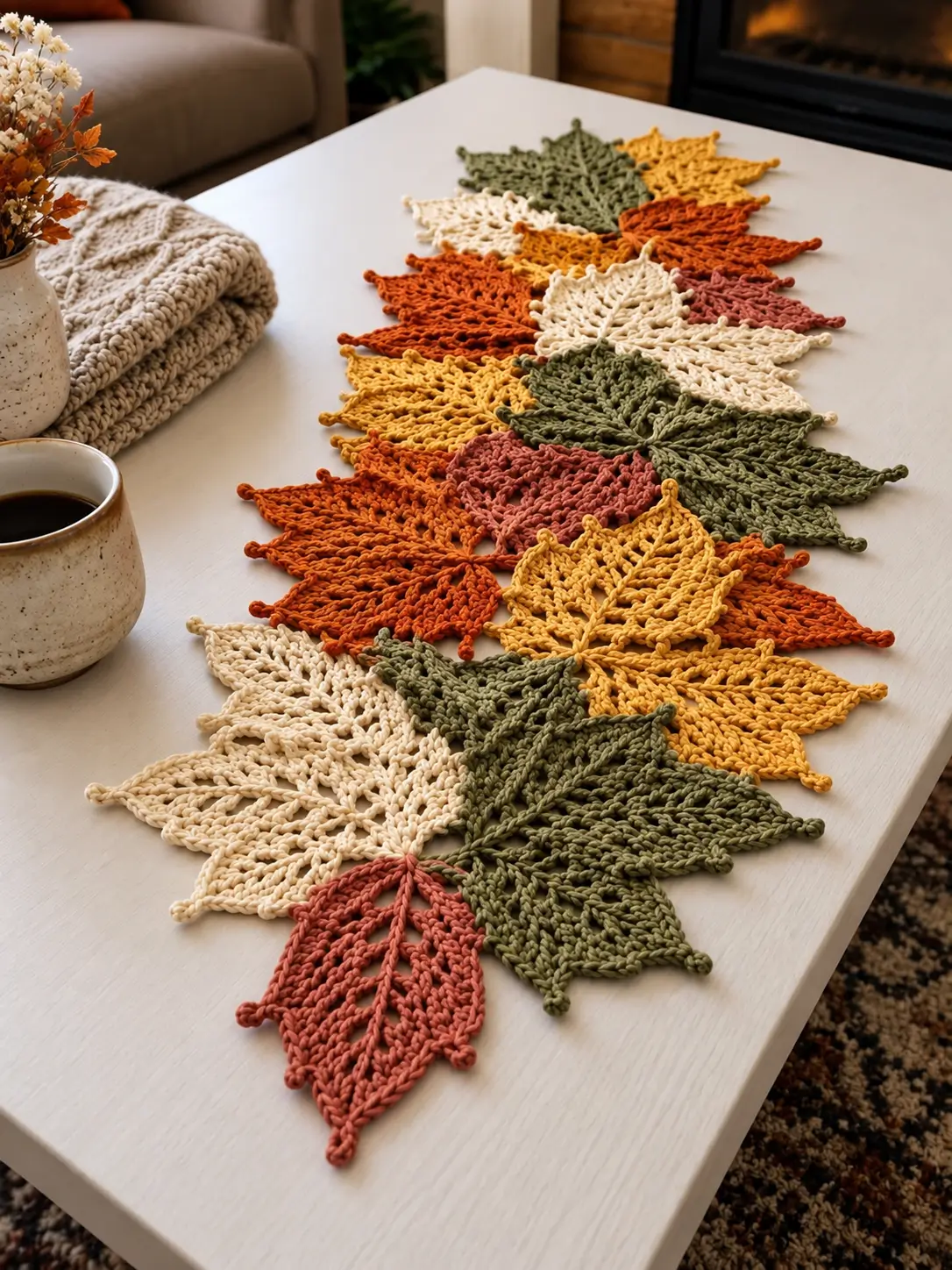
Maple leaves dominate this runner, but the acorns are what stop the arrangement from reading as a row of disconnected motifs. This crochet fall leaf table runner pattern combines large maple leaves, smaller autumn leaves, dimensional acorns and raised vein details in cream, mustard, olive, rust and brown. Use cotton yarn and a 3.5–4 mm hook for a modular intermediate project that can be lengthened to fit your table.
The Design: What Makes This Fall Table Runner Different
The runner is assembled from separate motifs rather than crocheted as one rectangular panel. Large maple leaves overlap along a central path, while smaller leaves and acorns cover gaps between their stems. That construction allows the finished length to be changed without rewriting the individual motifs.
Raised surface-crochet veins give each crochet maple leaf table runner a stronger botanical structure. Cream leaves create light sections, mustard supplies the dominant autumn color, and olive prevents the palette from becoming entirely orange and brown.
The main construction mistake is joining motifs edge to edge. The photographed arrangement depends on overlap. Position neighboring leaves 2–5 cm over one another before sewing so the center of the runner remains visually continuous.
Project Info at a Glance
| Skill Level | Suggested Width | Length | Hook | Yarn |
|---|---|---|---|---|
| Intermediate | Approx. 28–35 cm | Adjustable | 3.5–4 mm | DK or light worsted cotton |
The photograph does not provide a measurement scale or yarn label, so the runner dimensions are reconstruction targets rather than measurements taken from the original item. Make one large maple leaf first, block it, and use its finished width to calculate the complete runner.
Materials and Tools
Yarn
- Natural cream cotton — DK/light worsted — approximately 100–150 g
- Mustard gold cotton — DK/light worsted — approximately 100–150 g
- Olive green cotton — DK/light worsted — approximately 100–150 g
- Rust cotton — DK/light worsted — approximately 40–60 g
- Medium brown cotton — DK/light worsted — approximately 40–60 g
- Dark brown cotton — small quantity for acorn caps
- Beige cotton — small quantity for acorn bodies
Exact consumption depends on table length, leaf size and overlap. For a long dining-table runner, buy additional cream, mustard and olive because the large maple motifs consume most of the yarn.
Tools
- 3.5–4 mm crochet hook
- Yarn needle
- Scissors
- Stitch markers
- Measuring tape
- Blocking mats
- Rust-resistant pins
- Small amount of fiberfill for acorns
Abbreviations
- MR — magic ring
- ch — chain
- sl st — slip stitch
- sc — single crochet
- hdc — half double crochet
- dc — double crochet
- tr — treble crochet
- inc — increase
- dec — decrease
- st/sts — stitch/stitches
- sp — space
- BLO — back loop only
Use an invisible decrease for the stuffed acorns by working through the front loops of the next two stitches before completing the sc.
Pattern Construction
This is a photo-inspired reconstruction. The image provides the motif arrangement and visual proportions but not an identifiable original written pattern.
The runner is built in modules. Crochet the large leaves first, followed by smaller filler leaves and dimensional acorns. Block all flat motifs separately. Arrange everything on the table at full scale before sewing the pieces together.
Suggested Motif Plan
For a runner approximately 150–180 cm long, start with:
- 3 large mustard maple leaves
- 3 large cream maple leaves
- 3 large olive maple leaves
- 3–4 small rust leaves
- 3–4 small brown leaves
- 2–3 small mustard leaves
- 5–7 crochet acorns
Add or remove one large leaf for approximately every 18–25 cm of length required. The exact increase depends on how heavily the motifs overlap.
Large Crochet Maple Leaf
Make the large leaf in cream, mustard or olive.
Central Foundation
Ch 16.
Row 1: Sc in second ch from hook and across. (15)
Row 2: Ch 1, turn, sc in next 7 sts, (sc, ch 2, sc) in next st, sc across remaining 7 sts.
Row 3: Ch 1, sc toward center, work (sc, ch 2, sc) in center ch-2 sp, sc across.
Rows 4–7: Repeat the same center increase structure.
This creates the central spine from which the primary lobes will be shaped.
Central Lobe
Work across the central section.
Row 1: Sc across 7 sts. Turn. (7)
Row 2: Inc, sc across to final st, inc. (9)
Row 3: Sc across. (9)
Row 4: Inc, sc across, inc. (11)
Rows 5–7: Work even in sc.
Row 8: Dec, sc across, dec. (9)
Row 9: Sc across. (9)
Row 10: Dec, sc across, dec. (7)
Row 11: Dec, sc across, dec. (5)
Row 12: Dec, sc, dec. (3)
Tip: Ch 3, sl st into second ch from hook, sl st in next ch, sl st into center st.
Fasten off.
Upper Side Lobe – Make 2
Join yarn beside the central lobe.
Row 1: Sc across 6 available sts. (6)
Row 2: Inc, sc in next 4 sts, inc. (8)
Row 3: Sc across. (8)
Row 4: Inc, sc across, inc. (10)
Rows 5–6: Sc across. (10)
Row 7: Dec, sc across, dec. (8)
Row 8: Sc across. (8)
Row 9: Dec, sc across, dec. (6)
Row 10: Dec, sc across, dec. (4)
Row 11: Dec twice. (2)
Ch 2 and sl st back toward the lobe to create the point.
Fasten off.
Repeat on the opposite side.
Lower Side Lobe – Make 2
The lower lobes are shorter than the upper pair.
Row 1: Join yarn and sc across 6 sts. (6)
Row 2: Inc, sc across, inc. (8)
Row 3: Inc, sc across, inc. (10)
Rows 4–5: Sc across. (10)
Row 6: Dec, sc across, dec. (8)
Row 7: Dec, sc across, dec. (6)
Row 8: Dec, sc across, dec. (4)
Row 9: Dec twice. (2)
Ch 2 and sl st back into the lobe.
Fasten off.
Repeat on the opposite side.
Maple Leaf Serrated Edge
Join matching yarn at the bottom of the leaf.
Sc along the edge until reaching the first planned point.
For a small point work:
sc, hdc, dc, ch 2, sl st in second ch from hook, dc, hdc, sc.
For a larger point work:
sc, hdc, dc, tr, ch 3, sl st in first ch, tr, dc, hdc, sc.
Work only one sl st at each deep valley between the five main lobes.
Continue around the complete leaf and fasten off.
Long Maple Leaf Stem
Join matching yarn at the lower center.
Ch 14.
Sc in second ch from hook and across. (13)
Sl st firmly into the leaf base.
Fasten off.
The stem does not need to remain fully visible in the runner because neighboring motifs and acorns cover several junctions.
Raised Crochet Leaf Veins
The large leaves in the reference have contrasting raised veins.
Use cream on mustard and olive leaves. On cream leaves, use beige, mustard or the same cream yarn for a subtler result.
Insert the hook near the bottom of the leaf.
Pull up a loop from the back.
Surface slip stitch along the center line toward the central point.
Fasten off.
Create two diagonal branches toward each upper side lobe and two toward the lower lobes.
Keep surface stitches loose enough that the leaf remains flat.
Small Autumn Leaf Pattern
Use rust, brown, mustard or olive.
Ch 12.
Side 1: Beginning in second ch, work sl st, sc, hdc, dc, dc, tr, dc, dc, hdc, sc, sl st.
Ch 3 at the tip.
Rotate and work into the opposite side of the foundation chain.
Side 2: Sl st, sc, hdc, dc, dc, tr, dc, dc, hdc, sc, sl st.
Join at the base.
Fasten off.
Small Leaf Edging
Join yarn at the base.
Work sc toward the tip.
Every 2–3 stitches, make a small point with ch 2, sl st into second ch from hook.
Continue around both sides.
Fasten off.
Small Leaf Vein
Surface sl st from the base to the tip.
Add two short diagonal vein branches on each side.
Fasten off and weave the tails into the wrong side.
Crochet Acorn Pattern
The dimensional acorns break up the flat leaf surface and cover several motif junctions.
Acorn Body – Make 5–7
Yarn: beige
Make an MR.
Round 1: 6 sc in MR. (6)
Round 2: Inc around. (12)
Round 3: Repeat (sc, inc) around. (18)
Rounds 4–6: Sc around. (18)
Round 7: Repeat (sc, dec) around. (12)
Add a small amount of fiberfill.
Round 8: Dec around. (6)
Fasten off and close the opening.
Do not overstuff. The photographed acorns are compact and slightly tapered rather than spherical.
Acorn Cap
Yarn: dark brown
Make an MR.
Round 1: 6 sc in MR. (6)
Round 2: Inc around. (12)
Round 3: Repeat (sc, inc) around. (18)
Round 4: BLO sc around. (18)
Round 5: Sc around. (18)
Fasten off with a 20 cm sewing tail.
Place the cap over the wide end of the beige body and sew around the edge.
Acorn Stem
Join brown yarn at the top center of the cap.
Ch 5.
Sl st in second ch from hook and across.
Sl st back into the cap.
Fasten off.
Optional Textured Acorn Cap
For a more defined cap, replace Round 5 with alternating front-post and ordinary single crochet stitches where the scale permits.
A simpler option is surface slip stitch around the finished brown cap.
Avoid heavy embellishment because the acorn should remain small compared with the large maple leaves.
Blocking the Crochet Leaves
Block every leaf before assembling the runner.
Pin the center point first.
Next, pin the two upper side points.
Position the two lower lobes and then the smaller serrations.
Pull the valleys inward with separate pins.
Pin the stem last.
Check that the surface-crochet veins have not pulled the leaf inward.
Allow the motifs to dry completely before removing them from the blocking surface.
Planning the Table Runner Layout
Measure the usable length of the table.
Subtract approximately 15–25 cm if you want the runner to stop before the table ends, or add length if a hanging drop is required.
Place one large leaf near the lower end.
Position the next large leaf approximately 15–25 cm farther along the center line.
Rotate it slightly rather than aligning every stem vertically.
Continue alternating cream, mustard and olive motifs.
Overlap each large leaf with at least one neighboring motif.
Fill visible spaces with small rust, brown and mustard leaves.
Add the acorns last.
Suggested Color Sequence
A balanced sequence for nine large leaves is:
Cream → Olive → Mustard → Cream → Olive → Mustard → Cream → Olive → Mustard.
Do not repeat the same small-leaf color beside every large motif. Scatter rust and brown asymmetrically.
The arrangement should look botanical rather than like identical blocks repeated down the table.
Joining the Large Leaves
Once the complete arrangement has been approved, photograph it from directly above.
Thread a yarn needle with a color matching the motif underneath.
Sew only through overlapping areas.
Use small whip stitches approximately 5–8 mm apart.
Do not sew around the complete edge of either leaf.
Leave several outer lobes unattached so the runner retains dimensional layering.
Attaching the Small Leaves
Place each small leaf over a visible gap, stem junction or transition between two large leaves.
Sew the lower third of the leaf to the runner.
Add one small anchoring stitch near the center vein if necessary.
Leave the outer point free.
This method keeps the smaller motifs from looking completely flattened against the larger leaves.
Attaching the Acorns
Position acorns close to leaf stems and overlapping junctions.
Thread the long brown cap tail through the back of the runner.
Sew through several dense stitches of the underlying leaf.
Pass the yarn through the acorn cap again.
Repeat two or three times.
Do not attach the acorn only by its narrow stem. The stuffed body requires a stronger connection.
Assembly Order
- Block all large cream, mustard and olive maple leaves to consistent dimensions.
- Block the smaller rust, brown, mustard and olive filler leaves.
- Complete and stuff all acorns before arranging the runner.
- Lay the large leaves along the table center and adjust the overlap until the required length is reached.
- Rotate alternating leaves slightly so their main points do not form one rigid line.
- Place small leaves over open areas between the large motifs.
- Add acorns near stem junctions and wherever additional dimensional detail is required.
- Photograph the completed arrangement from above before moving any motif.
- Sew overlapping sections together while leaving selected lobe tips and small leaves free.
- Inspect the runner on the table, weave all remaining tails into matching colors and correct any motif that twists away from the surface.
The finished runner should form one continuous botanical strip rather than a sequence of visibly separate leaves.
How to Adjust the Runner Length
The modular construction makes resizing simpler than altering a rectangular stitch pattern.
Short Runner
Use approximately 5 large leaves, 4–6 small leaves and 3 acorns.
Medium Runner
Use approximately 7 large leaves, 6–8 small leaves and 4–5 acorns.
Long Dining Runner
Use approximately 9–11 large leaves, 8–12 small leaves and 5–8 acorns.
Do not calculate length by multiplying the individual leaf length. Overlap can remove several centimeters from every motif added to the arrangement.
Adjusting the Runner Width
For a narrow runner, keep most leaf stems near the center line and overlap the side lobes heavily.
For a wider centerpiece, rotate large leaves farther toward the table edges.
A width around 28–35 cm is a useful target for many dining tables, but measure the actual tabletop before assembly.
Keep enough clear surface on both sides for plates if the runner will remain on the table during meals.
Alternative Autumn Color Palettes
- Cream + mustard + olive + rust + brown — closest to the reference
- Ivory + sage + terracotta + camel — muted botanical palette
- Mustard + burgundy + forest green + cream — stronger contrast
- Beige + copper + chocolate + olive — darker woodland version
- Cream + dusty rose + sage + rust — softer autumn arrangement
- Golden yellow + orange + red + brown — traditional fall foliage palette
Keep at least one pale shade in the arrangement. Cream leaves separate the darker olive and brown motifs and make the raised vein details easier to see.
Using the Runner Without Sewing Every Motif
The leaves can also be stored separately and arranged directly on the table for temporary seasonal décor.
This method makes laundering and blocking individual motifs easier.
For a semi-permanent arrangement, sew groups of two or three large leaves together and leave the groups separate.
The sections can then be repositioned for different table lengths.
7 Technical Tips for a Better Crochet Leaf Table Runner
- Block large leaves to within approximately 5 mm of the chosen target dimensions. A significantly smaller motif creates an obvious narrow section in the assembled runner.
- Overlap neighboring large leaves by at least 2–5 cm. Edge-to-edge joining exposes gaps when the runner is moved across the table.
- Keep surface-crochet veins loose enough to lie flat. A vein worked under excessive tension pulls the central lobe inward and cups the leaf.
- Use no more than a small pinch of stuffing in each acorn. Overstuffing turns the tapered body into a ball and adds unnecessary weight to the runner.
- Pin the five major maple points before pinning smaller serrations. Starting with minor points can distort the overall leaf width during blocking.
- Sew only the lower third of most small leaves. Stitching their complete perimeter removes the layered effect and makes the runner appear flat.
- Check the runner after every two or three joined motifs. A center line that shifts more than approximately 2 cm sideways can cause the finished runner to curve along the table.
Preventing the Runner from Curling
Flat motifs should lie reasonably level before assembly.
If a maple leaf cups upward, inspect the lobe edges for insufficient stitches or unusually tight tension.
If it ripples heavily, reduce unnecessary increases.
Surface crochet can also create distortion. If the leaf was flat before the veins were added, remove the tight vein stitches and remake them with a larger hook or looser tension.
Keeping the Joined Runner Flat
Do not pull joining stitches tightly.
Place the runner on the table after attaching each major section.
If an overlap creates a raised ridge, reduce the number of joining stitches rather than flattening the area with more sewing.
The outer lobe tips may lift slightly. That small amount of dimension is consistent with the layered design.
Care and Storage
Follow the care instructions for the selected yarn.
If the motifs are cotton, reshape the points and veins while damp after washing.
Support the complete runner when wet rather than lifting it by one leaf or acorn.
Store the runner flat when possible. If it must be folded, place tissue or soft fabric between heavily textured acorn sections so they do not permanently press into neighboring leaves.
Using the Runner for Fall Table Décor
Keep tall decorations toward one end or the center so the detailed leaf arrangement remains visible. Small pumpkins, pinecones and neutral ceramics coordinate with the cream, mustard, olive and rust palette without covering the crochet work.
Because the runner includes raised acorns, place dishes on stable sections of the tabletop rather than directly over dimensional motifs.
This design is decorative. Do not treat the crochet motifs as heat protection unless the chosen fiber and construction are specifically suitable for hot cookware.
Finishing the Crochet Fall Leaf Table Runner
Inspect the complete runner from both ends of the table. The large leaves should alternate naturally without producing a repetitive left-right pattern.
Check every acorn attachment and confirm that no stuffed motif is hanging from a single yarn strand. Weave cream tails through cream leaves, olive tails through green sections and dark tails through brown or rust motifs.
Measure the finished runner after final blocking. Record its total length, maximum width and number of motifs before storing leftover yarn. Those measurements make it easier to add another section later if the runner moves to a longer table.
Conclusion
Make and block the large maple leaves first because their finished dimensions determine the length of the entire arrangement. Alternate cream, mustard and olive along the center, then use smaller rust and brown leaves to cover open transitions. Add the dimensional acorns only after the flat layout has been finalized, and sew through overlapping areas rather than around every leaf edge. Your next step is to crochet one large mustard motif and record its blocked width before calculating the remaining quantity. Save this crochet fall leaf table runner pattern to Pinterest and share the finished table arrangement on Instagram with #CrochetFallLeafRunner. Would you place the cream maple leaves at regular intervals or cluster two together near the center?