Introduction
Five two-tone flowers connect the pinafore and shoes into one design rather than two unrelated crochet projects. This crochet baby pinafore dress uses dense fabric, broad shoulder straps, button closures and matching Mary Jane shoes. A 4 mm hook and baby-appropriate yarn provide a useful starting point, with published baby-dress sizing beginning around a 40.5 cm chest. The construction suits an intermediate crocheter who can size fabric from gauge.
The Design: What Makes This Pinafore Different
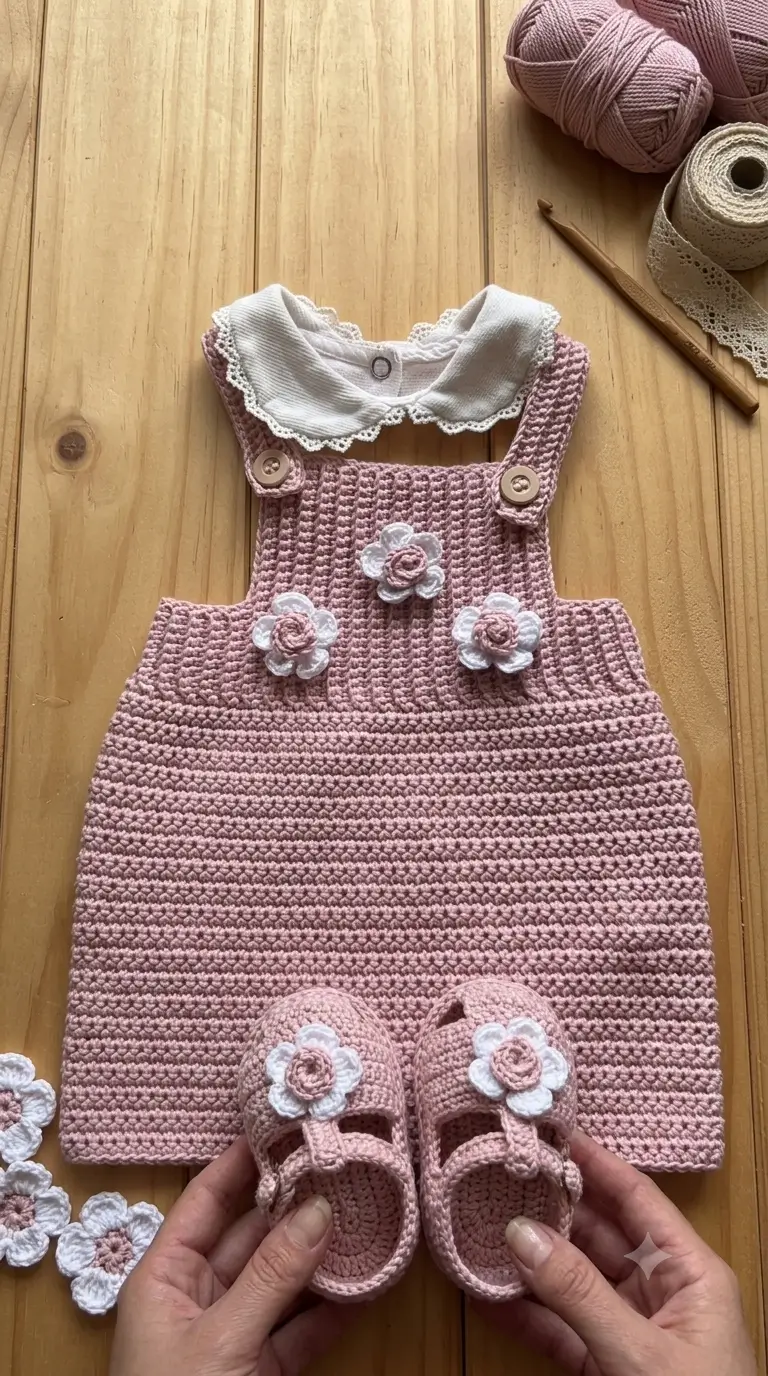
The reference garment avoids a conventional circular yoke. Its visual structure is geometric: a rectangular skirt rises into a narrower bib, while separate straps extend over the shoulders. That approach keeps the front flat enough to support three raised flowers.
The crochet flower baby dress also uses unusually dense fabric. Open lace would change the appearance substantially and provide weaker support for the dimensional decorations. The matching crochet Mary Jane baby shoes repeat both the base color and flower treatment, creating a consistent set.
One common mistake is treating the photographed garment as if stitch count alone determines size. It does not. Gauge, yarn diameter and the intended baby’s chest measurement control the starting width. Published patterns show substantial variation because baby dresses can be made successfully in sport, DK and worsted yarns at different gauges.
Project Info at a Glance
| Skill Level | Time | Finished Size | Hook | Best For |
|---|---|---|---|---|
| Intermediate | Multi-session project | Size to 40.5 cm chest for a 1–3 month benchmark | 4 mm starting point | Baby pinafore and matching shoe set |
The 40.5 cm measurement and 4 mm hook are comparison specifications from a published 1–3 month baby-dress pattern, not measurements extracted directly from the photograph.
Materials and Tools
Yarn
For a close visual interpretation, use a smooth yarn with enough stitch definition to show the dense rows.
- Dusty rose — sport/DK or light worsted — approximately 170–250 g for the complete set as a working allowance — smooth cotton or cotton-blend suggested
- White — matching or slightly finer yarn — approximately 20–40 g for flower petals
- Dusty rose flower centers — use yarn from the main color
The yarn quantities are planning ranges rather than claimed quantities from the photographed garment. Actual consumption changes with garment size, yarn weight, gauge and shoe size.
Tools
- 4 mm crochet hook
- 2.5–3 mm crochet hook for finer flower petals if required
- 2 buttons, approximately 12–15 mm
- Yarn needle
- Locking stitch markers
- Measuring tape
- Scissors
- Pins
- Sewing thread and needle for reinforcing the buttons if required
Abbreviations
- MR — magic ring
- sc — single crochet
- inc — 2 sc in one stitch
- dec — single crochet decrease
- sl st — slip stitch
- ch — chain
- hdc — half double crochet
- dc — double crochet
- BLO — back loop only
- st/sts — stitch/stitches
- RS — right side
- WS — wrong side
An invisible decrease is primarily an amigurumi technique and is unnecessary for the flat pinafore panels. Use standard garment decreases where shaping is required.
Crochet Baby Pinafore Dress Pattern — Step by Step
Construction note: The photograph does not expose the original designer’s stitch counts, gauge or written instructions. This is a photo-inspired construction framework rather than a transcription of an unidentified original pattern.
Gauge Swatch
Yarn: dusty rose.
Work at least a 12 × 12 cm square in single crochet. Measure the central 10 cm without stretching the fabric.
For a target garment circumference of approximately 40.5 cm, calculate the required stitch count using:
Stitches per cm × required garment width = starting stitch count
A garment should not be resized by simply adding six stitches per round as an amigurumi sphere would be. Garment gauge and the intended wearer’s measurements take priority.
Main Skirt Panel
Yarn: dusty rose.
For a flat-front pinafore interpretation, begin with a foundation width based on the intended chest or hip measurement.
Row 1: Ch to the required width, sc in second ch from hook and each ch across.
Row 2: Ch 1, turn, sc in each st across.
Rows 3 onward: Repeat Row 2 until the skirt reaches the required length from the lower hem to the beginning of the bib.
The photographed dress has dense horizontal rows without a large lace repeat. Single crochet therefore produces a closer visual interpretation than an open shell or lace stitch.
Check the width every 5 cm of height. Cotton yarn can change dimensions after washing.
Fasten off only if the bib will be worked separately. Otherwise continue directly into the bib.
Front Bib
Yarn: dusty rose.
Mark the central section of the upper skirt. The bib should be narrower than the skirt and centered accurately.
Row 1: Join at the first marker, ch 1 and sc across to the second marker.
Row 2: Ch 1, turn, sc across.
Rows 3 onward: Repeat Row 2 until the bib reaches the required upper-chest height.
The reference uses a nearly rectangular bib rather than aggressive triangular shaping. Keep both vertical edges square.
Fasten off. Leave approximately 20 cm of yarn for finishing.
Shoulder Straps — Make 2
Yarn: dusty rose.
Row 1: Ch to the required strap width and sc across.
Row 2: Ch 1, turn, sc across.
Rows 3 onward: Repeat until each strap reaches from the back attachment point over the shoulder to the front button.
To create the buttonhole, work to the planned button position, chain enough stitches to clear the button, skip the corresponding number of stitches and continue across.
Next row: Sc across, working one sc into each buttonhole chain.
The photograph uses broad shoulder straps rather than narrow cords. Count the rows so both straps finish at exactly the same length.
Fasten off. Leave a 20 cm sewing tail.
Side and Back Sections
Yarn: dusty rose.
The rear construction is hidden in the reference photograph, so its exact shaping cannot be recovered reliably. Size this area according to the intended baby’s torso measurement rather than guessing an unseen seam.
Work rectangular sections in sc if additional back coverage is required. Maintain the same row and stitch gauge used for the skirt.
Join the sections with mattress stitch or work them directly from the skirt edge.
Large Layered Flowers — Make 3
Yarn: dusty rose for the centers and white for the petals.
The dress shows three raised flowers with pink centers surrounded by broad white petals.
Center R1: 6 sc in MR (6)
Center R2: inc ×6 (12)
Center R3: BLO sc around (12)
For a more raised center, crochet a short chain and coil it over the center disc. Stitch the coil firmly into position.
Join white yarn to the available outer or front loops.
Petal: sl st in attachment point, ch 2, 2 dc, 1 hdc, ch 2, sl st.
Repeat the petal sequence 5 times, distributing the petals evenly around the center.
Fasten off. Leave approximately 20 cm for sewing.
Shoe Flowers — Make 2
Make two additional flowers using the same dusty-rose center and white-petal construction.
For smaller shoe decorations, reduce the hook size to approximately 2.5–3 mm or reduce the size of the raised center.
Both shoe flowers should have the same finished diameter before they are attached.
Mary Jane Soles — Make 2
Yarn: dusty rose.
Baby shoes require an oval foundation rather than the six-stitch circular progression used for stuffed amigurumi pieces.
R1: Ch 10. Work 2 sc in second ch from hook, sc in next 7 ch, 4 sc in final ch. Continue along the opposite side of the foundation chain, sc in next 7 ch and 2 sc in the final position.
R2: Increase around both curved ends while keeping the long sides comparatively straight.
R3: Continue the oval expansion until the sole reaches the required foot length.
Measure the sole against the intended baby’s actual foot length or an age-specific sizing chart before beginning the upper.
Shoe Upper — Make 2
Yarn: dusty rose.
Join the yarn around the completed sole.
R1: BLO sc around the entire sole.
R2: Sc around.
R3: Sc around, beginning controlled decreases across the center of the toe.
R4: Sc around with additional decreases centered over the toe.
R5: Continue shaping until the opening has the low Mary Jane profile shown in the reference.
Stop decreasing before the sides become tall enough to resemble booties. The photographed shoes leave much of the top of the foot open.
Fasten off and weave in the structural yarn end.
Shoe Straps — Make 2
Yarn: dusty rose.
Join the yarn at the outer side of each shoe opening.
Row 1: Ch across the intended instep width.
Row 2: Turn and sc back along the chain.
For an opening strap, form a small chain loop at the free end and attach a securely sewn button to the opposite side.
For a decorative fixed strap, sew the strap directly to both sides of the shoe.
Fasten off with approximately a 15 cm tail.
Attaching the Shoe Flowers
Position one small flower over the upper section of each Mary Jane shoe.
Sew through the center first. Add concealed stitches beneath several petals to prevent the flower from rotating.
Avoid leaving long yarn floats inside the shoe. The flower should sit above the upper without pulling the shoe opening inward.
Buttons — Attach 2
The reference dress uses two round buttons positioned at the upper corners of the bib.
Place each button directly beneath its corresponding shoulder strap. Test the buttonhole before permanently fixing the button position.
Sew repeatedly through the button holes and garment fabric. For an item intended for infant wear, inspect all detachable decorations and buttons carefully before use because loose components can present a choking hazard.
Assembly
- Wash or block the main pinafore components according to the yarn manufacturer’s instructions, then check the finished width against the intended chest measurement.
- Center the bib over the skirt and join it if it was made separately. Keep the vertical center of the bib aligned with the center of the skirt.
- Attach both shoulder straps symmetrically. Measure their positions from the garment center instead of positioning each strap independently by eye.
- Add the two buttons at equal distances from the upper corners of the bib. Test both buttonholes before securing the final thread ends.
- Position the three dress flowers with one on the upper central bib and two lower flowers arranged to the left and right.
- Sew each flower through its center first. Add concealed stitches underneath the petals so the decorations cannot rotate.
- Place the two finished shoe soles directly together before completing the uppers. Their lengths should differ by no more than a few millimeters.
- Finish both Mary Jane straps at the same row and position them at matching points on the shoe openings.
- Sew one smaller flower onto each shoe. Check that neither decoration distorts the shoe opening or reduces usable foot space.
- Weave each yarn tail through several stitches on the wrong side, reverse direction once, trim the excess and complete a final dimensional check.
The finished project consists of one button-strap crochet pinafore, three dress flowers and two coordinated flower-trimmed Mary Jane shoes.
7 Technical Tips for a Cleaner Finish
- Gauge drift: Measure the fabric again after approximately 10 cm of skirt depth. A difference of only one stitch per 10 cm can become several centimeters across a garment-sized panel.
- Stitch-marker asymmetry: Put markers at both bib edges and at its exact center. Repeatedly losing one stitch at a turning edge will move one shoulder strap farther from the center.
- Overly firm fabric: If the single-crochet fabric stands almost rigidly when held horizontally, the selected hook is too small for that yarn. Increase the hook by approximately 0.5 mm and make another gauge swatch.
- Incorrect button placement: Test the first strap before permanently sewing both buttons. The center of each button should line up with the center of its buttonhole rather than the outside edge of the strap.
- Flower distortion: Tack each large flower at a minimum of five or six points instead of sewing only through the center. Center-only attachment allows the petals to rotate or fold during laundering.
- Unequal shoes: Place both completed soles directly on top of each other before beginning the uppers. Correct a difference greater than approximately 3 mm at the sole stage rather than attempting to compensate with tighter upper tension.
- Loose yarn tails: Reverse the direction of each structural yarn tail at least once after weaving it through several stitches. A short tail woven only in one direction is more likely to work loose after repeated washing.
Final Sizing and Finishing
Before treating the project as finished, measure the chest circumference, pinafore length, strap length and both shoe soles. Garment dimensions matter more than an assumed age label because babies of the same age can require different measurements.
Check the flower placement after the garment is laid completely flat. The upper flower should remain centered between the straps, while the two lower flowers should balance each other across the bib.
Inspect the shoes as a pair rather than individually. Their soles, openings, straps and flowers should align when placed side by side.
For an infant garment, examine every attached button and raised flower before use. Decorative elements should be firmly attached, and the finished garment should be used only in an age-appropriate manner under appropriate adult supervision.
Conclusion
Measure the intended wearer before converting the photograph into fixed stitch counts. That is the critical next step for this crochet baby pinafore dress, because the reference image supplies useful proportions but no reliable gauge or age size. Make a 10 cm swatch, calculate the skirt width from the required circumference, then keep the same gauge through the bib and straps. Construct both shoes from measured sole length rather than relying only on the dress size label. Save the finished version to Pinterest and share the coordinated set on Instagram with #DustyRoseBabyPinafore. Would you keep all five flower centers dusty pink, or make the two shoe flowers entirely white?