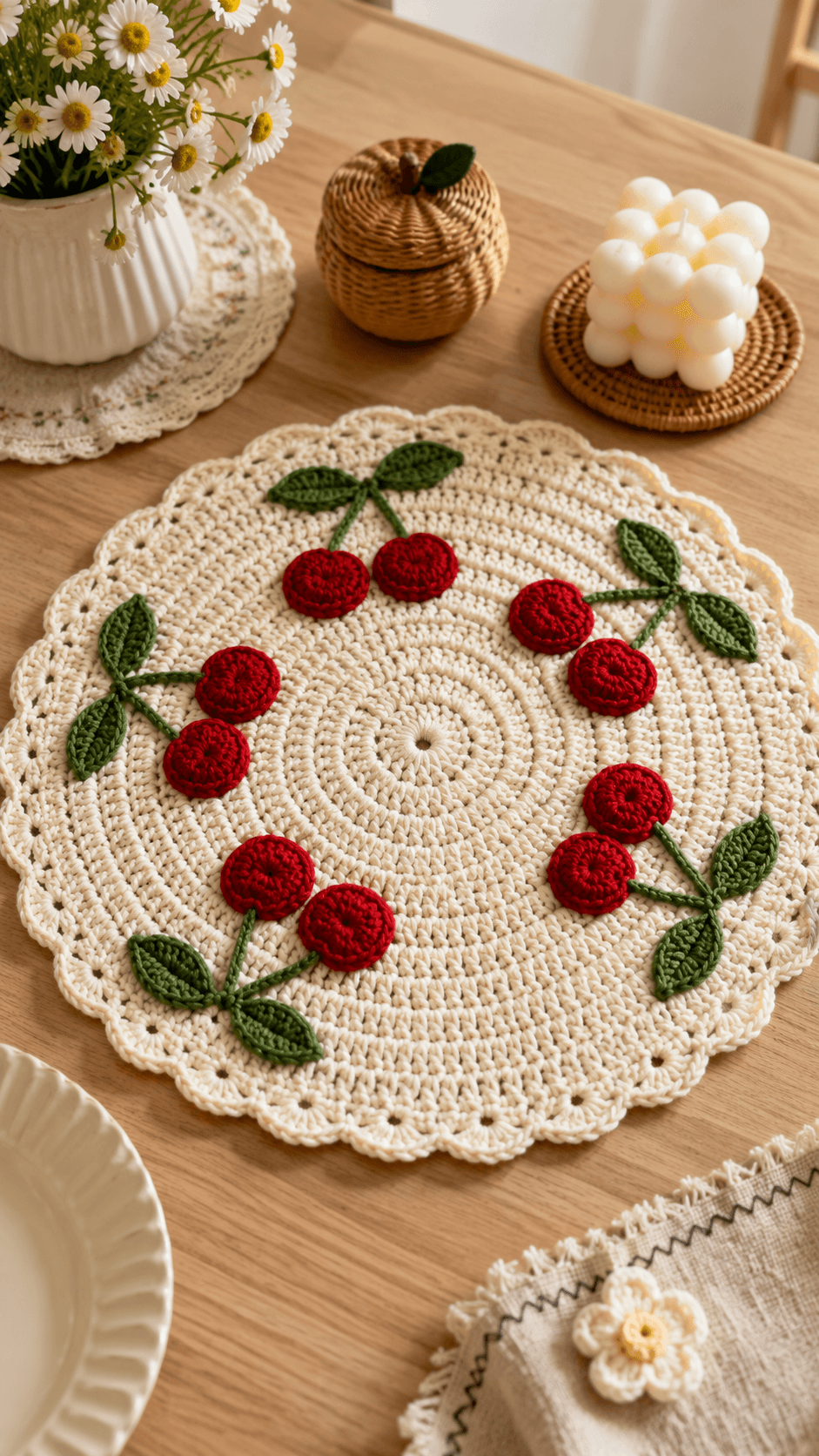
Appliqué cherries change a plain round mat into a fruit motif with clear focal points. That structure defines this cherry crochet doily pattern. The sample shown here uses a cream circular base, red cherry motifs, green stems and leaves, and a soft scalloped edge that frames the full piece. It suits intermediate crocheters who can manage even round increases, neat appliqué placement, and clean finishing across layered decorative parts.
The Design: What Makes This Cherry Doily Different
This doily depends on contrast between a neutral base and raised fruit details. The cream background stays visually quiet, which allows the cherry clusters to read immediately. That matters in motif-based crochet because too much texture in the base can compete with the appliqué work and weaken the overall shape.
The second design choice is circular spacing. The cherry groups are arranged around the outer field rather than crowded into the center, which keeps the middle open and preserves the round geometry of the mat. In a fruit crochet doily, that balance helps the motif feel decorative without becoming cluttered.
The third choice is the edge finish. A small scalloped border softens the outline and gives the piece a clean tabletop look. One common mistake with a cherry crochet mat is placing the appliqués before the base is blocked flat. That can shift the spacing and make the cherry clusters lean unevenly around the circle.
Project Info at a Glance
| Skill Level | Time | Finished Size | Hook | Best For |
|---|---|---|---|---|
| Intermediate | 4–7 hours | Approx. 30–38 cm / 12–15 in | 2.5–3.5 mm | Table decor, placemats, tray styling, seasonal kitchen accents |
Materials and Tools
Yarn
- Cream cotton yarn — DK or light worsted — approx. 80–120 g
- Red cotton yarn — DK or light worsted — approx. 20–35 g
- Green cotton yarn — DK or light worsted — approx. 15–30 g
Tools
- Crochet hook 2.5 mm to 3.5 mm
- Tapestry needle
- Stitch markers
- Scissors
- Blocking mat and pins
Abbreviations
- MR = magic ring
- ch = chain
- sl st = slip stitch
- sc = single crochet
- hdc = half double crochet
- dc = double crochet
- inc = increase
- rep = repeat
- sp = space
In a round appliqué doily, stitch count accuracy matters more than speed. Small increase errors become visible once the piece is blocked and the cherry motifs are attached.
Construction Overview
This piece is made in two stages. First, the round cream base is worked from the center outward in joined rounds with gradual increases to keep the circle flat. Then separate cherry motifs are crocheted and attached around the outer field of the doily. A final scalloped edge frames the entire piece and gives the mat a finished decorative border.
Base Doily Structure
The base is a simple circular mat with light textural ridges created by standard round construction. The center remains dense, while the outer area opens slightly before the border. That keeps the doily stable enough for tabletop use but still decorative enough to support the fruit appliqués.
- Start with an MR and work the first round of stitches into the ring.
- Increase evenly each round to maintain a flat circle.
- Use joined rounds to keep the spiral visually clean.
- Continue until the base reaches the desired diameter.
- Add one transition round near the edge if needed before the final scallop border.
How to Crochet the Cherry Motifs
Cherry Circles
- Work each cherry as a small circle beginning with an MR.
- Use even increase rounds to create a compact, slightly raised fruit shape.
- Make two cherries for each cluster.
- Keep the circles firm so they hold their shape once attached to the base.
Stems
- Chain a short length in green.
- Work back along the chain with sl st or sc to create a narrow stem.
- Join the two stems at the top point of each cherry pair.
Leaves
- Chain a short foundation.
- Work along both sides of the chain with increasing stitch height toward the center.
- Taper the opposite side evenly to create a pointed oval leaf.
- Make two leaves for each cherry cluster.
The leaf angle matters. A slight outward tilt keeps the cluster readable and prevents the stem section from looking too rigid.
Suggested Layout
The photographed sample uses multiple cherry clusters spaced evenly around the outer half of the doily. That arrangement preserves the center circle and keeps the fruit motif balanced. A practical approach is to divide the round into equal sections, then place one cluster in each marked segment before sewing anything down permanently.
- Block the cream base first.
- Mark equal placement points around the doily.
- Set each cherry pair slightly inside the border, not directly against it.
- Angle the stems inward or diagonally to vary the clusters while keeping the spacing even.
Assembly
- Block the finished base and let it dry flat.
- Arrange all cherry circles around the surface before sewing.
- Attach the red circles first.
- Sew stems above each cherry pair.
- Add the leaves last so they overlap the stem joins cleanly.
- Check the spacing from opposite sides before securing the final motifs.
- Weave in all ends on the back.
Border
The sample uses a neat scalloped border that softens the outer edge without overpowering the fruit design. Work one balancing round first if the stitch count needs adjustment, then add shell-style scallops at regular intervals. Keep the scallops shallow so the piece stays usable as a mat or placemat.
- Join cream yarn near the outer edge.
- Work one round of sc evenly around the doily if required.
- Add scallops using a small shell repeat.
- Check that the edge remains flat after every quarter of the round.
Color Placement Notes
Keep the base and border in cream, the fruit in bright red, and the stems and leaves in medium or dark green. That color arrangement matches the sample and gives the doily a clear cherry theme without extra detail work. A deep ivory base can also work, but strong contrast between the fruit and background is what keeps the appliqués visible.
Common Failure Points
- Base rippling: Too many increases were added in the outer rounds. Recount the round and reduce excess stitches.
- Cherry clusters drifting: The motifs were sewn on without marking equal sections first. Divide the round before attaching anything.
- Border cupping: Too few stitches were used before the scallop round. Add a balancing round to correct the count.
- Leaves twisting: The two sides of the leaf were worked unevenly. Match stitch height on both sides of the foundation chain.
- Appliqués puckering the base: The motifs were sewn on too tightly. Leave enough ease for the doily to stay flat.
Where This Doily Works Best
This style works well as a table centerpiece, fruit-themed placemat, tray liner, or seasonal kitchen accent. The cherry motif gives it a decorative function first, so it performs best where the full top surface can be seen clearly. It also suits summer table styling, café-inspired decor, and handmade gift sets built around bright food motifs.
Conclusion
A cherry crochet doily works when the circle stays flat and the appliqué spacing stays controlled. Focus on even increases, measured motif placement, and a light border that frames rather than competes with the fruit clusters. For the closest match to the sample, keep the base cream, use saturated red cherries with green leaves, and arrange the motifs evenly around the outer field. Once blocked, the piece reads as both functional table crochet and clear fruit-themed decor.