Introduction
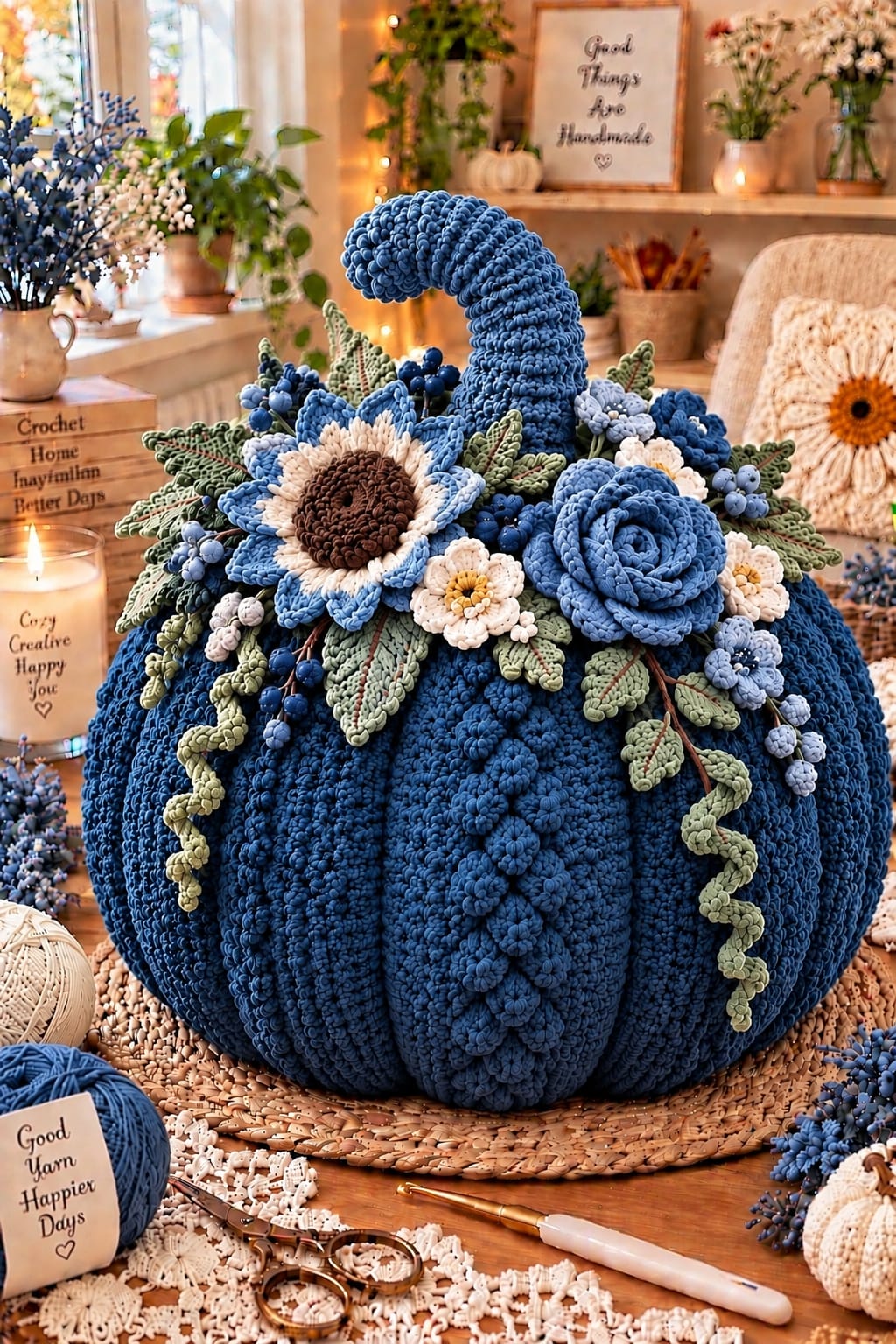
A blue pumpkin with a stem almost as tall as its body needs more than ordinary stuffing to keep that hooked silhouette upright. This giant blue crochet pumpkin pattern combines a super-bulky sculpted body, curved stem, sunflower-style bloom, layered rose, cream flowers, berries, sage leaves, raised ribs, and trailing vines. The intermediate project targets approximately 40–45 cm across and works as a large seasonal centerpiece.
The Design: What Makes This Blue Pumpkin Different
The pumpkin uses eight strongly compressed lobes because dark blue yarn can hide shallow shaping. Several front sections also receive raised blue botanical cords, creating visible texture without introducing another color across the body.
The crown uses two competing focal shapes: a wide sunflower-style bloom on the left and a dense blue rose on the right. Cream flowers separate those blue masses, while sage foliage spreads beyond the crown and establishes a transition between flowers and pumpkin.
The oversized hooked stem supplies the vertical structure. Its lower section is broad and firmly supported, while the upper portion becomes narrower and more flexible. A frequent mistake with a floral crochet pumpkin of this scale is overloading the crown. Several blue lobes must remain exposed below the flowers so the base still reads clearly as a pumpkin.
Project Info at a Glance
| Skill Level | Time | Finished Size | Hook | Best For |
|---|---|---|---|---|
| Intermediate–Advanced | 17–23 hours | Approx. 40–45 cm wide × 50–55 cm high | 8–9 mm body; 4–6 mm details | Fall centerpiece, entry display, seasonal table décor |
The dimensions are reconstruction targets estimated from the photograph rather than measurements taken from the pictured object. Published large crochet pumpkins can reach approximately 38 cm in diameter, while super-bulky pumpkin patterns commonly use hooks in the 8–9 mm range.
Materials and Tools
Yarn
- Deep denim blue — super bulky #6 — approximately 800–950 g for the giant pumpkin body.
- Deep denim blue — super bulky #6 — approximately 130–170 g for the curved stem.
- Medium blue — bulky #5 — approximately 180–230 g for the rose, sunflower petals, berries, and raised details.
- Pale blue — bulky or worsted — approximately 70–100 g for small flowers and berries.
- Sage green — bulky #5 — approximately 180–230 g for leaves and vines.
- Warm cream — worsted #4 — approximately 80–110 g for flowers and sunflower petals.
- Dark brown — worsted #4 — approximately 30–40 g for the sunflower center.
- Mustard — worsted #4 — approximately 10 g for small flower centers.
The body allowance is deliberately generous because the reference object is substantially larger than ordinary shelf pumpkins. Actual yarn consumption depends on fiber density, gauge, stuffing pressure, and final circumference.
Tools
- 8.0–9.0 mm crochet hook for the pumpkin body
- 6.0 mm crochet hook for the stem
- 5.0 mm crochet hook for large flowers
- 4.0–4.5 mm crochet hook for leaves, berries, and smaller flowers
- Polyester fiberfill — approximately 1–1.4 kg
- Long upholstery needle
- Tapestry needle
- Locking stitch markers
- Scissors
- Rust-resistant pins
- Optional flexible covered craft wire for the stem
Abbreviations
- MR — magic ring
- ch — chain
- sc — single crochet
- hdc — half double crochet
- dc — double crochet
- tr — treble crochet
- inc — increase
- dec — decrease
- sl st — slip stitch
- BLO — back loop only
- st/sts — stitch/stitches
- FO — fasten off
For an invisible decrease, insert the hook through the front loops of the next two stitches, yarn over, pull through both front loops, then complete the single crochet.
Pattern — Step by Step
This is an original photo-inspired construction rather than a transcription of a published pattern. Work the body in a continuous spiral unless another method is stated.
Giant Blue Pumpkin Body
Yarn: deep denim blue, super bulky #6.
R1: 6 sc in MR. (6)
R2: Inc ×6. (12)
R3: (Sc 1, inc) ×6. (18)
R4: (Sc 2, inc) ×6. (24)
R5: (Sc 3, inc) ×6. (30)
R6: (Sc 4, inc) ×6. (36)
R7: (Sc 5, inc) ×6. (42)
R8: (Sc 6, inc) ×6. (48)
R9: (Sc 7, inc) ×6. (54)
R10: (Sc 8, inc) ×6. (60)
R11: (Sc 9, inc) ×6. (66)
R12: (Sc 10, inc) ×6. (72)
R13–R27: Sc in every st around. (72)
The long 72-stitch section establishes the broad body. Check the diameter after R20; super-bulky yarn varies considerably between brands.
R28: (Sc 10, dec) ×6. (66)
R29: (Sc 9, dec) ×6. (60)
R30: (Sc 8, dec) ×6. (54)
R31: (Sc 7, dec) ×6. (48)
Begin stuffing around the outside circumference. Keep the center moderately compressible for later sculpting.
R32: (Sc 6, dec) ×6. (42)
R33: (Sc 5, dec) ×6. (36)
R34: (Sc 4, dec) ×6. (30)
R35: (Sc 3, dec) ×6. (24)
Add additional fiberfill, concentrating it in the outer lobes rather than packing the vertical center solid.
R36: (Sc 2, dec) ×6. (18)
R37: (Sc 1, dec) ×6. (12)
R38: Dec ×6. (6)
Fasten off with a 60 cm tail. Thread through the remaining six stitches and close firmly.
Sculpting Eight Deep Ribs
Cut approximately 3.5 m of strong matching blue yarn.
Insert a long upholstery needle through the bottom center and bring it out through the crown.
Carry the yarn down the exterior and return through the center.
Pull until the strand creates a pronounced groove.
Repeat until the pumpkin is divided into eight sections.
Inspect the pumpkin from above before knotting. The eight sections should have comparable width even though the floral crown will eventually obscure portions of the upper channels.
Raised Blue Botanical Rib — Make 3 to 5
Yarn: medium blue.
Ch 38–44, adjusting the chain to the measured height of one front pumpkin lobe.
Row 1: Beginning in second ch, sl st across.
Fasten off with a 60 cm tail.
Pin the cord vertically along a lobe.
Form a small side loop approximately every 3–4 cm. Alternate the loops left and right.
Sew through the underside of the cord so the raised edge remains visible.
Repeat on selected front lobes rather than decorating all eight sections.
Oversized Curved Blue Stem
Yarn: deep denim blue, super bulky #6. Use a 6.0 mm hook for a dense fabric.
R1: 6 sc in MR. (6)
R2: Inc ×6. (12)
R3: (Sc 1, inc) ×6. (18)
R4: (Sc 2, inc) ×6. (24)
R5–R10: Sc around. (24)
R11: (Sc 2, dec) ×6. (18)
R12–R20: Sc around. (18)
R21: (Sc 1, dec) ×6. (12)
R22–R36: Sc around. (12)
R37: Dec ×6. (6)
Fasten off and close.
Stuff the lower third firmly. Use moderate filling through the center and substantially less near the tip.
For the pronounced hook shown in the image, flexible covered craft wire can be inserted before closing. Fold both ends into blunt loops and bury them completely inside the stuffing.
Large Blue and Cream Sunflower-Style Flower
Yarn: dark brown, cream, and medium blue. Use a 4.5–5.0 mm hook.
Brown Center
R1: 6 sc in MR. (6)
R2: Inc ×6. (12)
R3: (Sc 1, inc) ×6. (18)
R4: (Sc 2, inc) ×6. (24)
R5: (Sc 3, inc) ×6. (30)
R6: (Sc 4, inc) ×6. (36)
Fasten off.
Cream Inner Petals — Make 18
Join cream around the brown center.
Petal: Ch 7. Beginning in second ch work sl st, sc, hdc, dc, hdc, sc.
Sl st into the next available center stitch.
Repeat evenly around.
Large Blue Outer Petals — Make 12
Join medium blue behind the cream petal layer.
Ch 10.
Beginning in second ch work:
Sl st, sc, hdc, dc, tr, tr, dc, hdc, sc.
Attach behind the next petal group.
Repeat around, distributing 12 petals evenly.
Block the blue petals outward before attaching the flower to the pumpkin.
Large Layered Blue Rose
Yarn: medium blue, bulky #5. Use a 5.0 mm hook.
Ch 52.
Row 1: Beginning in fourth ch from hook, work 2 dc in first ch. *Dc in next ch, 2 dc in next ch.* Repeat across.
Ch 3 and turn.
Row 2: Work 5 dc in first suitable stitch, sl st in next st. *5 dc in next st, sl st in next st.* Repeat across.
Fasten off with approximately 90 cm for assembly.
Roll the first section tightly to establish the center. Continue wrapping while allowing each subsequent shell to sit farther outward.
Sew through the underside after every complete rotation.
Outer Rose Petals — Make 8
Ch 10.
Beginning in second ch work:
Sl st, sc, hdc, dc, 3 tr, dc, hdc.
Work 3 sc into the end and return down the opposite side with the corresponding stitch sequence.
Fasten off.
Arrange eight petals beneath the rolled rose and sew only their bases in place.
Small Cream Flower — Make 4 to 6
Yarn: cream and mustard.
R1: With mustard, 6 sc in MR. Join. (6)
Change to cream.
R2: In each stitch work (sl st, ch 4, 2 dc, hdc, sl st).
Repeat six times.
Fasten off with a 20 cm attachment tail.
Small Blue Flower — Make 5 to 8
Yarn: pale or medium blue.
R1: 6 sc in MR. Join. (6)
R2: In each stitch work (sl st, ch 3, 2 dc, ch 2, sl st).
Repeat six times.
Fasten off.
Blue Berry — Make 24 to 30
R1: 6 sc in MR. (6)
R2: Inc ×6. (12)
R3: Sc around. (12)
R4: Dec ×6. (6)
Add a small amount of stuffing.
Fasten off and close.
Combine three to five berries into each cluster. Mix deep and pale blue berries so individual spheres remain visible.
Large Sage Leaf — Make 18 to 22
Yarn: sage green. Use a 4.0–4.5 mm hook.
Ch 15.
Beginning in second ch:
Side 1: Sl st, sc, hdc, dc, dc, tr, tr, tr, dc, dc, hdc, sc, sl st, sl st.
At the end work (sc, ch 2, sc).
Continue down the opposite side using the corresponding stitch sequence.
Join at the base.
Leaf Vein
Join sage yarn at the base.
Surface sl st toward the pointed tip.
Add two or three short diagonal surface-stitch branches on each side.
Fasten off.
Small Sage Leaf — Make 10 to 14
Ch 9.
Beginning in second ch work:
Sl st, sc, hdc, dc, dc, hdc, sc, sl st.
Work 2 sc into the end.
Repeat along the opposite side.
Fasten off with a sewing tail.
Long Sage Curly Vine — Make 4 to 6
Ch 42.
Beginning in second ch, work 2 sc in every chain.
For a tighter spiral, work 3 sc in every fifth chain.
Fasten off with a 30 cm tail.
Short Curly Vine — Make 6
Ch 22.
Beginning in second ch, work 2 sc in each chain.
Fasten off.
Suggested Component Count
| Component | Quantity | Main Color |
|---|---|---|
| Giant pumpkin body | 1 | Deep blue |
| Curved stem | 1 | Deep blue |
| Sunflower-style flower | 1 | Blue / cream / brown |
| Large rose | 1 | Medium blue |
| Small cream flowers | 4–6 | Cream |
| Small blue flowers | 5–8 | Blue |
| Large leaves | 18–22 | Sage |
| Small leaves | 10–14 | Sage |
| Berry clusters | 6–8 | Mixed blue |
| Long vines | 4–6 | Sage |
| Raised body ribs | 3–5 | Blue |
Assembly
- Complete and stuff the blue body, close the crown, then sculpt eight evenly distributed pumpkin lobes.
- Attach the oversized stem through a broad area of the crown and test its stability before adding the floral weight.
- Position the sunflower-style flower left of center and the large blue rose lower on the right.
- Add cream and smaller blue flowers between the two focal blooms, keeping their centers at different heights.
- Slide sage leaves beneath the flowers, directing several upward beside the stem and others horizontally across the crown.
- Add berry clusters near the stem and around gaps between large leaves rather than grouping every berry in one area.
- Sew the raised blue botanical ribs onto selected front lobes, keeping them separate from the primary sculpting channels.
- Attach long sage vines beneath the crown and tack them approximately every 5–7 cm while leaving the curls raised.
- Add short vines and remaining small leaves only where visible gaps interrupt the botanical crown.
- Rotate the pumpkin through 360 degrees, reinforce any moving component, weave the remaining tails into matching yarn, and reshape the lobes.
The completed centerpiece should retain a recognizable eight-lobed pumpkin silhouette beneath an asymmetric crown of blue flowers, cream accents, sage foliage, berries, and trailing vines.
7 Technical Tips
- Invisible dark-blue ribs: Shallow channels disappear on a dark body. Tighten each shaping strand until the groove remains visible from approximately 1 m away without flattening the adjacent lobe.
- Distorted body: Pulling one sculpting strand harder than the other seven shifts the crown away from the base center. Compare all eight lobe widths from above before knotting the shaping yarn.
- Visible fiberfill: Large super-bulky stitches can spread under stuffing pressure. If filling shows through several gaps, reduce the body hook by approximately 1 mm rather than adding more stuffing.
- Falling stem: The long hooked stem creates leverage at its base. Sew through at least 4–5 cm of its lower circumference and make several attachment passes through separate crown stitches.
- Collapsed sunflower: Heavy outer petals can fold behind the brown center. Block the complete flower flat before attachment and tack the bases of two or three lower petals if required.
- Hidden pumpkin body: Too many low flowers turn the project into a floral ball. Leave at least three front-facing blue lobes substantially exposed below the botanical crown.
- Stretched vines: Sewing continuously along a curly vine removes the spiral. Anchor long vines approximately every 5–7 cm and leave the intervening sections unattached.
Controlling the Blue Color Palette
The image uses several blues rather than one uniform shade. Deep denim belongs on the body and stem because those are the largest forms. Medium blue works on the rose and sunflower petals, while pale blue is most effective on small flowers and selected berries.
Cream has a specific structural role. The pale sunflower petals and small cream flowers interrupt large areas of blue so the individual focal blooms remain readable.
Sage green supplies the strongest color separation. Keep it concentrated in leaves and vines rather than adding green stitches to the pumpkin itself.
Dark brown should remain restricted to the sunflower center. A small mustard center in the cream flowers adds another warm accent without changing the overall blue-green palette.
Keeping the Giant Body Stable
Stuff the outer circumference before packing the center. The lobes require enough filling to remain rounded after the shaping strands are tightened.
The central vertical axis should stay slightly compressible. A completely rigid sphere is difficult to pull into the squat pumpkin profile visible in the photograph.
After closing R38, place both hands on the crown and press downward while supporting the base. Then apply the eight sculpting strands.
Check the underside before attaching the stem. The pumpkin must stand independently without the floral crown compensating for an uneven base.
Supporting the Hooked Stem
The stem should rise vertically before curving forward. Starting the bend immediately above the pumpkin makes the entire crown appear compressed.
If stuffing alone cannot hold the shape, insert covered flexible craft wire. Fold both ends into closed loops and surround them with fiberfill before closing the tube.
Keep the lower third densely filled. Reduce the stuffing through the center, then use a lighter amount through the upper hook.
Shape the final curve before attaching the flowers because the botanical crown will restrict access to the stem base.
Arranging the Botanical Crown
Place the two focal flowers first. Their positions determine every later attachment.
The sunflower-style bloom should occupy the left side and project slightly forward. Position the large rose on the right and several centimeters lower.
Add the cream flowers next. Use them as separators between blue focal pieces rather than distributing them at equal intervals.
Leaves should extend farther than most petals. Point several behind the stem, several toward the sides, and a few downward over the body.
Berries occupy the smallest gaps. Vines come last because their final paths depend on which pumpkin lobes remain exposed.
Making a Smaller Blue Pumpkin
Stop the body increases at 60 stitches for a medium version. Work approximately 10–12 rounds even, then reverse the shaping sequence by decreasing six stitches per round.
A slightly larger intermediate version can stop at 66 stitches.
Reduce the stem length proportionally. Remove approximately five to eight of the 12-stitch rounds from the upper section rather than shortening the broad base.
Use one large focal flower instead of two if the reduced crown becomes crowded. Leaves and berries can be decreased by roughly one-third.
Alternative Blue Combinations
Navy, cornflower, cream, and eucalyptus produce a cooler version. Teal can replace medium blue while keeping the pumpkin body dark navy.
For a softer palette, use dusty blue on the body, pale blue flowers, ivory accents, and muted sage leaves. A winter variation can combine midnight blue with silver-gray foliage and white flowers.
The same construction also works with a neutral pumpkin body. Cream or charcoal can replace deep blue while the botanical crown retains blue flowers and sage leaves.
Keep at least three distinct values—dark, medium, and light—when using several shades of one color. Without value contrast, separate flower layers can merge visually.
Care and Storage
Follow the washing directions supplied with the selected yarn. A centerpiece containing more than a kilogram of stuffing can be difficult to dry thoroughly after immersion, so surface cleaning may be more practical.
Support the hooked stem during storage. Do not place the pumpkin upside down or allow another object to press directly against the curve.
Place clean tissue between the large flower layers if the centerpiece will remain boxed for an extended period. Reshape petals and leaves by supporting their bases rather than pulling their tips.
If internal wire is used, inspect the stem periodically for any point where the support has shifted toward the crochet surface.
Finishing the Giant Blue Crochet Pumpkin
Inspect the centerpiece from the front and from directly above before trimming the final yarn tails. Eight body sections should remain readable beneath the crown, the sunflower and rose should form separate focal points, and the sage foliage should extend beyond the flowers without hiding the entire blue surface. Reposition any vine that crosses a major flower center.
The finished giant blue crochet pumpkin pattern depends on controlled scale: a broad sculpted body, oversized hooked stem, two dominant flowers, smaller cream accents, berries, and long sage foliage. Complete and measure the pumpkin before producing the full botanical component count.
Share the finished centerpiece on Pinterest or Instagram with #GiantBlueCrochetPumpkin. For this specific pumpkin, would you keep the sunflower petals blue and cream or make the entire flower pale blue?