Introduction
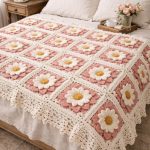
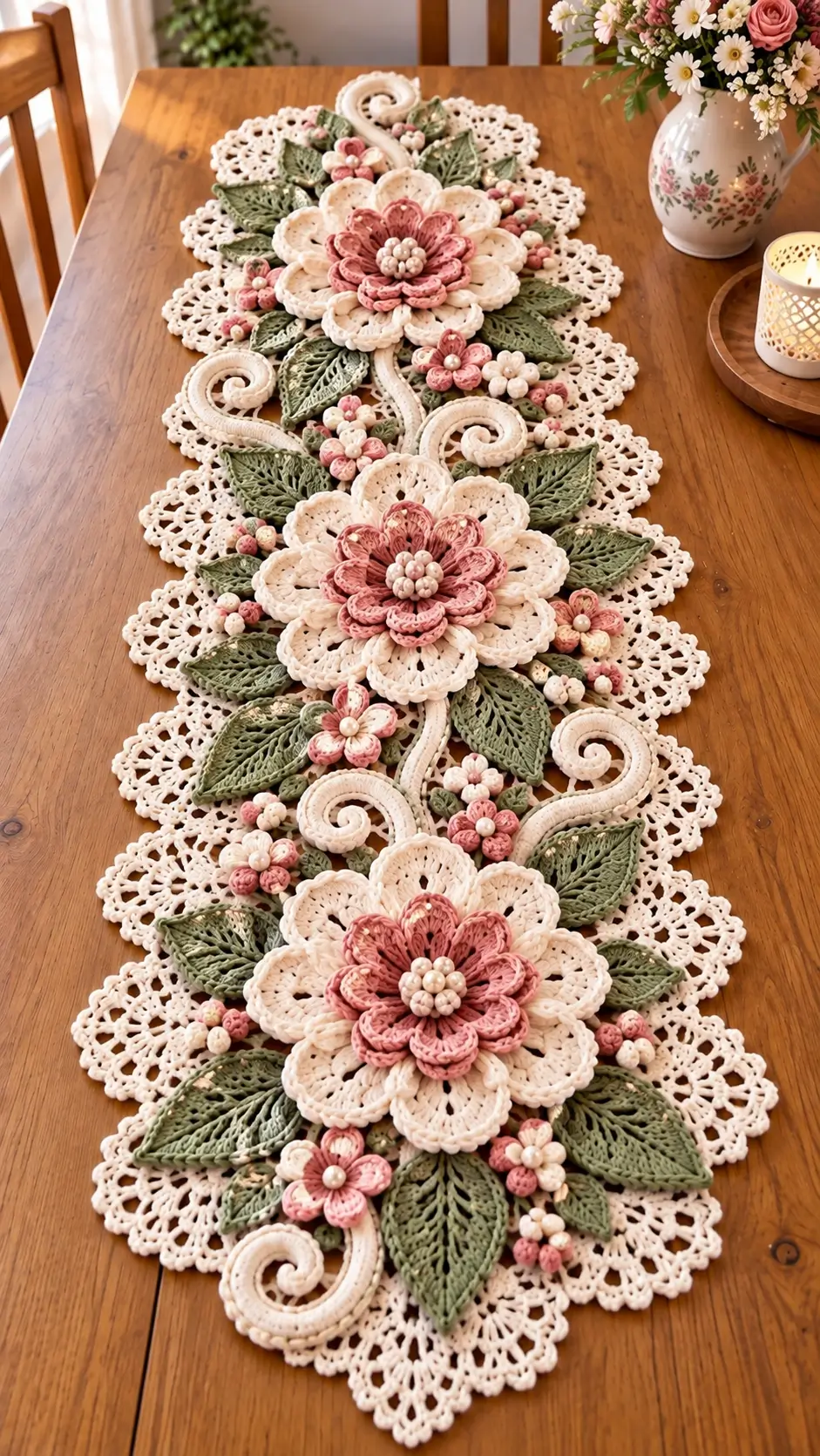
Three flowers this large need a lace foundation wide enough to support their petals without hiding the wooden table underneath. This crochet floral table runner pattern combines layered cream and dusty-rose blossoms, openwork sage leaves, small flowers, berries, raised scroll vines, and an ivory lace border. Use DK or light-worsted cotton with a 3.5–4.0 mm hook for an intermediate project measuring approximately 38 × 145 cm.
The Design: What Makes This Floral Table Runner Different
The runner is constructed in layers rather than crocheted as one rectangular fabric. An ivory openwork foundation establishes the long outline, while three oversized flowers create the central rhythm. Each large blossom uses broad cream outer petals and smaller dusty-rose inner petals so the flower remains dimensional without requiring extremely thick yarn.
Openwork sage leaves extend beyond the flower edges and fill the spaces between motifs. Raised ivory scrolls provide a third shape, preventing the composition from becoming a continuous row of circles. Small pink flowers and berry clusters cover selected attachment points.
A common mistake with a 3D crochet flower table runner is sewing every leaf and flower flat. This removes the layered botanical structure. Attach large petals primarily at their centers and bases while leaving their outer edges free.
Project Info at a Glance
| Skill Level | Time | Finished Size | Hook | Best For |
|---|---|---|---|---|
| Intermediate | 18–26 hours | Approx. 38 × 145 cm | 3.5–4.0 mm | Dining table, sideboard, dresser, floral centerpiece |
The finished measurement is a photo-inspired target. Published floral crochet runners vary considerably: one documented worsted-cotton motif runner measures approximately 28 × 94 cm, while longer modular floral designs reach roughly 145 cm. Length is easy to change because the botanical sections are assembled separately.
Materials and Tools
Yarn
- Warm ivory — DK/light-worsted cotton — approximately 220–280 g for lace, large petals, scrolls, and accents.
- Dusty rose — DK/light-worsted cotton — approximately 100–140 g for inner petals, small flowers, and berries.
- Sage or olive green — DK/light-worsted cotton — approximately 130–170 g for leaves and small botanical accents.
- Blush pink — DK/light-worsted cotton — approximately 30–50 g for secondary blossoms.
Published floral table runners demonstrate substantial variation in yarn consumption. A worsted cotton motif runner lists about 250 g total, while another floral table mat uses roughly 140–160 g for each major color. Make one complete botanical section before purchasing additional yarn if substituting a significantly heavier fiber.
Tools
- 4.0 mm crochet hook for the lace foundation and large flowers
- 3.5 mm crochet hook for leaves, berries, and smaller flowers
- Tapestry needle
- Scissors
- Locking stitch markers
- Blocking mats
- Rust-resistant pins
- Optional pearl-style beads for flower centers
- Strong sewing thread if beads are added
Abbreviations
- MR — magic ring
- ch — chain
- sc — single crochet
- hdc — half double crochet
- dc — double crochet
- tr — treble crochet
- sl st — slip stitch
- sp — space
- st/sts — stitch/stitches
- RS — right side
- FO — fasten off
An invisible decrease is primarily an amigurumi technique and is not required for the flat and layered motifs used in this runner.
Pattern — Step by Step
This is an original photo-inspired interpretation rather than a transcription of a commercial pattern. The photograph cannot reveal hidden stitches, exact attachment points, or gauge, so make one flower and one leaf before committing to the complete runner.
Large Flower — Make 3
The three large flowers form the structural centerline. Each is assembled from an ivory outer flower and a smaller dusty-rose flower.
Large Flower Center Foundation
Yarn: ivory. Use a 4.0 mm hook.
R1: 6 sc in MR. Join with sl st. (6)
R2: Ch 1, 2 sc in each st around. Join. (12)
R3: Ch 1, (sc 1, 2 sc in next st) ×6. Join. (18)
R4: Ch 1, (sc 2, 2 sc in next st) ×6. Join. (24)
This flat disc supports the large petals and provides a stable area for attaching the inner flower.
Large Ivory Petals — Make 10 Per Flower
Work the petals directly around the foundation.
R5: *Ch 10, skip 1 st, sl st into next st.* Repeat 10 times as evenly as possible around the disc.
R6: Into each ch-10 loop work:
(sc, hdc, 3 dc, 3 tr, 3 dc, hdc, sc).
Repeat in all 10 loops.
Join with sl st.
The petals should overlap slightly at their bases while remaining separate at the rounded tips.
Ivory Petal Edge
R7: Work sc around each petal, placing (sc, ch 1, sc) at the center of each petal tip.
Sl st into the valley between petals.
Repeat around and fasten off.
Block the flower before adding the dusty-rose layer. Target approximately 18–21 cm across.
Dusty-Rose Inner Flower — Make 3
Yarn: dusty rose. Use a 3.5–4.0 mm hook.
R1: 6 sc in MR. Join. (6)
R2: Inc ×6. Join. (12)
R3: (Sc 1, inc) ×6. Join. (18)
R4: *Ch 6, skip 1 st, sl st in next st.* Repeat 9 times. (9 loops)
R5: Into each loop work (sc, hdc, 3 dc, hdc, sc).
Join and fasten off.
Make a second tier behind the first if additional depth is required.
Second tier: Join yarn behind a valley between two petals. *Ch 8, sl st behind next valley.* Repeat around.
Into each ch-8 loop work (sc, hdc, 4 dc, hdc, sc).
Fasten off.
Large Flower Assembly
Center the dusty-rose flower over the ivory flower.
Sew through the center 3–4 cm only. Do not stitch around the outer dusty-rose petals.
This limited attachment allows the inner petals to stand above the ivory layer.
Add 7–10 pearl-style beads to the center if reproducing the beaded appearance. Sew each bead independently with strong thread rather than relying on one continuous strand.
Large Openwork Leaf — Make 20 to 26
Yarn: sage green. Use a 3.5 mm hook.
Ch 17.
Row 1: Beginning in second ch from hook work sc, hdc, dc, dc, tr, tr, tr, tr, tr, tr, dc, dc, hdc, sc, sl st, sl st.
Work (sc, ch 2, sc) into the end of the foundation.
Continue along the opposite side using the corresponding stitch sequence.
Join at the base.
Leaf Openwork Round
R2: Ch 3. *Skip approximately 2 sts, sl st into next st, ch 3.* Repeat around both sides while preserving the pointed tip.
The exact spacing can be adjusted by one stitch so the chain loops remain symmetrical.
Leaf Edge
R3: Work (sc, hdc, sc) into each ch-3 loop.
At the leaf point work (sc, ch 2, sc).
Fasten off with a 25 cm attachment tail.
Raised Leaf Vein
Join matching sage yarn at the base.
Surface sl st along the original foundation chain toward the tip.
Fasten off on the wrong side.
The completed leaf should remain flexible and slightly open rather than becoming a dense oval.
Small Five-Petal Flower — Make 12 to 18
Use dusty rose, blush, or ivory.
R1: 5 sc in MR. Join. (5)
R2: In each stitch work:
(Sl st, ch 3, 2 dc, hdc, ch 2, sl st).
Repeat five times.
Fasten off with a 20 cm sewing tail.
Add one pearl-style bead to the center if desired.
Small Berry — Make 24 to 36
Use dusty rose, ivory, or blush.
R1: 6 sc in MR. (6)
R2: Inc ×6. (12)
R3: Sc around. (12)
R4: Dec ×6. (6)
For table décor, the berry can remain unstuffed. Insert a tiny amount of fiberfill only if a firmer sphere is wanted.
Fasten off and close the opening.
Berry Cluster
Arrange three to five berries together.
Pass matching yarn through their lower centers and tie securely on the back.
Mix ivory and dusty-rose berries in several clusters to reproduce the scattered botanical texture.
Large Ivory Scroll Vine — Make 6 to 8
The padded scrolls are a major feature of the reference runner. They should appear thicker than ordinary curly chains.
Yarn: ivory. Use a 4.0 mm hook.
Ch 45.
Row 1: Beginning in second ch, sc across. Ch 1, turn.
Row 2: Sc across.
Fasten off with a long tail.
Roll the first 8–10 cm into a tight spiral and tack the coils together from the back.
Continue shaping the remaining strip into a broad S-curve.
For a thicker scroll, crochet a second identical strip and sew the two long edges together before shaping.
Short Scroll — Make 4 to 6
Ch 28.
Row 1: Sc from second ch across.
Row 2: Ch 1, turn, sc across.
Fasten off.
Coil one end inward and leave the remaining section gently curved.
Central Lace Foundation
Yarn: ivory. Use a 4.0 mm hook.
The foundation does not need to be a completely solid rectangle because much of it will be hidden by flowers and leaves.
Ch 181, or continue chaining until the foundation measures approximately 125 cm without stretching.
Row 1: Dc in fourth ch from hook and across.
Row 2: Ch 4, turn. *Skip 2 sts, dc in next st, ch 2.* Repeat across.
Row 3: Ch 3, turn. Work 3 dc into each ch-2 sp across.
Row 4: Ch 4, turn. *Skip 2 sts, dc in next st, ch 2.* Repeat across.
Row 5: Repeat Row 3.
Continue until the central strip measures approximately 14–16 cm wide.
Fasten off.
Lace Side Panels
Join ivory yarn along one long side of the central strip.
Side R1: Ch 5, *skip approximately 1 cm of edge, sc into edge, ch 5.* Repeat along the side.
Side R2: Sl st into first loop. Into each ch-5 loop work (sc, ch 5, sc).
Side R3: Into each ch-5 loop work (sc, ch 3, 2 dc, ch 3, sc).
Fasten off.
Repeat on the second long side.
Scalloped Lace Border
The outer lace in the photograph forms broad rounded points rather than a plain straight edge.
Join ivory yarn in a side-panel loop.
Border R1: *Sc in loop, ch 6, sc in next loop.* Repeat around the perimeter.
Border R2: Into each ch-6 loop work:
(sc, ch 3, dc, ch 3, dc, ch 3, sc).
At the outermost ends of the runner, increase the center loop to ch 8 to produce a slightly longer point.
Fasten off.
Botanical Layout
Block the lace foundation before placing any dimensional pieces.
Position the three large flowers along the centerline. Place one near each end and the third around the midpoint.
Leave approximately 25–35 cm between flower centers depending on the final runner length.
Arrange 6–9 sage leaves around each large flower. Alternate their angles rather than forming identical radial stars.
Place ivory scrolls in the spaces between the large flowers. Turn some spirals clockwise and others counterclockwise.
Fill remaining gaps with small flowers and berry clusters.
Attaching the Large Flowers
Sew each flower through its central foundation only.
Make at least six secure passes through the lace ground, distributing them around the flower center.
Add two or three concealed tacking stitches beneath selected ivory petals if the flower shifts when the runner is lifted.
Do not stitch the complete outer edge of every petal to the foundation.
Attaching the Leaves
Slide the base of each leaf underneath a flower or scroll.
Sew the lower 2–3 cm of the leaf to the runner.
Add one small tack near the midpoint if a leaf turns over during handling.
Leave the pointed outer third unattached so it retains the layered appearance.
Attaching the Scrolls
Pin the complete S-curve before sewing.
Anchor the scroll approximately every 4–5 cm.
Place additional stitches around the tight spiral because this section carries more weight.
Do not sew continuously along both edges. Intermittent attachment preserves the raised cord effect.
Assembly
- Complete and block the ivory lace foundation to approximately 38 × 145 cm before adding dimensional components.
- Make all three large flowers and block the ivory petal layers to matching diameters.
- Sew the dusty-rose inner flowers to the ivory foundations and add optional pearl-style centers.
- Arrange the three large flowers along the runner’s centerline and pin them before sewing.
- Position sage leaves beneath each flower, keeping their pointed outer sections visible beyond the petals.
- Shape the ivory scrolls into alternating S-curves and spirals between the three main flowers.
- Add small five-petal flowers to transitions between leaves, scrolls, and large blossoms.
- Place mixed dusty-rose and ivory berry clusters in narrow spaces that are too small for another leaf.
- Lift the runner from both ends and add concealed attachment stitches anywhere a heavy motif shifts or folds inward.
- Lay the finished runner flat, correct the lace perimeter, weave all remaining tails into matching-color stitches, and complete a final light blocking.
The finished runner should retain an open ivory perimeter while the central botanical arrangement remains raised above the lace foundation.
7 Technical Tips
- Cupped large flowers: Petal bases packed too closely around the center force the flower upward. Block each ivory flower to approximately 18–21 cm before attaching the inner layer.
- Collapsed petals: Sewing around the complete perimeter removes the three-dimensional effect. Attach large flowers mainly within the central 3–4 cm and leave the petal tips free.
- Twisted leaves: A tight surface-slip-stitch vein shortens the leaf center and causes the sides to curl. Work the vein with visibly relaxed loops and stop if the leaf begins folding lengthwise.
- Distorted lace: Heavy flowers can pull an unblocked foundation inward. Block the complete ivory ground to approximately 38 × 145 cm before sewing on the first botanical piece.
- Loose scrolls: Attaching only the two ends allows an S-shaped vine to rotate. Tack long scrolls approximately every 4–5 cm while leaving the spaces between attachment points raised.
- Unbalanced flower spacing: Three large flowers placed by eye can drift toward one end. Mark the runner midpoint and both outer flower centers with locking markers before pinning any petals.
- Unsafe bead attachment: A single loose thread can release several decorative beads at once. Sew each pearl-style center bead securely and treat a beaded runner as decorative tableware rather than a children’s item.
Choosing Yarn for the Floral Runner
Cotton is a practical fiber for this construction because the lace and leaf points respond well to blocking. Published floral motif runners use worsted cotton with a 4.0 mm hook, while other lace-based runners use finer yarn and hooks around 3.5 mm.
DK cotton produces a lighter runner with more open leaves. Light-worsted cotton increases petal thickness and makes the raised scrolls more substantial.
Use the same yarn family for ivory, rose, and green when possible. Different fibers can respond differently during blocking, causing one flower layer to expand more than another.
Changing the Runner Length
The three-flower layout targets a long dining-table runner. A shorter version can use two large flowers with one scroll section between them.
For a longer table, add a fourth flower and another group of leaves, berries, and scrollwork. Extend the lace foundation before adding its outer border rather than trying to attach a separate lace section afterward.
Maintain approximately equal spacing between the large flower centers. Small blossoms and berries can vary more freely because they function as fillers rather than structural motifs.
Making the Flowers Flatter
A dining table runner does not always need the full raised profile shown in the photograph. For a lower version, omit the second dusty-rose petal tier and attach each ivory petal near its midpoint.
Replace the dimensional berries with small flat five-petal flowers. The scrolls can also be made from a single row of surface crochet instead of doubled strips.
These changes reduce bulk if plates or serving pieces will be positioned near the runner. Keep the center of the table clear of high-dimensional flowers wherever a stable flat surface is required.
Color Variations
The reference palette combines warm ivory, muted pink, and sage green. Those colors can be changed without altering the construction.
For an autumn version, substitute terracotta for dusty rose and olive for sage. A blue botanical version can combine ivory petals, dusty-blue inner flowers, and eucalyptus green leaves.
For a nearly monochrome runner, work the foundation, scrolls, and large flowers in ivory and reserve sage only for leaves. Small champagne or wooden beads can replace the pearl-style centers.
Keep one dominant neutral color throughout the lace and scrollwork. That repetition connects otherwise separate botanical motifs.
Blocking the Finished Runner
Complete a second light blocking after assembly. Pin the lace perimeter first without forcing the dimensional flowers flat.
Shape each openwork leaf with the point directed away from its flower. Arrange the scrolls so their curves remain visible rather than disappearing beneath nearby leaves.
Place rolled towels underneath large flowers while the surrounding lace dries if necessary. This supports their raised shape without flattening the petal tiers.
Follow the yarn manufacturer’s washing and blocking instructions. Do not apply high heat to synthetic yarn or decorative beads.
Using the Finished Table Runner
This design functions best as decorative table textile because the flowers and scrolls intentionally rise above the foundation. Position serving dishes on exposed tabletop areas rather than balancing them on the large flowers.
A vase can be placed between motifs if its base rests completely flat. Keep candles and other heat sources away from yarn, beads, and raised petals.
For everyday dining, make the central flower sections removable or shorten the runner so the dimensional portion occupies the unused center of the table.
Finishing the Crochet Floral Table Runner
Inspect the runner from directly above before trimming the final attachment tails. Three large flowers should establish a clear centerline, while the sage leaves extend sideways without hiding the ivory lace perimeter. The scrolls should connect the botanical groups visually without forming a continuous solid strip.
The finished crochet floral table runner pattern depends on controlled layering: lace first, large flowers second, foliage third, then scrolls, small blossoms, and berries. Make one complete flower and leaf sample before producing the full motif count, then adjust the hook if either piece feels too stiff.
Share the finished runner on Pinterest or Instagram with #FloralCrochetTableRunner. For this exact design, would you keep the dusty-rose flower centers or change them to burgundy?