Introduction
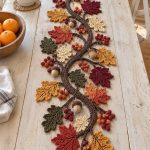
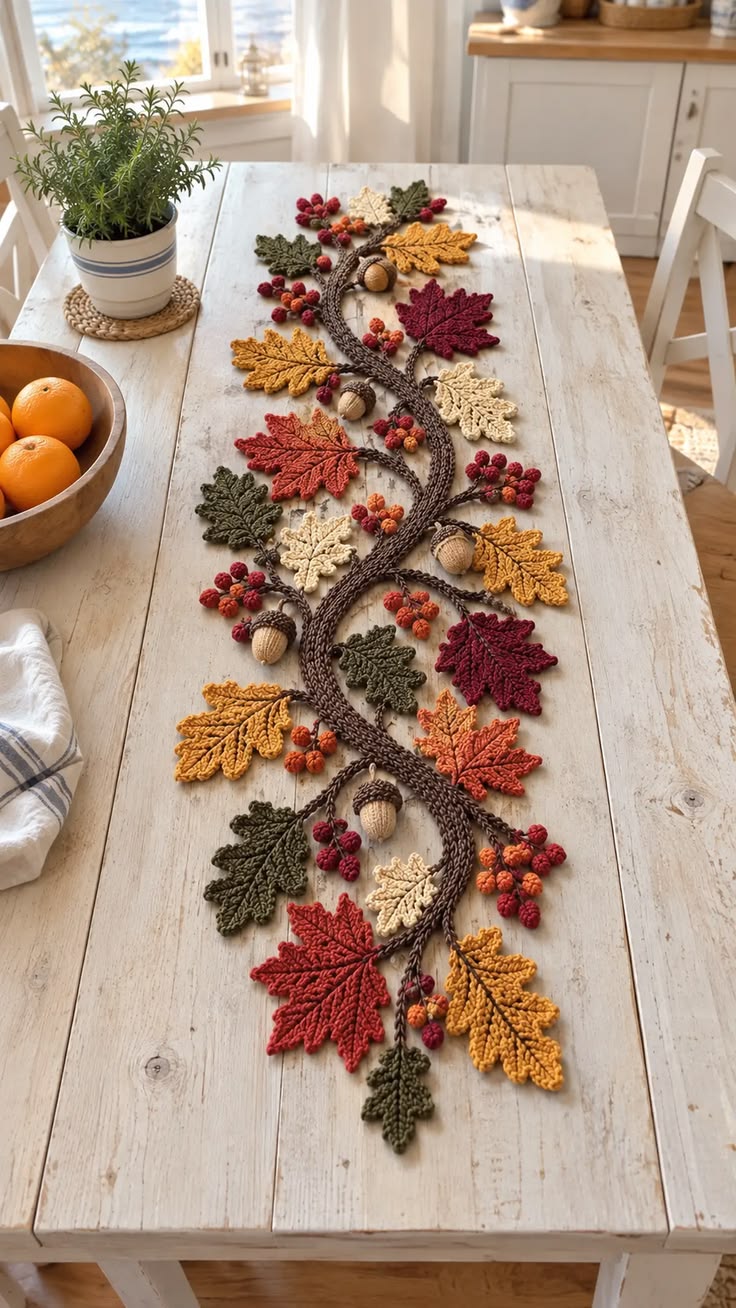
Maple points, oak lobes and acorn caps prevent this runner from becoming a row of interchangeable crochet leaves. This crochet autumn leaf garland combines a branching brown vine with maple-style leaves, oak leaves, stuffed acorns and berry clusters. DK yarn with a 3.5–4 mm hook produces crisp decorative motifs. Make the vine to fit the table first, then position the individual elements before permanent attachment.
The Design: What Makes This Autumn Garland Different
The central vine provides the structure, but asymmetry gives the arrangement its natural branching shape. Rather than attaching leaves at equal intervals, short side branches alternate between large leaves, smaller oak leaves, acorns and berry clusters.
Color distribution is equally important. Burgundy and rust provide the darkest focal points, mustard supplies the brightest leaves, olive breaks up the warm palette, and cream prevents the crochet fall table runner from becoming visually dense. Brown is reserved for stems, branches and acorn caps.
The most common construction mistake is attaching every motif as soon as it is finished. That makes spacing difficult to correct. Crochet all major components first, lay the complete crochet autumn garland on the table, and attach the pieces only after the composition has been checked from end to end.
Project Info at a Glance
| Skill Level | Construction | Leaf Size | Hook | Best For |
|---|---|---|---|---|
| Intermediate | Separate motifs attached to a branching vine | Approximately 7–12 cm for larger motifs | 3.5–4 mm recommended starting range | Dining tables, consoles and autumn displays |
The final runner length is adjustable. Measure the usable center length of your table and make the main vine approximately 15–25 cm shorter than that measurement if you want clear space at both ends.
Materials and Tools
Yarn
- Dark brown DK yarn — approximately 60–100 g for the vine, branches, stems and acorn caps.
- Mustard DK yarn — approximately 20–30 g for leaves and optional berries.
- Rust / burnt orange DK yarn — approximately 20–30 g.
- Burgundy DK yarn — approximately 20–30 g.
- Olive green DK yarn — approximately 20–30 g.
- Cream DK yarn — approximately 15–25 g for pale leaves and acorn bodies.
- Orange and red yarn scraps — for mixed berry clusters.
Exact yarn consumption changes with runner length and motif count. This design is particularly suitable for using small quantities left from larger DK projects.
Tools
- 3.5 mm crochet hook
- Polyester stuffing for acorns and dimensional berries
- Yarn needle
- Locking stitch markers
- Scissors
- Tape measure
- Blocking pins
- Blocking mat
Abbreviations
- MR — magic ring
- ch — chain
- sl st — slip stitch
- sc — single crochet
- hdc — half double crochet
- dc — double crochet
- tr — treble crochet
- inc — 2 sc in one stitch
- dec — single crochet decrease
- BLO — back loop only
- st / sts — stitch / stitches
Use an invisible decrease for the stuffed acorns and berries by inserting the hook through the front loops of the next two stitches before completing one single crochet.
Crochet Autumn Leaf Garland Pattern
The runner is assembled from separate components. Make the main vine first, followed by the branches, leaves, acorns and berries. Keep long yarn tails on motifs that will be sewn to the vine.
Main Branching Vine
Yarn: dark brown.
The photographed runner uses a thick, irregular central branch rather than a thin hanging-garland cord.
Foundation: Ch until the cord is approximately 20 cm shorter than your desired finished runner length.
Row 1: Starting in the second ch from the hook, sl st in each ch across.
Do not fasten off.
Row 2: Ch 1 and work sc back along the full cord. Work loosely enough that the vine does not curl tightly.
Fasten off with a 20 cm tail.
Make a second cord approximately the same length and place it beside the first. Twist the two cords gently together at irregular intervals. Sew through both layers every 4–6 cm to maintain the thicker branch profile.
Side Branches
Yarn: dark brown.
Make approximately 12–18 side branches in several lengths.
Short branch: Ch 12.
Medium branch: Ch 18.
Long branch: Ch 24.
For each branch, sl st in the second ch from the hook and in every remaining chain.
Fasten off, leaving a 15 cm sewing tail.
Attach branches at irregular intervals rather than opposite one another. Some should curve upward along the runner; others should angle outward to support leaves, berries or acorns.
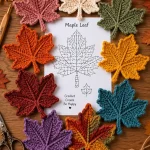
Large Maple-Style Leaf
Make approximately 6–8 in mustard, rust and burgundy.
Round 1: MR, ch 2, work 12 dc into ring. Join with sl st. (12)
Round 2: Ch 1. Work 2 sc in each st around. Join. (24)
The next round creates five pointed sections rather than maintaining a circular shape.
Point 1: Ch 4, sl st in second ch from hook, sc in next ch, hdc in next ch. Skip 1 base st, sl st in next.
Point 2: Ch 6, sl st in second ch from hook, sc in next, hdc in next, dc in next 2. Skip 2 base sts, sl st in next.
Center Point: Ch 8, sl st in second ch from hook, sc in next, hdc in next, dc in next 2, tr in next 2. Skip 2 base sts, sl st in next.
Point 4: Repeat Point 2.
Point 5: Repeat Point 1.
Use slip stitches across any remaining base stitches to return to the lower center.
Stem: Ch 8. Sl st in second ch from hook and across. Sl st into the base of the leaf.
Fasten off with a 20 cm tail.
Block the leaf before assembly. Pin the five tips individually so the points remain distinct.
Oak-Style Leaf
Make approximately 7–10 in olive, cream and mustard.
Foundation: Ch 16.
Beginning in the second ch from the hook:
Side 1: Sl st, sc, hdc, dc, then work (dc, tr, dc) into the next chain to create the first lobe.
Sc in next 2 chains.
Work (dc, tr, dc) in next chain for the second lobe.
Sc in next 2 chains.
Work (hdc, dc, tr, dc, hdc) into the next chain for the upper lobe.
Continue toward the tip with sc stitches.
Tip: Work (sc, ch 2, sc) in the final chain.
Rotate the work and crochet into the unused loops on the opposite side of the foundation chain.
Mirror the lobe sequence down the second side.
Sl st at the base.
Stem: Ch 6. Sl st in second ch from hook and in each remaining chain.
Fasten off with a 20 cm sewing tail.
The oak leaves should remain narrower than the maple-style leaves. Pin each lobe during blocking to prevent the outline from collapsing into an oval.
Cream Accent Leaf
Make 3–5.
Use the oak-style leaf instructions with cream yarn but reduce the foundation to ch 13.
Remove one sc between each major lobe to compensate for the shorter foundation.
These smaller pale leaves function as visual breaks between burgundy, orange and mustard motifs.
Acorn Body
Make approximately 4–6 in cream or tan.
Work in continuous rounds.
R1: 6 sc in MR. (6)
R2: Inc ×6. (12)
R3: (1 sc, inc) ×6. (18)
R4: Sc around. (18)
R5: Sc around. (18)
R6: Sc around. (18)
R7: (1 sc, dec) ×6. (12)
Stuff firmly enough to hold the oval shape without stretching the stitches apart.
R8: Dec ×6. (6)
Fasten off and close the remaining opening.
Acorn Cap
Make one dark-brown cap for each acorn.
R1: 6 sc in MR. (6)
R2: Inc ×6. (12)
R3: (1 sc, inc) ×6. (18)
R4: BLO sc around. (18)
R5: Sc around. (18)
Sl st and fasten off with a 25 cm sewing tail.
Place the cap over the wide end of the stuffed acorn and sew it through both layers around the lower edge.
Stem: Join brown yarn at the top of the cap, ch 5, sl st back along the chain and fasten off.
Small Crochet Berry
Make approximately 30–45 berries using burgundy, red and burnt orange.
R1: 6 sc in MR. (6)
R2: Inc ×6. (12)
R3: Sc around. (12)
Add a very small amount of stuffing.
R4: Dec ×6. (6)
Fasten off and close the opening.
Leave a 12–15 cm tail for attaching the berry to a cluster.
Berry Clusters
Arrange 3–5 berries in each cluster. Mix burgundy and orange in some groups rather than making every cluster a single color.
Cut three strands of brown yarn approximately 15 cm long.
Attach one berry to the end of each strand. Twist or lightly braid the upper sections together, then sew the combined stem to a side branch.
For larger clusters, add another one or two berries on shorter brown stems.
Assembly
- Place the completed brown vine down the center of the table and shape it into a loose S-curve.
- Attach the side branches at irregular intervals, alternating their direction along the main vine.
- Position the largest maple-style leaves first, leaving approximately 12–18 cm between major focal leaves.
- Add olive and cream oak leaves between the larger colored motifs to fill open sections without covering the vine.
- Sew each leaf through its stem and lower center only; leave the outer lobes free so the motifs retain dimension.
- Position the stuffed acorns beside branch junctions rather than at every branch tip.
- Add berry clusters to the remaining short branches, varying clusters between three and five berries.
- Turn several leaves 20–40 degrees away from the vine axis so the arrangement does not form two rigid parallel rows.
- Weave all visible yarn tails into the back of the motifs and trim only after checking the complete arrangement.
- Lay the runner flat and make final adjustments so no large leaf or acorn sits directly beneath a plate, serving dish or hot cookware.
The completed runner should form one continuous branching line with alternating large leaves, smaller leaves, acorns and berry clusters rather than a symmetrical repeating sequence.
7 Technical Tips for the Autumn Crochet Runner
- Block pointed leaves before sewing. A maple point that curls by more than 1–2 cm can disappear beneath the adjacent lobes once the motif is attached.
- Keep the central vine flexible. Overly tight slip stitches can make the cord coil, so move up 0.5 mm in hook size for the vine if it refuses to lie flat.
- Stuff the acorns in stages. Packing all the filling into the final round can produce a spherical nut instead of the elongated approximately 4 cm acorn profile.
- Do not overstuff berries. A berry only needs enough filling to prevent collapse; visible gaps between stitches indicate excessive stuffing.
- Pin every large leaf before sewing. Keep at least 2–3 cm of visible vine between neighboring large motifs to prevent the branch structure from disappearing.
- Vary branch angles. Repeated 90-degree branches make the runner resemble a ladder; angles between roughly 30 and 70 degrees create the irregular structure visible in the reference design.
- Weave attachment tails along the vine. Run each tail through at least 4–5 cm of dense brown stitches before trimming so repositioning the runner does not loosen individual motifs.
Adjusting the Garland to Your Table
Measure the table length before making the central vine. For a runner contained entirely on the tabletop, subtract approximately 20–30 cm from the full table length. A 180 cm table, for example, can use a central arrangement around 150–160 cm long.
Width should come primarily from the leaves and side branches rather than a wide central structure. Large leaves can project approximately 8–12 cm from each side of the vine, producing a decorative band about 20–30 cm wide.
For a narrower dining table, reduce the number of large maple leaves and use more small oak leaves. On a wide farmhouse table, increase branch length instead of simply adding more motifs to the central cord.
Color Placement
Do not work through the colors in a fixed mustard-orange-red-green sequence. Place one dark burgundy leaf near each third of the runner, then distribute mustard and rust leaves between them. Olive leaves work well beside red berry clusters, while cream leaves provide separation where several saturated colors meet.
The acorns should remain neutral. Cream or light tan bodies with dark brown caps connect them visually to the brown vine without competing with the leaf colors.
Before sewing, photograph the entire arrangement from directly above. The image makes repeated colors, accidental symmetry and empty areas easier to identify than viewing the runner from normal seated height.
Conclusion
Build this runner from the branch outward rather than treating it as a fixed sequence of motifs. Measure the table, crochet the brown vine to the required length, complete all leaves and acorns, and arrange every component before sewing. That order gives you control over spacing and keeps the larger maple leaves from obscuring the smaller oak leaves and berry clusters. Pin this crochet autumn leaf garland for the next fall decorating project and share the finished table arrangement on Instagram with #AutumnLeafTableGarland. For the photographed palette, would you make the largest focal leaf burgundy, burnt orange or mustard? “`1