Introduction
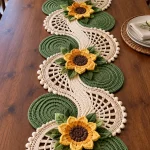
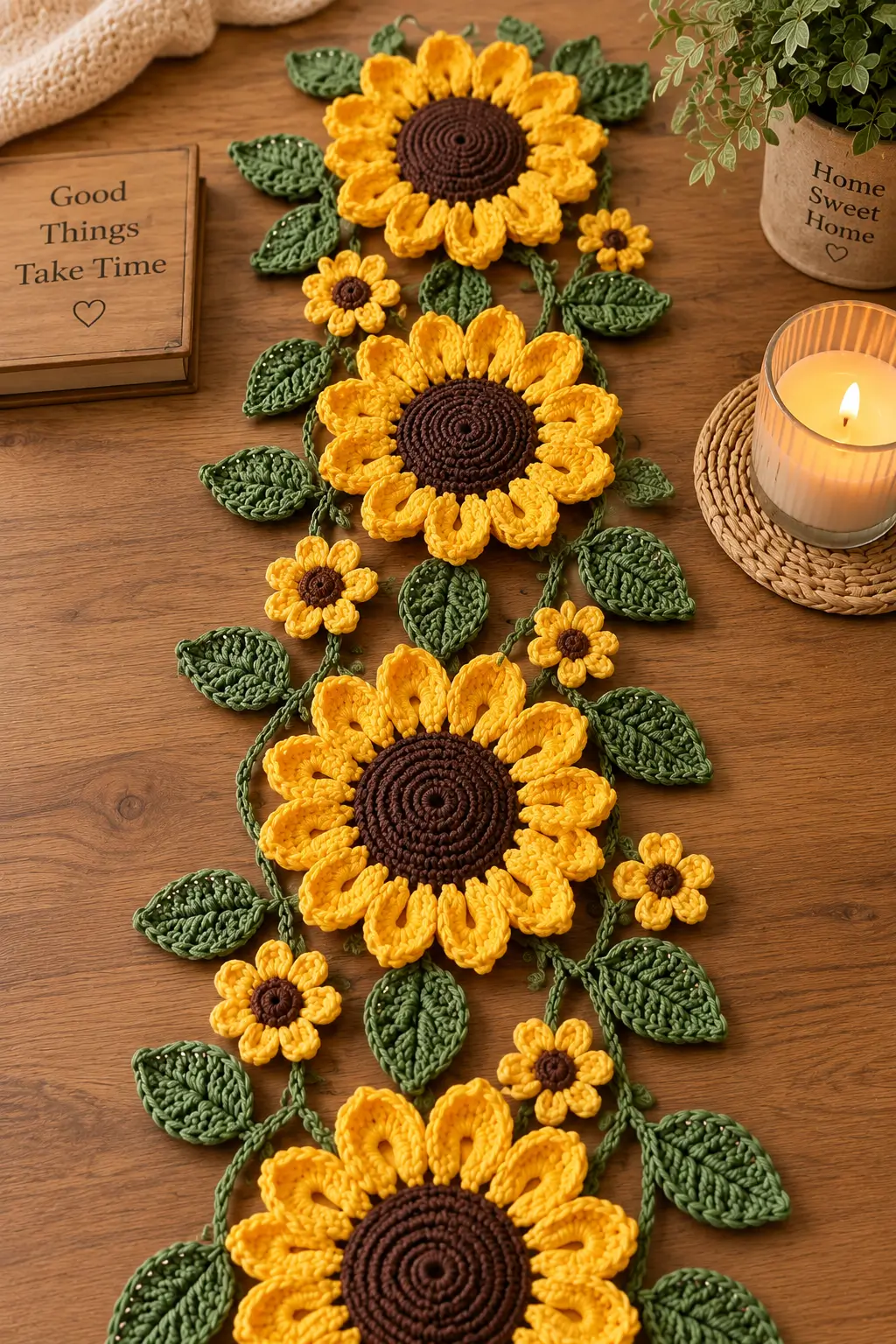
Four oversized brown disks surrounded by twelve folded golden petals establish the scale of this botanical runner. This 3D sunflower crochet table runner pattern uses worsted-weight cotton, a 4 mm hook, large and small flowers, pointed olive leaves, and crocheted vines. The intermediate reconstruction targets roughly 32 × 145 cm. Modular construction also lets you shorten the runner without recalculating every flower.
The instructions below are an original photo-inspired reconstruction based on visible structure; published patterns cited later are used only for sizing, gauge, and material benchmarks.
The Design: What Makes This Sunflower Runner Different
The photograph has no rectangular foundation. Instead, four large sunflowers form a loose center line while smaller flowers, paired leaves, and curved green cords fill the spaces between them. Each major flower needs a broad, flat brown disk because that dark center visually separates twelve folded petals and prevents the yellow sections from collapsing into one ring. Pointed leaves use an exact chain foundation with a central vein, while narrow vines connect motifs without covering the tabletop. This 3D sunflower crochet table runner pattern therefore behaves more like botanical appliqué assembly than a conventional crochet table runner. One frequent construction error is sewing every leaf and petal flat. The photographed design depends on free petal tips and partially unattached leaves, so only their structural bases should be secured.
Project Info at a Glance
| Skill Level | Time | Finished Size | Hook | Best For |
|---|---|---|---|---|
| Intermediate | Reconstruction estimate: 14–18 hours | Reconstruction target: approx. 32 × 145 cm | 4 mm | Dining tables, coffee tables, consoles, autumn displays |
The dimensions above are inferred from the photograph rather than measurements of an identified original. For comparison, Raine Eimre’s published filet sunflower runner measures about 18 × 8.5 inches and uses size-10 cotton thread with a 1.75 mm hook. StitchAndGlamBy Kiana publishes an intermediate sunflower runner using a 4 mm hook and acrylic yarn, which provides a closer hook-size benchmark for this heavier dimensional reconstruction.
Materials and Tools
Yarn
- Golden sunflower yellow — worsted #4 cotton or cotton blend — reconstruction allowance: 220–270 g
- Dark chocolate brown — worsted #4 — reconstruction allowance: 100–130 g
- Olive green — worsted #4 — reconstruction allowance: 180–230 g
Use a smooth yarn with clear stitch definition. The photographed petals hold a pronounced fold, so very soft chenille is a poor substitute. Mercerized or tightly spun cotton produces especially crisp leaves, while ordinary matte cotton gives the motifs a less reflective surface.
Tools
- 4 mm crochet hook
- Tapestry needle
- Sharp scissors
- Stitch markers
- Blocking mats
- Rust-resistant pins
- Measuring tape
Abbreviations
- MR — magic ring
- ch — chain
- sl st — slip stitch
- sc — single crochet
- hdc — half double crochet
- dc — double crochet
- tr — treble crochet
- inc — two stitches in one stitch
- sp — space
- st/sts — stitch/stitches
- BLO — back loop only
An invisible decrease works through the front loops of two adjacent stitches before completing one single crochet; these motifs are flat and do not require decreases.
Motif Plan
For the photo-inspired layout, make:
- 4 large sunflowers — approximately 24–26 cm diameter after blocking
- 7 small sunflowers — approximately 8–9 cm diameter
- 18 pointed leaves — approximately 9–11 cm long
- 1 main vine assembled from several curved cord sections
- 8–10 short branch stems for leaves and small flowers
The components intentionally overlap. Their individual measurements therefore add up to considerably more than the 145 cm finished runner length.
Pattern — Step by Step
Large Brown Sunflower Center — Make 4
Yarn: dark chocolate brown — original photo-inspired reconstruction.
R1: 6 sc in MR. (6)
R2: Inc ×6. (12)
R3: *Sc in next st, inc.* Repeat ×6. (18)
R4: *Sc in next 2 sts, inc.* Repeat ×6. (24)
R5: *Sc in next 3 sts, inc.* Repeat ×6. (30)
R6: *Sc in next 4 sts, inc.* Repeat ×6. (36)
R7: *Sc in next 5 sts, inc.* Repeat ×6. (42)
R8: *Sc in next 6 sts, inc.* Repeat ×6. (48)
Sl st to the first stitch. Fasten off.
The center increases by exactly six stitches per round, moving from 6 to 48 stitches without breaking the standard flat-circle progression.
Large Sunflower Petal Foundation
Join golden yellow to any stitch of R8.
Petal Foundation Round: *Ch 1, sc in next 4 sts.* Repeat ×12. (48 sc plus twelve ch-1 markers)
The four-stitch sectors divide the 48-stitch perimeter exactly:
48 ÷ 12 = 4 stitches per petal.
Large Folded Petal — Make 12 on Each Flower
Each petal is worked across one four-stitch sector.
From the first stitch of a sector, ch 9.
Starting in second chain from hook work:
Sc, hdc, dc, tr, tr, dc, hdc, sc. (8)
Sl st into the fourth stitch of the same four-stitch sector.
Turn the petal slightly toward the front.
Working into the unused loops on the opposite side of the starting chain, work:
Sc, hdc, dc, tr, tr, dc, hdc, sc. (8)
Sl st at the petal base.
Repeat around for 12 petals.
Fasten off after the final petal. The two-sided chain construction makes each petal thicker than a conventional flat shell and reproduces the folded appearance visible in the image.
Petal Edge Ridge
For stronger definition, join yellow at the base of one petal.
Surface sl st along one side of the petal to the tip and return along the opposite side.
Fasten off.
Repeat for all twelve petals only if the selected yarn is soft enough that the petal edges disappear. A tightly spun cotton generally holds the shape without this additional pass.
Small Sunflower — Make 7
Small Brown Center
R1: 6 sc in MR. (6)
R2: Inc ×6. (12)
R3: *Sc, inc.* Repeat ×6. (18)
Fasten off brown and join yellow.
Six Small Petals
The 18-stitch center divides into six three-stitch petal sectors.
For each petal:
Sl st in first stitch of sector, ch 5.
Starting in second chain work sc, hdc, dc, hdc.
Sl st in third stitch of the same sector.
Repeat ×6.
Fasten off.
Block each small flower to approximately 8–9 cm diameter.
Pointed Olive Leaf — Make 18
Yarn: olive green.
Ch 14.
Starting in second chain from hook, work into the next 12 chains, leaving the final chain unused until the tip:
Sl st in next ch, sc in next 2 ch, hdc in next 2 ch, dc in next 3 ch, tr in next 2 ch, dc in next ch, hdc in next ch. (12)
Work 5 sc into the final chain to turn around the tip.
Working along the opposite side of the foundation chain, mirror the twelve-stitch sequence:
Hdc, dc, tr in next 2 positions, dc in next 3, hdc in next 2, sc in next 2, sl st in final position. (12)
Join at the base.
The foundation math is exact: 12 side stitches + 5 tip stitches + 12 opposite-side stitches = 29 stitches around the leaf body.
Leaf Definition Round
Ch 1.
Sc in next 3 sts.
Hdc in next 4 sts.
Dc in next 5 sts.
At the center of the five tip stitches work:
Sc, ch 3, sl st in first ch, sc around the central tip area.
Mirror the side with dc in next 5 sts, hdc in next 4 sts, and sc in next 3 sts.
Sl st at the base and fasten off with a 25 cm tail.
Leaf Center Vein
Join olive yarn at the leaf base.
Surface sl st along the foundation chain toward the pointed tip.
Fasten off just below the ch-3 point.
Keep the surface stitches loose enough that the leaf remains flat.
Alternative Open Leaf
The photograph includes small openings between some leaf stitches. To reproduce that detail, substitute the definition round with:
*Sc in next 2 sts, ch 1, skip 1 st* along each side, stopping before the pointed tip.
Work the ch-3 point normally, then mirror the spacing on the second side.
Use this version for roughly half the leaves and the solid version for the remainder. Small differences in leaf texture make the botanical arrangement less repetitive.
Main Vine Cord
Make several cord sections rather than one extremely long chain. Separate sections are easier to curve around the flowers.
Long Vine — Make 3
Ch 55.
Starting in second chain from hook, sl st loosely in every chain. (54)
Fasten off with a 30 cm tail at each end.
Medium Vine — Make 4
Ch 35.
Sl st in second chain and each chain across. (34)
Fasten off with long tails.
Short Branch — Make 8
Ch 18.
Sl st in second chain and each remaining chain. (17)
Fasten off.
Steam or wet-block the cords into gentle curves before assembly. Do not stretch them straight.
Optional Curly Tendril — Make 4
Ch 22.
Starting in second chain from hook, work 2 sc in each chain. (42)
The doubled stitch density makes the cord coil naturally.
Fasten off and position one or two curls near the smaller flowers rather than around every major sunflower.
Blocking the Large Sunflowers
Pin the brown disk flat first.
Arrange the twelve petal tips at equal angular intervals.
A twelve-petal flower places a petal approximately every 30 degrees around the circle.
Target a finished diameter of approximately 24–26 cm.
Do not flatten the petal folds completely. Pin only the bases and tips, allowing the central portion of each petal to retain its raised profile.
Blocking the Leaves
Pin each leaf to approximately 9–11 cm long.
Keep the tip sharp and the base narrower than the widest central section.
Check the center vein after pinning. If it draws the leaf into a cup, remove the surface stitches and remake them with looser tension.
Runner Layout
Arrange the four large sunflowers along a loose vertical axis.
Leave approximately 8–12 cm between neighboring flower edges. Bridge those spaces with vines, small flowers, and leaves rather than connecting the large petals directly.
Rotate alternate flowers slightly. The reference is botanical rather than geometrically symmetrical.
A practical order from one end is:
Large sunflower → small flower branch → large sunflower → two small flower branches → large sunflower → small flower branch → large sunflower.
Distribute the remaining small flowers asymmetrically around the outer vine.
Leaf Placement
Place approximately four leaves around each major flower zone, reserving two leaves for gaps near the runner ends.
Point leaves away from the central axis at angles between approximately 25 and 60 degrees.
Do not place every leaf perpendicular to the vine. Alternating the angles creates the flowing arrangement visible in the photograph.
Overlap the leaf base with its branch by approximately 1.5 cm.
Connecting the Main Vine
Place the three long vine sections between successive large flowers.
Overlap cord ends behind a brown center or leaf by approximately 2 cm.
Sew those overlaps securely from the reverse.
Use medium cords to curve around the outer sides of the major flowers. Attach short branches to those curves wherever a small flower or leaf needs support.
Leave some cord sections visible between motifs. Completely covering the vine removes the botanical framework that connects the runner visually.
Attaching Large Sunflowers
Sew through the reverse of the brown center rather than through the yellow petal tips.
Anchor each major flower to the vine at three points: lower center, upper center, and one side connection.
Keep all twelve petal tips free.
If a flower rotates when the runner is lifted, add one additional concealed attachment beneath the opposite side of the brown disk.
Attaching Small Sunflowers
Position each small flower over the end of a short green branch.
Sew the brown center to the branch at three points.
Do not sew through the yellow petal tips.
Angle neighboring small flowers differently so their petals do not form rigid horizontal rows.
Attaching Leaves
Sew the lower 15–20 mm of each leaf to its branch.
Add one hidden stitch through the center vein approximately 2 cm above the base if additional stability is needed.
Leave the outer half of the leaf unattached.
This lets the pointed end lift slightly from the tabletop while the runner remains stable.
Assembly
- Crochet four 48-stitch brown centers and add exactly twelve golden folded petals to each, keeping the four-stitch petal sectors consistent around every flower.
- Make seven small six-petal sunflowers with 18-stitch brown centers and block them to approximately 8–9 cm diameter.
- Crochet 18 olive leaves from the exact 14-chain foundation, add their center veins, and block each motif to approximately 9–11 cm long.
- Make three long, four medium, and eight short vine sections, then block the cords into gentle curves rather than straight lines.
- Arrange the four large sunflowers over an approximately 145 cm central axis, leaving 8–12 cm between neighboring petal edges for connecting foliage.
- Place the long vines between the major flowers and use medium cords around their sides, hiding cord overlaps beneath brown disks or leaf bases.
- Distribute seven small flowers and 18 leaves along the branches, rotating leaves 25–60 degrees from the central vine and preserving visible areas of bare tabletop.
- Sew each large sunflower through three or four concealed points beneath its brown center while leaving every yellow petal tip free.
- Attach small flowers through their centers and leaves through only the lower 15–20 mm, then lift the runner and reinforce any joint that opens more than 5 mm.
- Weave every tail through at least 4 cm of matching crochet, lightly block the complete arrangement to approximately 32 × 145 cm, and reshape all free petals and leaf points.
The completed reconstruction contains four large twelve-petal sunflowers, seven small accent flowers, 18 pointed leaves, and a branching olive vine assembled as one flexible centerpiece.
7 Technical Tips
- The sunflower petals crowd one side: divide the 48-stitch center into twelve four-stitch sectors before attaching yellow yarn. Missing one sector shifts every subsequent petal and leaves an obvious gap near the final join.
- The brown center cups upward: verify the progression of 6, 12, 18, 24, 30, 36, 42, and 48 stitches. A missed increase reduces circumference and cannot be corrected reliably by stretching the disk during blocking.
- The petals look flat instead of folded: work both sides of the nine-chain petal foundation and pin only its base and tip. Pressing the complete petal flat removes the raised channel visible down its center.
- The leaf twists around its vein: make the surface slip stitches looser than the surrounding fabric. A vein shortened by even 5 mm can pull a 10 cm leaf into a permanent cup.
- The runner kinks between flowers: overlap adjoining vine sections by approximately 2 cm behind a motif. Joining two cord ends at a single point creates a hinge rather than a continuous botanical line.
- The large flowers rotate during handling: anchor each brown disk at a minimum of three separated points. One central stitch acts as a pivot and allows a 25 cm flower to turn independently from the vine.
- The finished runner becomes too dense: maintain approximately 8–12 cm between neighboring large petal edges before adding branches. Filling every gap with leaves removes the negative space that distinguishes the free-form runner from a solid rectangular mat.
Why the Large Flowers Use Twelve Petals
The supplied image shows broad individual petals rather than the dense narrow fringe found on realistic sunflower patterns. Twelve provides enough repetition to make the flower circular while keeping each petal visually separate.
The stitch math also works cleanly. A 48-stitch center divides into twelve four-stitch attachment sectors with no remainder. Each sector therefore receives one folded petal, eliminating the need to squeeze an additional petal into the final stitches.
Published sunflower appliqués vary widely in scale and petal construction. A current worsted-weight appliqué benchmark measures approximately 9–10 cm across with a 3.5–4 mm hook, demonstrating how substantially the oversized petals in this reconstruction increase the final diameter.
Published Sunflower Runner Benchmarks
Raine Eimre’s established Sunflower Table Runner uses size-10 cotton thread, a 1.75 mm hook, and approximately 183 m / 200 yards. Its published dimensions are about 18 inches long × 8.5 inches wide. The construction is filet crochet, so it provides a useful comparison for runner dimensions but not for the dimensional motif technique used here.
StitchAndGlamBy Kiana’s 2025 Sunflower Table Runner uses a 4 mm hook and acrylic yarn. The published materials specify approximately half a skein of brown, one skein of yellow, one skein of green, and two skeins of white. Its intermediate classification and 4 mm hook are closer to this reconstruction’s working scale.
Published Sunflower Appliqué Benchmark
A current sunflower appliqué listing specifies worsted/category-4 yarn with a 3.5–4 mm hook. Its blocked diameter is approximately 9–10 cm, including a 4–4.5 cm center and petals roughly 2.5–3 cm long.
That size aligns closely with the seven small accent flowers used here. The four major flowers are intentionally much larger because they establish the runner’s central structure rather than functioning as small appliqués.
Published Large Sunflower Size Comparison
A contemporary handmade sunflower runner listing documents sunflower motifs with an approximately 14-inch circumference and an overall runner measuring about 47 × 18 inches. Although its construction differs from this reconstruction, it demonstrates how large floral motifs can determine the width of an open botanical centerpiece.
The supplied photograph uses the same general strategy: large flower heads define the maximum width while leaves and vines occupy narrower connecting spaces.
Why There Is No Background Mesh
Adding a mesh rectangle would fundamentally change the supplied design. The visible wooden tabletop acts as negative space between flowers and leaves.
Green cords perform the structural role normally assigned to a mesh foundation. They connect the components while remaining narrow enough that individual botanical shapes stay readable.
This also makes the runner easier to resize. Removing one major flower and its adjacent branch changes length without requiring a new foundation-chain calculation.
Why the Centers Stay Flat
The brown disks should provide visual depth through concentric stitch rounds, not stuffing.
A raised stuffed center would make glasses, bowls, or candles less stable if placed over the runner. Flat centers also give the large flowers a broad surface for concealed assembly stitches.
If more texture is wanted, work alternate brown rounds in BLO. That produces shallow concentric ridges without increasing the physical height significantly.
Why the Petal Tips Remain Free
Sewing every yellow petal to the vine would make the flowers read as flat appliqués.
Attach only the brown center. The petals can then overlap leaves, curl slightly upward, and cast small shadows between neighboring sections.
This construction also makes blocking easier because individual petals can be reshaped after the runner has been washed.
Making a Three-Sunflower Runner
For a shorter coffee-table version, make three large flowers, five small flowers, and 13–14 leaves.
Use two long vine sections and approximately three medium sections.
A practical reconstruction target is approximately 30–32 × 105–115 cm.
Keep the large flower diameter unchanged. Reducing motif size instead of motif count alters the proportions visible in the reference.
Making a Five-Sunflower Runner
Add one large sunflower, two small flowers, and approximately four leaves.
Extend the main vine with another 55-chain section.
With the same 8–12 cm spaces between major flowers, the finished length should increase by approximately 30–35 cm.
Pin the complete arrangement before joining because petal overlap changes the exact measurement.
Making Smaller Large Flowers
Stop the brown disk after R7 at 42 stitches.
Because 42 does not divide evenly into twelve whole-number sectors, switch to 14 petals with three stitches per sector rather than forcing twelve petals around the edge.
For a visually similar twelve-petal flower, the cleaner option is to stop at R6 with 36 stitches and assign three stitches to each petal.
Maintain exact divisibility whenever changing the center size.
Making Larger Large Flowers
Continue the brown disk:
R9: *Sc in next 7 sts, inc.* Repeat ×6. (54)
R10: *Sc in next 8 sts, inc.* Repeat ×6. (60)
For twelve petals, divide the 60-stitch edge into five-stitch sectors.
Increase each petal foundation from ch 9 to ch 11 and use a longer sequence such as sc, hdc, dc, tr, tr, tr, dc, hdc, sc, sl st along the chain.
Make one test flower before changing all four motifs.
Changing the Leaf Size
For smaller leaves, ch 11. Starting in the second chain, work into the next nine chains while leaving the final chain for the turn: sl st, sc, sc, hdc, hdc, dc, dc, hdc, sc. Work 3 sc in the final chain and mirror the nine-stitch sequence along the opposite side.
For larger leaves, extend the foundation to 18 chains and add stitches symmetrically on both sides. Never consume the final chain before working the turning stitches at the tip.
Using Rust or Cream Accents
The photographed runner is restricted to yellow, brown, and olive, but the modular construction supports controlled color substitutions.
Replace two or three small yellow flowers with cream or rust while retaining brown centers. Keep all four major sunflowers golden so the central rhythm remains consistent.
If changing leaf colors, use the alternate shade on no more than one-third of the 18 leaves to avoid breaking the continuous vine effect.
Correcting a Wavy Brown Center
Place the disk on a flat table before adding petals.
Repeated waves indicate excess circumference. Count backward through the increase sequence until the first incorrect round appears.
The required totals are 6, 12, 18, 24, 30, 36, 42, 48. Correct the stitch count rather than attempting to flatten a ruffled center under heavy blocking.
Correcting a Cupped Brown Center
Cupping usually indicates a missing increase or excessively tight tension.
First confirm all round totals. If they are correct, remake the center with a 4.5 mm hook or loosen the working tension while retaining the 4 mm hook for the petals.
A center that already forms a bowl will pull the yellow petal bases inward.
Correcting Unequal Petals
Every major petal begins with the same nine-chain foundation and contains eight return stitches per side.
Count those stitches before moving to the next sector.
If one petal is visibly shorter, remake it immediately. Blocking can correct a few millimeters of tension variation but should not be used to disguise a missing treble or chain.
Correcting a Twisted Leaf
Confirm that the first side contains exactly 12 stitches before the five single crochets at the tip.
The opposite side must also contain 12.
An unbalanced foundation is the most common cause of a leaf rotating toward one side. If both counts are correct, inspect the surface vein and loosen it before remaking the complete leaf.
Correcting an Unstable Runner
Lift the assembled piece from one end and watch every connection.
A joint that rotates or opens more than 5 mm needs reinforcement.
Add concealed stitches beneath a nearby leaf base or flower center instead of sewing through an exposed petal. Several short distributed joins provide better stability than one heavily stitched connection.
Yarn Planning
Complete one large sunflower, one small sunflower, and two leaves before buying final quantities when possible.
Weigh each blocked sample. Multiply the major flower weight by four, the small flower weight by seven, and the average leaf weight by 18.
Add the estimated vine requirement and then another 10–15% for swatching, tails, joining, and tension differences. This method is more dependable than calculating from the runner’s rectangular footprint because most of that footprint is empty tabletop.
Care and Storage
Follow the care label for the chosen yarn. Hand washing is practical for a heavily dimensional cotton centerpiece because it reduces friction on free petal edges.
Support the runner along its length while wet rather than lifting it by one sunflower. Dry flat and reshape all petals and leaf tips before the fabric sets.
For storage, roll the runner loosely around a clean cardboard tube or fold only through open vine sections. Avoid pressing a hard fold through a brown center or across a pointed leaf.
Sources
Ravelry — Sunflower Table Runner by Raine Eimre — published 18 × 8.5 inch size, 1.75 mm hook, size-10 cotton thread, 183 m yardage, and filet-crochet construction.
HandmadebyRaine — Sunflower Table Runner — designer’s free project page documenting the 1.75 mm hook, thread choice, finished dimensions, and blocking method.
Ravelry — Sunflower Table Runner by StitchAndGlamBy Kiana — intermediate sunflower runner using a 4 mm hook, acrylic yarn, and separate brown, yellow, green, and white quantities.
LoveCrafts — Sunflower Table Runner by StitchAndGlamByKiana — current published materials and 4 mm hook benchmark for a heavier-yarn sunflower runner.
Etsy — Beginner Crochet Sunflower Appliqué — category-4 yarn, 3.5–4 mm hook, 9–10 cm diameter, and 4–4.5 cm center benchmark.
Puqqu — Crochet Sunflower Table Runner — dimensional sunflower, leaf, stem, and table-runner construction reference.
Etsy — Handmade Crochet Sunflower Table Runner — contemporary large-flower runner measuring approximately 47 × 18 inches with documented sunflower sizing.
Etsy — Crochet Sunflower Table Runner Pattern — current modular sunflower-and-leaf runner reference with adjustable sizing.
Conclusion
The runner depends on separation between four large flower heads, not on filling every centimeter with crochet. Keep each 48-stitch brown center flat, divide its perimeter into twelve equal petal sectors, and leave the folded yellow tips free after assembly. Block the leaves and vines before arranging the final 145 cm composition. Your next step is to make one complete large sunflower and confirm a 24–26 cm blocked diameter before calculating the remaining yarn. Save this 3D sunflower crochet table runner pattern to Pinterest or share the finished piece on Instagram with #GoldenSunflowerVineRunner. Would you keep all eighteen leaves olive green or replace a few with muted autumn rust? “`0