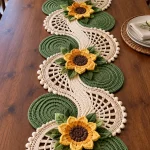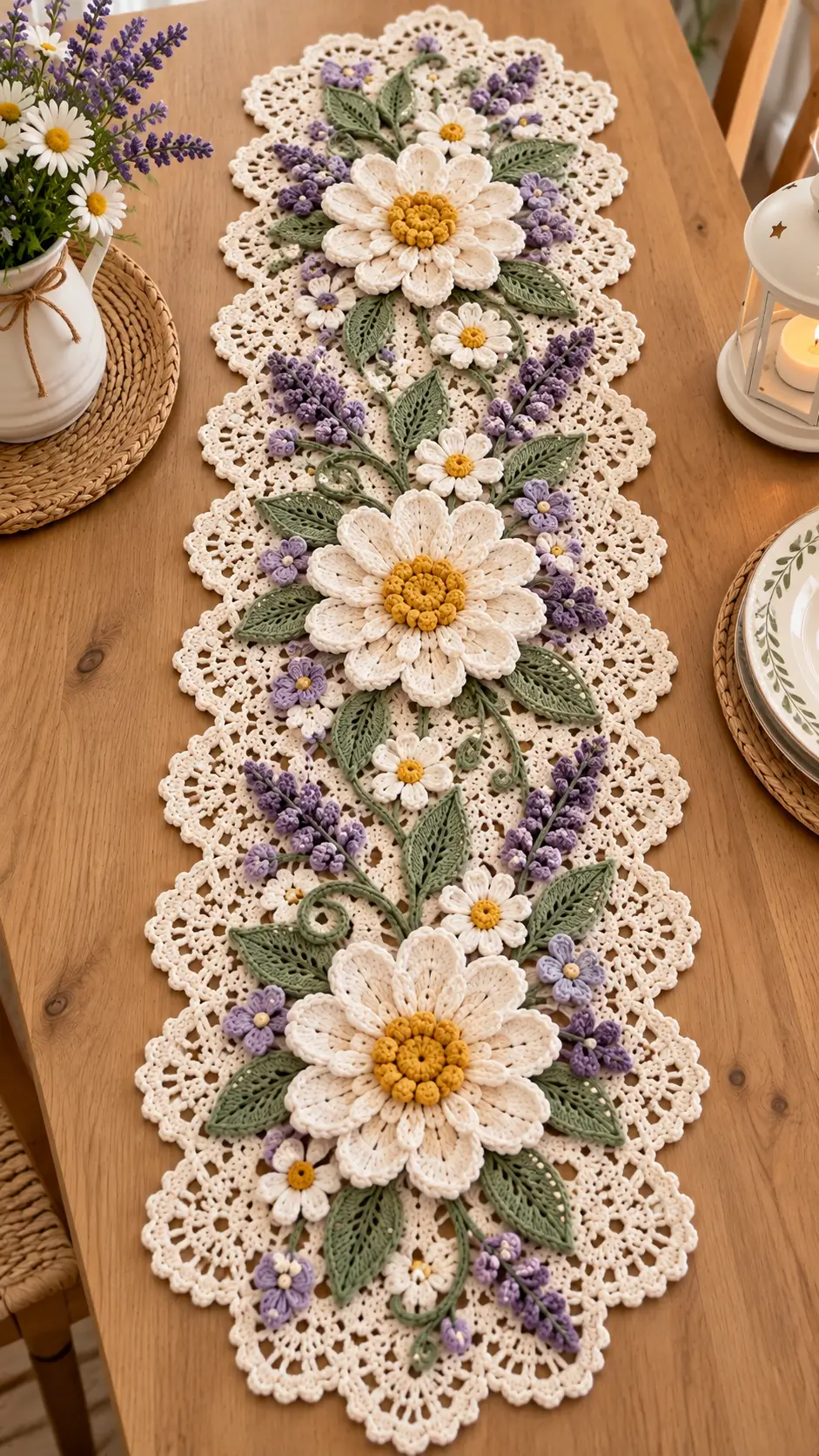
A daisy needs a flat radial petal structure, but this runner needs those petals to rise above lace without pulling the base inward. This crochet daisy table runner pattern uses size-10 cotton, a 1.75 mm hook and layered floral appliqués to produce an approximately 115 × 34 cm runner. The project is intermediate level. Separate motifs make damaged or stained flowers replaceable without rebuilding the lace foundation.
The Design: What Makes This Daisy Runner Different
The main daisies are constructed as separate layered motifs rather than being worked directly into the runner. That decision keeps the lace base flat and allows the petals to overlap naturally without transferring their tension into the openwork fabric.
A second structural choice concerns the foliage. Long leaves and narrow lavender spikes run diagonally rather than directly across the runner, breaking up the strong center line created by the three large flowers. The floral crochet table runner therefore reads as one continuous botanical arrangement instead of three disconnected medallions.
Finally, curled green stems occupy spaces where another flower would make the surface too dense. A common error in a 3D crochet daisy pattern is attaching every petal edge. That flattens the flower. Stitch only the center and inner petal bases so the outer edges remain raised.
Project Info at a Glance
| Skill Level | Time | Finished Size | Hook | Best For |
|---|---|---|---|---|
| Intermediate | 18–26 hours | Approx. 115 × 34 cm | 1.75 mm | Dining and console tables |
The 115 cm finished-length target provides enough room for three large dimensional daisies, secondary flowers, lavender sprigs and foliage while maintaining visible sections of the lace foundation.
Materials and Tools
Yarn
- Warm cream — size-10 mercerized cotton — approximately 180 g — for the lace runner.
- Natural white — size-10 cotton — approximately 45 g — for large and small daisy petals.
- Sage green — size-10 cotton — approximately 30 g — for leaves and curling vines.
- Lavender purple — size-10 cotton — approximately 20 g — for lavender spikes and small flowers.
- Mustard yellow — size-10 cotton — approximately 15 g — for dimensional daisy centers.
- Pale yellow — size-10 cotton — approximately 3–5 g — for small flower centers.
The yarn amounts are practical purchasing estimates. Actual consumption changes with tension, motif quantity and the final length of the runner.
Tools
- 1.75 mm crochet hook
- Blunt tapestry needle
- Fine sewing pins
- Scissors
- Measuring tape
- Blocking mat
- Rust-resistant blocking pins
No stuffing or safety eyes are required for this project.
Abbreviations
- MR — magic ring
- ch — chain
- sc — single crochet
- hdc — half double crochet
- dc — double crochet
- tr — treble crochet
- inc — 2 stitches in one stitch
- sl st — slip stitch
- st/sts — stitch/stitches
- sp — space
- BLO — back loop only
- FLO — front loop only
- picot — ch 3, sl st into first ch
Invisible decrease is not required for these flat botanical motifs; where shaping contracts, stitches are skipped or joined rather than decreased as in stuffed amigurumi.
Pattern — Step by Step
The flower and foliage motifs are worked separately and attached after the lace foundation has been blocked. This construction keeps the base flat and makes the placement of the dimensional elements easier to control.
Lace Runner Base
Yarn: warm cream.
The base is worked back and forth. Ch 103 loosely.
Row 1: Dc in 7th ch from hook, *ch 2, skip 2 ch, dc in next ch* across. Turn.
Row 2: Ch 5, dc in first ch-2 sp, *ch 2, dc in next ch-2 sp* across. Turn.
Row 3: Ch 3, 2 dc in first ch-2 sp, *ch 2, 3 dc in next ch-2 sp* across. Turn.
Row 4: Ch 5, sc in next ch-2 sp, *ch 5, sc in next ch-2 sp* across. Turn.
Repeat Rows 3–4 until the work measures approximately 108 cm before edging. Keep the mesh relaxed so the sides do not contract.
Edging Round 1: Work sc evenly around all four sides, placing 3 sc into each corner.
Edging Round 2: *Skip 2 sts, 5 dc in next st, skip 2 sts, sl st in next st* around, adjusting the final repeat at each corner.
Edging Round 3: Over each shell work *(sc, ch 3, sc) between adjacent dc stitches* to form a pointed lace edge.
Fasten off. Block the foundation to approximately 115 × 34 cm before adding any flowers or leaves.
Large Layered Daisy — Make 3
Yarn: mustard yellow and natural white.
Center R1: With mustard, 6 sc in MR. (6)
R2: Inc ×6. (12)
R3: *(sc, inc) ×6.* (18)
R4: BLO sc around. (18)
Fasten off mustard.
Join white to an unused front loop from R3.
Petal Round 1: *Ch 8, sc in second ch, hdc, 4 dc, hdc, sl st into next FLO.* Repeat around to form 18 narrow lower petals.
For the upper petal layer, join white between center stitches.
Petal Round 2: *Ch 7, sc, hdc, 3 dc, hdc down chain, sl st at center.* Repeat 12 times evenly around.
Fasten off with a 20 cm sewing tail.
For the raised mustard details, join mustard at the center and make 12 compact popcorn-style bumps distributed across R2–R3. Keep the center tension controlled; pulling these stitches too tightly will make the flower cup.
The finished large daisy should measure approximately 14–16 cm after blocking.
Small Daisy — Make 8–10
Yarn: mustard yellow and natural white.
R1: With mustard, 6 sc in MR. (6)
R2: Inc ×6. (12)
Change to white.
R3: *Sl st, ch 5, sc in second ch, hdc, 2 dc, sl st into next center st.* Repeat six times to create six petals.
Fasten off and leave approximately 15 cm for sewing.
Small differences in tension can be used to vary the secondary daisies without altering the stitch structure. This produces a less repetitive arrangement around the three dominant flowers.
Purple Five-Petal Flower — Make 10–14
Yarn: lavender purple and pale yellow.
R1: With pale yellow, 5 sc in MR. (5)
Change to lavender.
R2: In each stitch work *sl st, ch 4, 2 dc in same st, ch 4, sl st in same st.* Repeat around for five petals.
Fasten off.
Each flower should measure approximately 2.5–3.5 cm. Position most of these motifs beside lavender spikes and leaf junctions instead of clustering them around the large yellow centers.
Lavender Spike — Make 10–12
Yarn: sage green and lavender purple.
With sage, ch 24.
Stem Row: Sl st into second ch and every remaining ch. (23)
Fasten off sage.
Join lavender close to the tip of the stem.
Work *ch 4, 3 hdc into second ch from hook, sl st around stem* repeatedly down alternating sides of the stem. Space the clusters approximately 2–3 chain stitches apart.
Keep the upper clusters compact. Increase the spacing slightly as the flowers move toward the lower section of the stem.
Fasten off with a long sewing tail.
Each completed lavender sprig should measure approximately 9–11 cm.
Pointed Leaf — Make 18–24
Yarn: sage green.
Ch 18.
Side 1: Sc in second ch, hdc, 2 dc, 8 tr, 2 dc, hdc, sc.
Work 3 sc into the final chain and continue along the opposite side of the foundation chain.
Side 2: Sc, hdc, 2 dc, 8 tr, 2 dc, hdc, sc.
Sl st at the base.
For a visible central vein, sl st loosely through the back ridge toward the tip or surface-crochet a line after blocking.
Fasten off with approximately 20 cm of yarn remaining for attachment.
The finished leaves should measure approximately 7–9 cm long.
Small Leaf — Make 8
Yarn: sage green.
Ch 11.
Sc in second ch, hdc, 2 dc, 3 tr, dc, hdc, sc. Work 3 sc into the final chain.
Continue down the opposite side and repeat the stitch sequence.
Sl st at the base and fasten off.
Use these smaller leaves where a full pointed leaf would obscure too much of the lace foundation.
Curling Vine — Make 6–8
Yarn: sage green.
Ch 35–45 according to the required finished length.
Work 2 sc into each of the first 12 chains, then one sl st into each remaining chain. Concentrating the increases at one end creates a spiral while leaving the longer stem comparatively straight.
For a tighter curl, work 3 sc in each of the first eight chains instead.
Fasten off with a 25 cm sewing tail.
Tiny White Filler Flower — Make 6
Yarn: natural white and pale yellow.
R1: With yellow, 6 sc in MR. (6)
Change to white.
R2: *Ch 3, hdc in same st, ch 3, sl st in same st* ×6.
Fasten off.
These flowers are optional. Add them only after the main arrangement has been pinned and a small isolated gap remains between leaves or lavender stems.
Assembly
- Block the cream runner base first and allow it to dry completely at approximately 115 × 34 cm.
- Position the three large daisies along the longitudinal center line. Leave substantial sections of lace visible between the flowers.
- Pin each large flower through its mustard center and inner petal bases. Sew the centers securely while leaving most outer petals unattached.
- Add the small daisies between the three main flowers. Rotate each motif so neighboring petals do not form obvious parallel lines.
- Place 18–24 sage leaves diagonally around the large flowers. Stitch along the center vein and lower third of each leaf while leaving the outer edges free.
- Arrange the lavender spikes in groups of two or three. Point the tips away from the closest large daisy to maintain the botanical flow visible along the runner.
- Sew the purple five-petal flowers into smaller open spaces. Maintain approximately 1 cm between their outer petals and the nearest large daisy center.
- Thread the curling vines through the remaining gaps and secure them every 2–3 cm. Avoid sewing every chain directly to the lace.
- Add tiny white filler flowers only where the arrangement leaves an isolated blank section. Weave yarn tails through stitches of the same color on the wrong side.
- Lay the finished runner flat and steam-block from above without pressing directly onto the raised flowers. The lace foundation should remain flat while petals, leaves and lavender clusters retain their dimensional structure.
The finished runner should measure approximately 115 × 34 cm, with minor variation according to thread, hook and individual tension.
7 Technical Tips for a Cleaner Floral Runner
- Watch for runner narrowing. Measure the base every 10 cm. If its width contracts by more than 1 cm, the mesh chains or turning chains are being worked too tightly.
- Correct twisting petals before assembly. A petal that twists sharply at its base usually has an overly tight slip stitch. Leave approximately 1–2 mm of movement at each petal join.
- Keep the large daisy centers flat. Excess tension in the mustard center creates a bowl shape. Block each center into a flat circle before attaching the flowers to the runner.
- Do not sew around the entire leaf. Full-perimeter attachment removes the raised effect. Anchor each leaf along its center vein and approximately the lower 25–35% of its length.
- Control lavender weight. Dense clusters can pull a fine-thread stem into an unwanted curve. Keep each finished sprig around 9–11 cm and distribute the flower clusters along the stem.
- Pin all three large flowers before sewing. Misalignment becomes obvious on a long narrow runner. Keep the three centers close to the longitudinal center line while allowing the foliage to remain asymmetrical.
- Hide contrasting yarn tails inside the appliqués. A sage tail woven through cream openwork can remain visible from above. Carry green and purple tails through matching motifs before making the final anchoring stitches.
Finishing and Blocking
Blocking is particularly important because the project combines two structures with different tension requirements. The cream foundation is open and flat, while the flowers and foliage are deliberately dimensional.
Complete the first blocking stage before assembly. Pin the lace runner to approximately 115 × 34 cm and correct any narrowing along the long edges. Allow it to dry before removing the pins.
Individual leaves and daisy petals can also be lightly blocked before attachment. Do not flatten the raised mustard centers or lavender clusters.
After assembly, perform only a light final blocking. Position the runner on a flat surface, correct the lace border and use steam from above if the chosen cotton permits it. Avoid placing an iron directly against the crochet.
Adjusting the Runner Length
The floral arrangement can be adapted for a shorter console table or a longer dining table without changing the dimensions of the large daisies.
For a shorter runner, stop the foundation once it reaches the required pre-edging length and use two large daisies instead of three. Reduce the secondary flowers and leaves proportionally.
For additional length, continue the established lace repeat before working the border. Add another large daisy only when there is enough space to maintain visible lace between the main motifs.
A useful layout rule is to position the large daisies first, then distribute leaves, lavender and smaller flowers around them. Enlarging the main flowers to fill extra space changes the proportions of the entire botanical arrangement.
How to Arrange the Crochet Flowers
The arrangement should not be completely symmetrical. The three largest daisies establish the central rhythm, but the lavender stems, leaves and small flowers should alternate from one side to the other.
Start by placing the largest daisy near each end of the main decorated area and the third close to the center. Add leaves diagonally beneath them. The foliage acts as a visual transition between the large white motifs and the cream lace.
Next, place lavender clusters in elongated gaps. Their narrow form is useful where another round flower would create excessive visual density.
Use the small purple and white flowers last. These are gap fillers rather than primary motifs. Leaving some uncovered lace is necessary because the openwork background is part of the design rather than simply a support layer.
Conclusion
Block the lace foundation before arranging a single flower because its final dimensions determine the spacing of every appliqué above it. Once dry, pin the three large daisies first, establish the diagonal leaf lines, then fill the remaining spaces with lavender spikes, small flowers and curling vines. That sequence maintains visible openwork while supporting the raised botanical structure. For a longer table, extend the foundation repeat and add floral groups proportionally rather than enlarging individual motifs. Save this crochet daisy table runner pattern to Pinterest and share the finished layout on Instagram with #3DDaisyTableRunner. Which would you repeat more prominently on your runner: the large layered daisies or the narrow lavender spikes?