Introduction
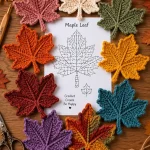
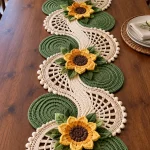
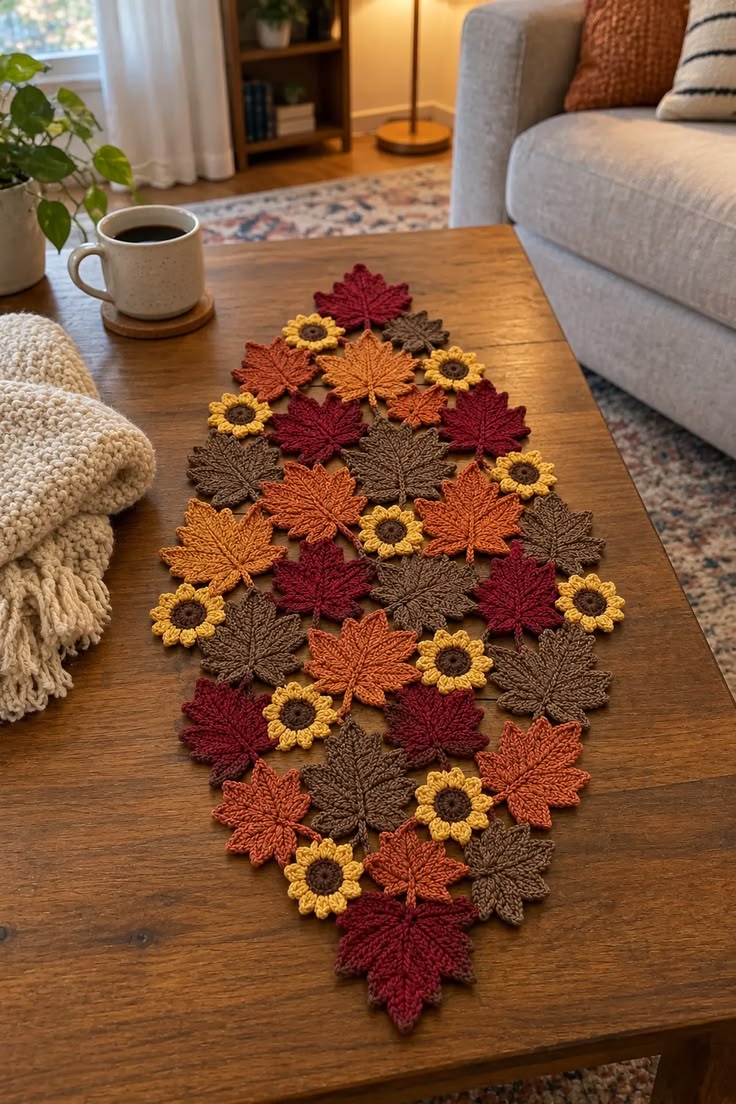
A maple leaf fails visually when its five points collapse into one rounded edge. This autumn maple leaf crochet table runner pattern uses individually shaped leaves in burgundy, burnt orange, mustard and brown, then breaks up the foliage with small yellow sunflowers. Worked as separate motifs and joined afterward, the runner can be lengthened without rebuilding a rectangular foundation. It is an intermediate project designed for autumn table décor.
The Design: What Makes This Autumn Leaf Runner Different
The reference design has no conventional solid background. Instead, overlapping crochet maple leaves create the body of the runner while sections of the tabletop remain visible between motifs. That construction keeps a long arrangement visually lighter than a solid rectangle.
Color performs a structural job as well. Burgundy, orange and taupe leaves are distributed irregularly rather than arranged in stripes. Yellow sunflowers interrupt those darker colors and create smaller circular focal points between the larger five-point leaves.
The third feature is the pronounced leaf veining. Each crochet maple leaf motif needs a defined center ridge and visible side veins; otherwise, the points can resemble a generic star. A common mistake is joining the leaves before blocking them. Curled points become substantially harder to correct after several motifs have been stitched together.
Project Info at a Glance
| Skill Level | Estimated Time | Target Size | Hook | Construction |
|---|---|---|---|---|
| Intermediate | 10–15 hours | Approx. 30 × 110 cm | 4.0–5.0 mm | Joined motifs |
A published autumn leaf table runner provides a useful size benchmark of approximately 20 × 100 cm when worked in DK cotton with a 3 mm hook. The photographed runner is visibly wider because its separate leaves extend beyond the central arrangement, so approximately 30 × 110 cm is a practical target for this reconstruction.
Materials and Tools
Yarn
- Burgundy / wine — DK or light worsted — approximately 60–80 g.
- Burnt orange — DK or light worsted — approximately 70–90 g.
- Taupe / medium brown — DK or light worsted — approximately 70–90 g.
- Mustard yellow — DK or light worsted — approximately 30–40 g.
- Dark brown — DK or light worsted — approximately 15–20 g for sunflower centers and selected joining points.
Cotton or a cotton-rich yarn is particularly suitable for a table runner because blocked leaves retain their points more effectively. Published sunflower appliqué patterns commonly use worsted-weight cotton with hooks between 4 and 5 mm.
Tools
- 4.0–5.0 mm crochet hook
- Yarn needle
- Scissors
- Locking stitch markers
- Tape measure
- Blocking mats
- Rust-resistant pins
Abbreviations
- MR — magic ring
- ch — chain
- sc — single crochet
- hdc — half double crochet
- dc — double crochet
- tr — treble crochet
- dtr — double treble crochet
- sl st — slip stitch
- st/sts — stitch/stitches
- sp — space
- inc — two stitches worked into one stitch
Autumn Maple Leaf Crochet Table Runner Pattern
The runner is constructed from separate maple leaves and sunflowers. Make and block every motif first, arrange the pieces directly on a table or blocking mat, then join them only at selected contact points. There is no rectangular crochet foundation underneath.
Large Maple Leaf — Make 16
Use burgundy, burnt orange and taupe. Distribute the colors irregularly.
R1: MR, ch 3, work 11 dc into ring. Join with sl st. (12)
R2: Ch 1, 2 sc in each stitch around. Join. (24)
The 24-stitch foundation supplies five separate working zones for the maple-leaf points.
First side point: Ch 7. Beginning in second ch from hook, work sc, hdc, dc, tr, dc, hdc. Sl st into the next 2 foundation stitches.
First upper point: Ch 9. Beginning in second ch, work sc, hdc, dc, tr, dtr, tr, dc, hdc. Sl st into the next 2 foundation stitches.
Center point: Ch 12. Beginning in second ch, work sc, hdc, dc, tr, dtr in next 3 chains, tr, dc, hdc, sc. Sl st into the next 2 foundation stitches.
Second upper point: Ch 9. Beginning in second ch, work sc, hdc, dc, tr, dtr, tr, dc, hdc. Sl st into the next 2 foundation stitches.
Second side point: Ch 7. Beginning in second ch, work sc, hdc, dc, tr, dc, hdc. Sl st into the next 2 foundation stitches.
Work sc stitches around the remaining lower section of the circular foundation.
Do not fasten off yet.
Large Leaf Stem
Ch 11 from the lower center of the leaf.
Sl st in second chain from hook and in every remaining chain back toward the leaf.
Sl st into the leaf base.
Fasten off. Leave a 25 cm tail when the leaf will be used as a joining motif.
Defining the Maple Leaf Edges
Rejoin matching yarn at the base of one side point.
Work sc evenly toward the tip. At the final stitch before the point, work hdc. Into the tip work (sc, ch 2, sc). Continue down the opposite edge with sc.
Repeat this edging sequence around all five points.
The ch-2 tips sharpen the silhouette. Do not substitute multiple tall stitches at every tip because excessive fabric causes the points to curl.
Surface Vein for the Large Leaves
Place the leaf right side up.
Using the same color yarn or a slightly darker shade, insert the hook at the base near the stem and surface slip stitch along the center toward the tip of the longest point.
Create one short diagonal vein toward each side point.
Keep every surface stitch relaxed. A tight surface chain shortens the middle of the motif and causes the outer points to lift.
Medium Maple Leaf — Make 8
Use orange, burgundy and taupe.
R1: MR, ch 3, 11 dc into ring. Join. (12)
R2: 2 sc in each stitch around. (24)
Shape five points as follows:
Point 1: Ch 6. Work sc, hdc, dc, tr, hdc back along the chain. Sl st into foundation.
Point 2: Ch 8. Work sc, hdc, dc, tr, tr, dc, hdc back along chain. Sl st into foundation.
Center Point: Ch 10. Work sc, hdc, dc, tr, dtr, tr, dc, hdc, sc. Sl st into foundation.
Point 4: Repeat Point 2.
Point 5: Repeat Point 1.
Sc around the lower section.
Ch 8 for the stem, sl st back along the chain and join at the leaf base.
Fasten off.
Small Maple Leaf — Make 4
The smaller leaves fill narrow spaces between the large motifs without increasing the width of the runner.
R1: MR, 10 hdc into ring. Join. (10)
R2: 2 sc in each stitch. (20)
Create five points with chain lengths of 5, 6, 8, 6 and 5.
For a 5-chain point, work sc, hdc, dc, hdc.
For a 6-chain point, work sc, hdc, dc, tr, hdc.
For the center 8-chain point, work sc, hdc, dc, tr, tr, dc, hdc.
Finish with a 6-chain stem worked back in slip stitches.
Fasten off.
Sunflower — Make 10
Use dark brown for the center and mustard yellow for the petals.
Published sunflower appliqués commonly use worsted-weight yarn and a 4–5 mm hook. Depending on yarn and construction, finished examples measure approximately 7.5–11.5 cm. Make a test flower before producing all 10 motifs.
Center R1: With dark brown, MR, ch 2, work 10 dc into ring. Join to first dc. (10)
Center R2: Ch 1, 2 sc in every stitch around. Join. (20)
Fasten off brown.
Join mustard yellow to any stitch.
Petal: Ch 5. Sc in second chain from hook, hdc in next, dc in next, hdc in final chain. Sl st into the next brown stitch.
Repeat the petal sequence around the center, spacing the petals evenly.
For the compact sunflower proportions visible in the reference photograph, aim for approximately 10–12 petals rather than an extremely dense outer ring.
Fasten off. Leave a 20 cm tail for assembly.
Optional Textured Sunflower Center
For a more pronounced center, join dark brown yarn to the front loops of R2.
Work one small surface sl st into each front loop around the circle.
Alternatively, work loosely spaced French knots with a yarn needle after the flower has been blocked.
The center should remain flatter than the petals so cups and serving dishes can sit near the runner without excessive wobble.
Blocking the Individual Motifs
Blocking is part of the construction rather than a final cosmetic step.
Place each damp maple leaf on a blocking mat. Pin the center first. Pull the longest point into position and pin its tip, then position the four remaining points.
Pin the stem last.
Measure several large leaves from stem base to center-point tip. Keep the variation within approximately 5 mm whenever possible.
Sunflowers need less aggressive blocking. Spread the petals evenly and pin only those that curl significantly.
Allow every component to dry completely before removing the pins.
Color Layout
Do not arrange the colors in strict rows. The reference composition works because neighboring maple leaves frequently differ in color.
Place burgundy leaves at several points along the centerline. Distribute burnt orange leaves around them, then use taupe to separate adjacent warm shades.
Yellow sunflowers should appear intermittently along both sides and through the central area rather than forming a separate stripe.
A practical starting distribution is:
- 7 burgundy maple leaves
- 10 burnt-orange maple leaves
- 11 taupe/brown maple leaves
- 10 yellow sunflowers
The exact count can be changed to fit the table. The important feature is an irregular arrangement with no obvious repeating color sequence.
Arranging the Table Runner
Mark a straight centerline approximately 110 cm long on a blocking mat or temporary fabric surface.
Place one large leaf at each end with its longest point facing outward. These become the visual anchors.
Add large leaves through the central area, rotating each motif approximately 20–60 degrees from its neighbors.
Fill the spaces with medium and small leaves. Allow neighboring motifs to overlap by approximately 1–2 cm.
Insert sunflowers into smaller openings between the leaves.
The runner does not need to form a solid rectangle. Leave small openings where the tabletop can remain visible. Those spaces are a deliberate part of the motif-based construction.
Joining the Maple Leaves
Thread a yarn needle with a matching leaf color.
At every overlap, sew through approximately 2–3 cm of the touching edges. Do not sew around the complete perimeter.
Secure each large leaf at a minimum of two points. Leaves near the middle of the runner may require three connections because they carry more of the finished weight.
Hide joining stitches inside the ridged edges or surface veins wherever possible.
After completing approximately 30 cm of joins, lift that section from the work surface. If a motif rotates or hangs away from the arrangement, add another joining point before continuing.
Attaching the Sunflowers
Place each sunflower over a gap between two or three leaves.
Sew through the outer section of the brown center rather than through every yellow petal.
Attach the flower to at least two neighboring leaves. Three contact points are preferable when the flower bridges a larger opening.
Leave most petal tips unattached. This preserves the dimensional edge visible in the reference design.
After attaching each sunflower, check the reverse side and remove any long exposed yarn carries.
Assembly
- Crochet all large maple leaves in burgundy, orange and taupe.
- Make the medium and small leaves required to fill narrower spaces.
- Add stems and surface veins to every maple leaf.
- Crochet the dark-brown and mustard sunflower motifs.
- Block every leaf and flower individually before joining.
- Arrange two large maple leaves at the opposite ends of the planned runner.
- Fill the center with overlapping leaves, rotating neighboring motifs in different directions.
- Insert sunflowers into selected openings and check the complete color distribution.
- Sew the leaves together at two or three discrete contact points, then attach each sunflower to neighboring motifs.
- Lay the completed runner flat, correct any twisting joins and weave every remaining tail into matching-colored stitches.
The completed runner forms one flexible openwork strip built entirely from connected autumn leaves and sunflower motifs.
7 Technical Tips for Cleaner Maple Leaf Motifs
- Prevent curled leaf points. Pin every point while the motif is damp and keep it pinned until completely dry. A tip that rises more than about 5 mm from the blocking surface will remain noticeable after assembly.
- Avoid tight surface veins. The center vein must follow the existing length of the leaf rather than shorten it. If the motif cups immediately after adding the vein, remove those stitches and work them with less tension.
- Control motif size. Measure the first three large leaves before making the remaining batch. Keep the stem-to-tip measurement within approximately 5 mm so one oversized leaf does not distort the runner width.
- Do not over-sew overlaps. Join neighboring leaves across only 2–3 cm at each contact point. A long rigid seam removes the flexible open structure that distinguishes this runner from a solid crochet panel.
- Stabilize the sunflowers. Connect each flower to at least two leaves through its brown center. Sewing only one petal to the runner allows the entire flower to rotate during washing or handling.
- Check the centerline during assembly. Measure from the runner center to both outer edges every 25–30 cm. A side that becomes more than about 2 cm wider indicates that too many large motifs have accumulated there.
- Hide dark tails carefully. Weave burgundy and brown tails only through matching motifs for at least 5 cm before reversing direction. Dark yarn carried behind a mustard sunflower remains visible through the spaces between petals.
Adjusting the Runner Length
The joined-motif construction makes length changes relatively simple. Do not stretch individual leaves to reach a predetermined measurement. Add or remove complete clusters instead.
For a shorter coffee-table runner, reduce the central arrangement by approximately four to six large leaves and two sunflowers. Keep a prominent maple leaf at each end so the tapered silhouette remains intact.
For a dining-table runner, add another cluster containing two or three large leaves, one medium leaf and one sunflower. Alternate the dominant color of successive clusters to prevent visible repetition.
A published filet-style autumn leaf runner measures approximately 20 × 100 cm using about 100 g of DK cotton and a 3 mm hook, demonstrating how strongly yarn weight and construction affect finished dimensions. A motif runner like this one will generally require substantially more yarn because each leaf is worked as a complete piece.
Choosing Yarn and Hook Size
DK cotton with a 3.5–4 mm hook produces smaller, firmer leaves and is useful when the runner needs to remain relatively narrow.
Worsted cotton with a 4.5–5 mm hook produces larger motifs. Published sunflower appliqués using worsted yarn and a 5 mm hook can measure approximately 4–4.5 inches across, so using that combination for every flower would create a much larger runner than the photograph suggests.
For proportions closer to the image, use the same yarn family for every motif but make the sunflower with a hook approximately 0.5 mm smaller than the one used for the maple leaves.
Make one leaf and one sunflower before buying yarn for the entire project. Block both samples, position them together and check their proportions.
Finishing the Autumn Crochet Table Runner
Lay the assembled runner on a flat surface and check the outline from both ends. Correct any isolated leaf that projects far beyond the surrounding motifs by adjusting its joining point rather than trimming or folding the point. The next practical step is to make one large maple leaf and one sunflower, block both pieces, then calculate the final motif count from their actual measurements.
For Pinterest, photograph the full autumn maple leaf crochet table runner pattern from directly above so the open spaces and color distribution remain visible. A lower Instagram photograph can show the raised veins and overlapping leaf edges. Use #AutumnMapleLeafRunner when sharing the finished project.
For this specific runner, would you use the dark burgundy maple leaves mainly through the center, or distribute them evenly from one end to the other? “`0