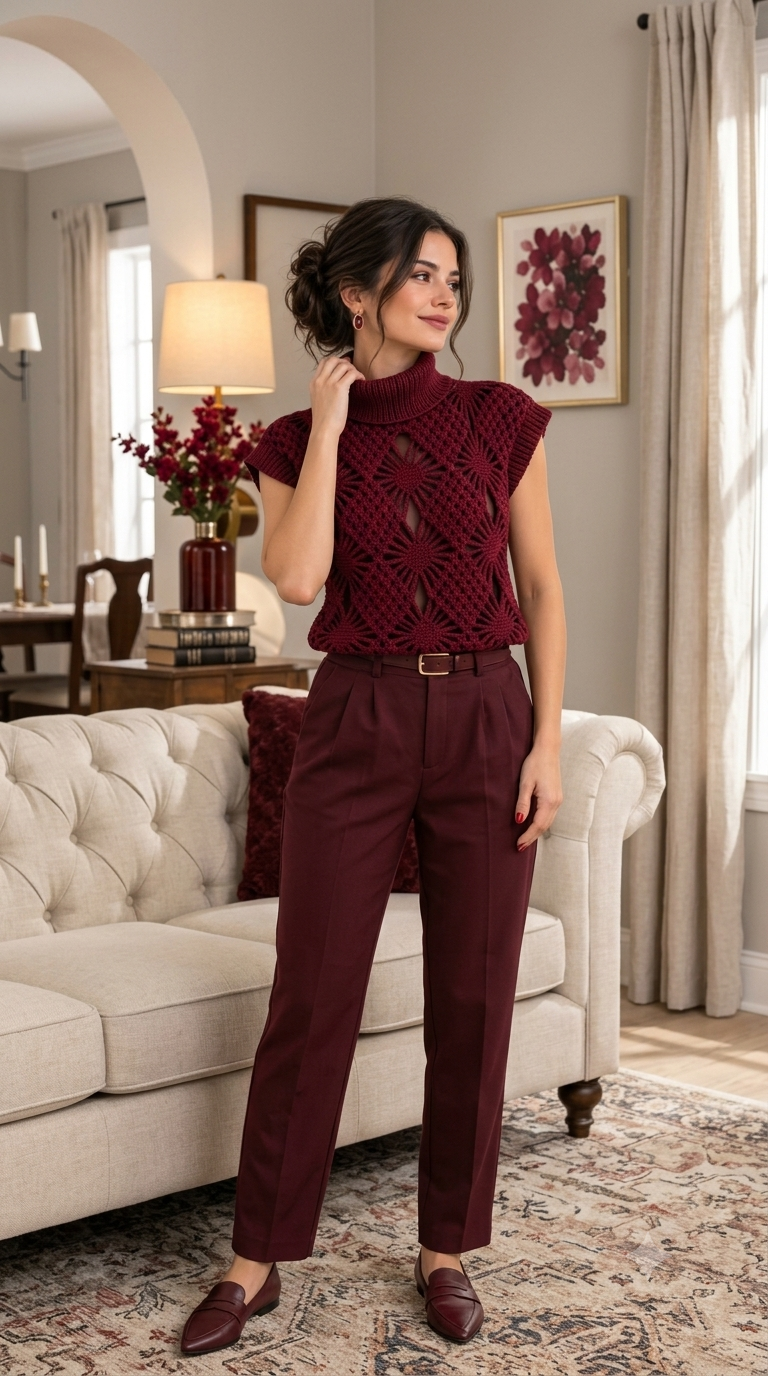
Pineapple motifs create the large geometric openings running vertically through this burgundy top, but the high collar changes how the garment must be balanced. This pineapple lace crochet top combines openwork body panels with a structured neckline, fitted hem, and defined shoulder edges. A DK-weight yarn and approximately 3.5 mm hook provide a useful starting point for this style. The project is best approached at an intermediate skill level.
The Design: What Makes This Crochet Top Different
The main feature is the vertical arrangement of large pineapple-inspired lace motifs. Instead of covering the entire garment with uniform mesh, the design concentrates denser stitches around each motif. This helps the fabric retain structure while preserving the open geometric sections visible through the center.
The second structural feature is the high ribbed collar. A neckline like this needs considerably more stability than the edge of a standard sleeveless crochet top. The shoulder bands also use denser stitching, which visually separates the pineapple stitch crochet top from lightweight halter and summer-tank constructions.
Another important detail is proportion. The largest motifs occupy most of the torso length, so altering the garment length cannot be treated like adding ordinary rows to a solid crochet blouse. One common mistake is changing motif depth without recalculating the surrounding lace. That can distort both the hem and armhole positions.
Project Info at a Glance
| Skill Level | Construction | Suggested Hook | Suggested Yarn | Style |
|---|---|---|---|---|
| Intermediate | Motif/Lace Garment | Approx. 3.5 mm | DK / Light Weight | Sleeveless High-Neck Top |
Important: Hook size and yarn weight above are starting references from comparable pineapple-stitch garments. The exact yarn, gauge, hook size, and stitch counts of the photographed garment cannot be determined from the image alone.
Materials and Tools
Yarn
- Burgundy / deep wine yarn — DK or similar light garment weight
The photograph shows a single dominant yarn color. Select a yarn with enough stitch definition to keep the pineapple sections recognizable. Make a gauge swatch before calculating garment dimensions because the same motif can change substantially when worked with a different fiber or hook.
Tools
- 3.5 mm crochet hook as an initial swatching size
- Tapestry needle for joining and weaving yarn tails
- Stitch markers for motif and side placement
- Measuring tape for garment dimensions
- Blocking pins for opening the lace motifs evenly
- Blocking mat
- Scissors
Abbreviations
- ch — chain
- sc — single crochet
- hdc — half double crochet
- dc — double crochet
- tr — treble crochet
- sl st — slip stitch
- sp — space
- ch-sp — chain space
- st/sts — stitch/stitches
- rep — repeat
- RS — right side
- WS — wrong side
Understanding the Pineapple Lace Construction
A pineapple crochet motif is built by expanding and then contracting groups of stitches around chain spaces. The resulting shape has a broad upper section that gradually narrows toward a point. Repeating that sequence vertically creates the elongated fan-like geometry visible across the photographed top.
This construction behaves differently from solid crochet. Adding one row changes more than length because the chain spaces and stitch groups determine the outline of the motif. For garment work, calculate the dimensions from complete motif repeats rather than treating every row as independently adjustable.
The photograph appears to arrange prominent motifs vertically through the front. Smaller mesh sections connect them and provide enough fabric between the openings to maintain the shape of the torso.
Swatch Before Building the Top
Begin with the yarn you intend to use and make a substantial lace swatch. A small square of solid double crochet will not provide useful measurements because open pineapple lace stretches differently.
Work at least one complete motif repeat. Wash or wet-block the swatch according to the yarn manufacturer’s instructions, lay it flat without excessive stretching, and allow it to dry completely.
Measure the width and height of the finished motif. These two measurements become the basis for determining how many motifs are required across the front and back.
For example, if one blocked motif measures 12 cm wide, four motifs require approximately 48 cm before accounting for side sections or joining areas. This calculation is more reliable than selecting an arbitrary foundation-chain count.
Planning the Front Panel
The front is the visual center of this sleeveless crochet top. Position the motifs symmetrically around the vertical center line before calculating the side sections.
The photographed garment uses prominent geometric openings rather than a uniform all-over lace pattern. That means motif placement needs to be planned as part of the garment dimensions.
Start with the desired finished bust measurement. Add the amount of ease required for the intended fit, then divide the total measurement between the front and back. Compare that figure with the blocked width of the selected motif repeat.
Do not force an additional complete pineapple into a panel simply to reach the required width. Solid or mesh side sections can provide smaller increments and make sizing more precise.
Building the Pineapple Motifs
Work the selected pineapple lace repeat according to its chart or written instructions. Mark the center of each repeat with removable stitch markers during the first several rows.
Maintain identical chain lengths throughout the panel. A chain-five space worked loosely in one repeat and tightly in another changes the apparent width after blocking.
Count the stitch groups at the end of every major motif row. Pineapple patterns often contain several visually similar sections, so an omitted chain space may remain unnoticed until multiple rows have been completed.
After each full motif repeat, lay the work flat and check its alignment. The center points should form a consistent vertical line rather than drifting toward either side.
Back Panel Construction
The back can repeat the front motif arrangement or use a slightly denser interpretation if additional coverage is required. Maintain the same total blocked width so the side seams match.
Keep the shoulder areas structurally stronger than the central lace. Dense shoulder sections carry the weight of the completed garment and reduce distortion around the neckline.
Before finishing either panel, compare the front and back directly. Their armhole depth, shoulder width, and overall length should correspond before joining.
Shaping the Armholes
The armholes in the reference image are relatively clean and structured. They do not appear to use loose scalloped lace as the final edge.
Stop the main body pattern at the calculated underarm position. Reduce the width gradually while maintaining symmetry on both sides. Avoid cutting directly through the center of a large pineapple unless the motif has been designed specifically for armhole shaping.
A denser finishing band can then be worked around the armhole. This stabilizes the openwork fabric and creates the defined shoulder edge visible in the design.
Creating the High Crochet Collar
The high neckline is one of the strongest differences between this garment and a conventional pineapple crochet tank. The lace body needs to transition into a compact, stable neck opening before the collar begins.
Work an even foundation around the completed neckline. Count the stitches and mark the center front, center back, and both shoulder positions.
A ribbed appearance can be produced with back-loop crochet or post stitches. The collar should stretch enough to pass comfortably over the head while returning close to its original circumference.
Test the neckline before extending the collar to full height. A collar that looks correct when lying flat can become too restrictive once several centimeters of ribbing have been added.
Finishing the Lower Hem
The photographed top ends around the natural waist and appears more compact at the lower edge than through the main lace body. A structured hem helps control the tendency of pineapple lace to flare after blocking.
Complete all major motif repeats before beginning the hem. Work an even transition row across the lower edge, adjusting stitch placement where necessary to create a stable foundation.
Add a narrow ribbed or dense crochet band. Keep the band flexible enough to accommodate the intended waist measurement rather than pulling the lower edge inward excessively.
Assembly
- Block the front and back panels to their calculated finished measurements.
- Place both panels together with corresponding motif positions aligned.
- Join the shoulder sections while leaving the calculated neck opening.
- Join the side seams from the lower edge toward the underarm.
- Check that both armholes have equal depth before finishing their edges.
- Work the stabilizing border around the first armhole.
- Repeat the same number of stitches and rounds around the second armhole.
- Work the neckline foundation and construct the high ribbed collar.
- Add the lower hem treatment and weave every yarn tail into dense stitch areas.
- Block the assembled garment lightly, concentrating on motif alignment rather than stretching the collar or ribbing.
The finished top should have vertically aligned pineapple motifs, balanced armholes, a stable lower edge, and a collar that retains its shape.
7 Technical Tips for a Cleaner Pineapple Lace Top
- Mark every motif repeat. A misplaced chain space can shift the next pineapple several stitches sideways. Put a marker at the center and boundary of each major repeat until the structure becomes visually obvious.
- Measure after blocking. Open lace may gain several centimeters after wet blocking. Building the entire garment from an unblocked gauge measurement can produce excessive finished width.
- Control chain tension. Loose chain spaces produce oversized openings and distorted motif edges. Compare chain-space lengths regularly rather than checking only the height of double-crochet stitches.
- Pin the shoulder seams before joining. A difference of even 1–2 cm can pull the collar away from the center. Align the neckline ends and outer shoulder edges before sewing the seam.
- Count neckline stitches. Uneven stitch pickup can cause the high collar to twist or flare. Divide the neckline into four marked sections and distribute stitches consistently.
- Do not over-block the ribbing. Stretching the collar to the same degree as the lace removes its ability to contract. Block the open motifs first and handle the ribbed sections with minimal tension.
- Weave tails through dense sections. Yarn ends hidden inside large chain spaces can become visible or work loose. Run each tail through several solid stitches or seam areas before trimming it.
Choosing Yarn for the Burgundy Crochet Top
DK or similar light-weight yarn is a practical starting category for reproducing the proportions of this style. The fiber choice still affects the final result considerably.
Cotton produces strong stitch definition and helps geometric lace remain readable. Cotton blends can reduce weight and introduce more recovery, while wool blends may create greater elasticity. Very fuzzy yarn obscures the smaller spaces that define pineapple construction.
The deep burgundy color in the reference photograph also emphasizes the negative space of the pattern. When substituting another shade, examine the blocked swatch from normal viewing distance. Highly variegated yarn can make individual pineapple outlines less distinct.
Adjusting the Fit
Make width adjustments from blocked motif measurements rather than generic clothing sizes. Measure the intended bust circumference, calculate the required ease, and compare that total with the width produced by the motif repeats.
Length requires separate planning. If the pineapple repeat is tall, removing half of a motif may leave an unfinished geometric shape. A better adjustment may be changing the depth of the hem, altering the upper mesh section, or selecting a shorter compatible motif repeat.
The armhole should also be calculated independently. Extending the body does not automatically require a deeper armhole.
For the high neck, check head circumference as well as neck circumference. The finished opening has to accommodate the larger measurement unless the collar includes another opening method.
Final Construction Notes
This pineapple lace crochet top is defined by the relationship between open motifs and structured finishing rather than by the pineapple stitch alone. The body can remain highly open because the shoulder bands, armhole edges, hem, and high collar provide the stability required by a wearable garment.
Before beginning a full-size version, make one complete blocked pineapple motif and record its exact width and height. Use those measurements to calculate the front and back panels instead of copying stitch counts from an unrelated garment.
For a burgundy version similar to the reference image, test DK yarn with a 3.5 mm hook first, then change hook size according to the blocked fabric. Save the finished swatch with its yarn label and measurements for reference while constructing the garment.