A sofa arm curves in two directions, while its seat does not—and that difference determines how this cover must be built. This crochet sofa cover pattern uses separately measured pink panels with cream scalloped edging instead of treating the furniture as one rectangle. Use medium-weight yarn and a hook matched to gauge; finished dimensions are customized to the sofa. Intermediate crochet skills are appropriate, and removable panels make high-wear areas independently washable.
The Design: What Makes This Sofa Cover Different
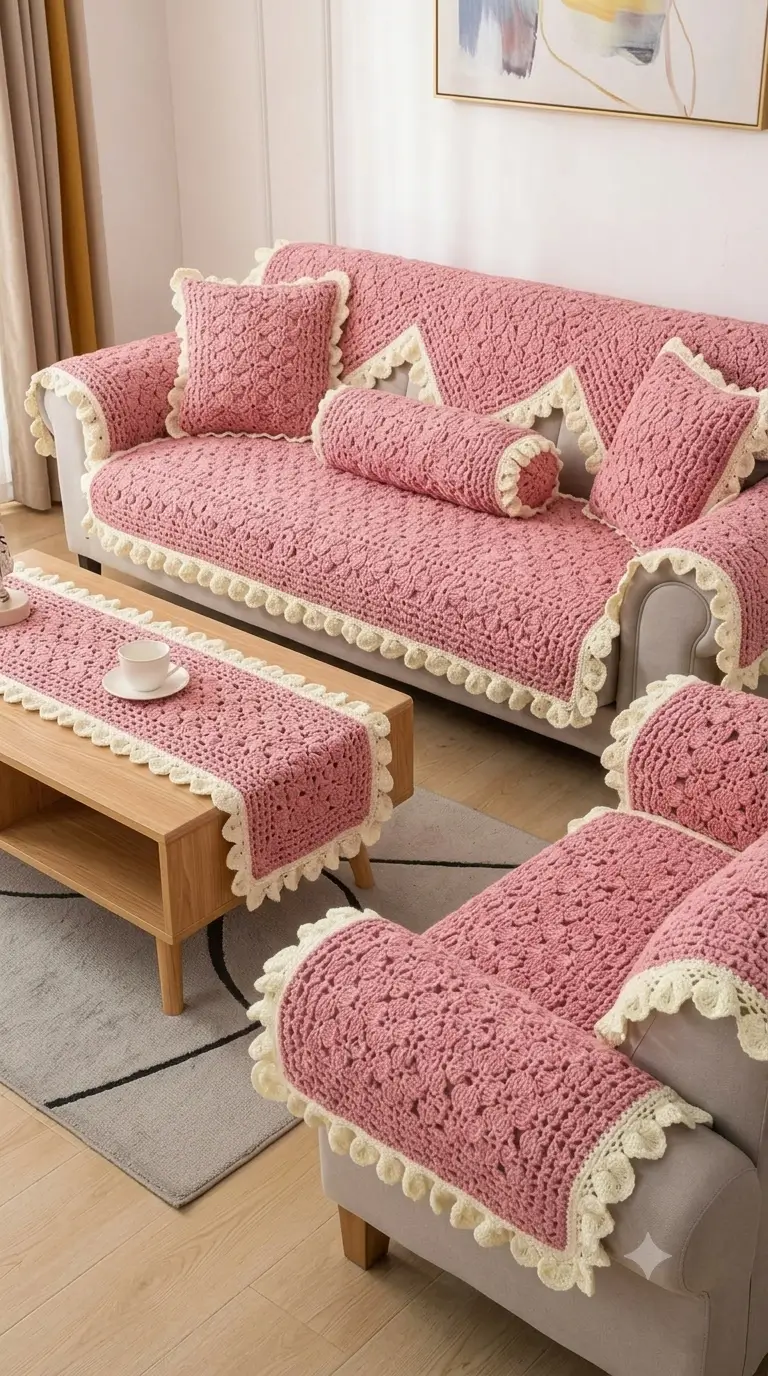
The photographed set relies on three structural decisions. First, the seat, back, and arms are covered separately, allowing each rectangle to follow a different furniture dimension without forcing the crochet fabric around every corner. Second, the main pink fabric combines relatively solid areas with repeated openwork motifs. This gives the crochet furniture cover visual structure without turning every row into dense crochet.
Third, the cream border is intentionally deeper than a basic edging. Its scallops form a distinct outline around the pink field and visually connect the sofa, armchair, cushions, bolster, and runner.
A frequent mistake in a crochet couch cover pattern is calculating the foundation chain from the sofa measurement alone. Crochet gauge—not centimeters alone—determines the correct starting stitch count.
Project Info at a Glance
| Skill Level | Time | Finished Size | Hook | Best For |
|---|---|---|---|---|
| Intermediate | Multi-session project | Custom to furniture | 3 mm reference; adjust to yarn and gauge | Sofa, loveseat, or armchair protection |
A published modular furniture-cover reference specifies 5-ply cotton at 100 g/200 m, a 3 mm hook, and approximately 25 cm finished square units. These specifications provide a useful technical reference, but they do not establish the exact yarn or hook used in the photographed cover.
Materials and Tools
Yarn
- Dusty rose yarn — medium or light-medium cotton/cotton blend — quantity calculated from swatch — main panels
- Cream yarn — matching yarn weight — approximately 15–25% of the planned main-color quantity as a starting purchasing allowance — borders and trim
For a fitted furniture set, yarn quantity should be calculated from a representative swatch rather than copied from an unrelated blanket. Sofa dimensions, yarn thickness, stitch density, border depth, and the amount of openwork can substantially change total consumption.
Tools
- 3 mm crochet hook as a starting reference; change size when required by yarn and gauge
- Flexible measuring tape
- Yarn needle
- Locking stitch markers
- Scissors
- Rustproof pins for temporary fitting
- Notebook or spreadsheet for recording panel measurements
Abbreviations
- ch — chain
- sc — single crochet
- dc — double crochet
- sl st — slip stitch
- sp — space
- st/sts — stitch/stitches
- rep — repeat
- RS — right side
- WS — wrong side
Invisible decrease is an amigurumi shaping method and is not required for these flat furniture panels.
Measurement and Gauge
This project should be drafted from the furniture outward. Measure the seat width from the inside edge of one arm to the other. Then measure the seat depth from the front edge to the point where the seat meets the back. Repeat the process for the back panel and both arms.
For a draped front edge like the photographed example, add the required drop to the seat depth. Measure that drop independently rather than estimating it from the overall sofa height.
Make a minimum 15 × 15 cm gauge swatch in the selected main stitch. Wash and dry it exactly as the completed cover will be maintained. Measure the center 10 cm rather than using stitches close to the swatch edges.
Suppose the washed swatch contains 20 stitches per 10 cm and the required panel width is 180 cm. Calculate the starting stitch count as follows:
180 ÷ 10 × 20 = 360 stitches
The final foundation must also comply with the selected motif repeat. If the lace pattern repeats over 12 stitches, 360 stitches works exactly. If the calculated stitch count does not divide evenly into the motif repeat, adjust it to the nearest valid repeat and check the resulting finished width.
This calculation is more accurate than copying a foundation-chain number from a sofa with different dimensions.
Pattern — Step by Step
The exact original stitch pattern cannot be confirmed from a single photograph. The instructions below reproduce the photographed construction style: dusty-pink textured panels combined with contrasting cream scalloped edging.
Main Seat Panel
Yarn: dusty rose.
Foundation: Chain the number required for the measured seat width and selected stitch repeat.
Row 1: Work 1 dc in the fourth ch from hook and across. Turn.
Row 2: Ch 1, sc in each st across. Turn.
Row 3: Ch 3, dc in each st across. Turn.
Row 4: Repeat Row 2.
These rows create a stable lower band before the openwork section begins.
Pattern Row A: Ch 3, *skip 2 sts, 3 dc in next st, skip 2 sts, dc in next st*; repeat across.
Pattern Row B: Ch 1, sc across, keeping the stitch count consistent with the established width.
Repeat Pattern Rows A and B until the panel reaches the required seat depth minus the final stabilizing band.
Work four rows alternating dc and sc to mirror the starting edge.
Fasten off and weave in the yarn tail.
Back Panel
Yarn: dusty rose.
Measure the visible back width and required vertical drop separately. Do not assume the back panel should have the same dimensions as the seat panel.
Make the foundation chain according to the measured width and washed gauge.
Rows 1–4: Work the same stabilizing rows used for the main seat panel.
Pattern Row A: Ch 3, *skip 2 sts, 3 dc in next st, skip 2 sts, dc in next st*; repeat across.
Pattern Row B: Ch 1, sc across.
Repeat these two pattern rows until the back panel reaches its required height.
Finish with four stabilizing rows, matching the beginning of the panel.
Fasten off.
Sofa Arm Panels — Make 2
Yarn: dusty rose.
Measure from the inside edge of the sofa arm, over the crown, and down the outside to the desired finishing point. Record both the required length and width.
The arm pieces should be narrower than the seat panel. Their purpose is to protect the upholstery while following the curved profile of the furniture.
Make a foundation chain corresponding to the required arm-panel width.
Work the same four-row stabilizing section, followed by the repeating openwork pattern.
Continue until the panel reaches the measured length.
For a moderately curved sofa arm, keep the crochet panel rectangular. The natural drape of the fabric can conform to the curve without introducing unnecessary shaping.
Fasten off and make the second arm panel to match.
Armchair Seat and Back Panels
Yarn: dusty rose.
Measure the chair independently rather than reducing the sofa measurements by a percentage. Furniture from the same collection can have different internal proportions.
Calculate the foundation chain from the chair measurement and washed gauge.
Work the same stabilizing rows and openwork repeat used on the sofa pieces.
The motif and colors should remain consistent across the set, while individual stitch counts change according to the dimensions of each furniture section.
Finish each panel with the same stabilizing band.
Fasten off.
Square Cushion Covers
Yarn: dusty rose with cream trim.
Measure each cushion from seam to seam. Make the finished crochet face approximately equal to the cushion dimensions after blocking.
Two separate square panels can be made and joined around three or four sides. Alternatively, crochet one long rectangle and fold it around the cushion before joining the side seams.
For a 45 cm cushion, calculate the starting stitch count from the washed gauge. Do not assume that a foundation used for another 45 cm pattern will produce the same dimensions with different yarn.
Join the pieces with sc or a sewn seam.
Add cream scalloped edging around the visible perimeter to coordinate the cushion with the furniture panels.
Bolster Cover
Yarn: dusty rose with cream edging.
Measure the circumference and length of the cylindrical bolster.
Crochet a rectangle whose finished width corresponds to the bolster circumference and whose length matches the cylindrical body.
Seam the long edges together to create a tube.
Fit the pink tube over the bolster before adding the cream edging. Checking the fit at this point prevents the decorative border from compensating for an incorrectly sized main panel.
Work cream trim around both circular ends.
Coffee-Table Runner
Yarn: dusty rose and cream.
Measure the table length and width, then determine the desired overhang at each end.
Make a narrow rectangular panel using the same stitch family as the sofa covers. Keep several rows of relatively solid crochet close to the perimeter to support the decorative edging.
Continue until the runner reaches the calculated length.
Finish the perimeter with the same cream foundation border and scallops used on the furniture pieces.
Cream Foundation Border
Yarn: cream.
Join the cream yarn at one corner of the completed pink panel.
Round 1: Ch 1 and sc evenly around the entire panel. Place sufficient stitches at each corner to turn without pulling the fabric inward.
Round 2: Sc in each st around.
Place the panel on a flat surface before proceeding. A border that forms waves usually contains too many stitches. A border pulling the panel inward usually contains too few.
Cream Scalloped Border
Yarn: cream.
The photographed set uses large rounded cream scallops that create a stronger outline than a narrow decorative picot.
Scallop Round: *Skip 2 sts, work 5 dc in next st, skip 2 sts, sl st in next st.* Repeat around.
For larger scallops, work 7 dc in the shell and adjust the number of skipped stitches so the border remains flat.
At corners, position a shell centrally where possible. Avoid placing a tight sl st directly on the corner because it can pull the fabric inward.
Continue around the entire panel.
Sl st to the starting point and fasten off.
Make a short border sample before edging every furniture panel. Even a small spacing problem becomes highly visible when repeated over several meters.
How to Calculate Yarn Quantity
A fitted crochet sofa cover pattern should be estimated from a swatch rather than a generic blanket yardage figure.
Crochet a representative sample measuring at least 20 × 20 cm. Wash and dry the swatch, then weigh it accurately.
If a 20 × 20 cm swatch weighs 18 g, calculate its area:
20 × 20 = 400 cm²
Next calculate yarn weight per square centimeter:
18 ÷ 400 = 0.045 g/cm²
If all planned pink furniture panels have a combined area of 40,000 cm²:
40,000 × 0.045 = 1,800 g
Add approximately 10–15% for swatching, joining, gauge variation, yarn tails, fitting corrections, and future repairs.
Calculate the cream border separately. Open scallops have a different yarn-consumption rate from the main textured fabric, so treating both colors as having the same grams-per-area measurement can produce an inaccurate estimate.
Assembly
- Block the completed pink seat panel to its calculated dimensions.
- Position the seat panel on the sofa and mark the exact front and rear alignment points.
- Fit the back panel independently instead of permanently attaching it to the seat panel.
- Place both arm panels on the furniture and compare their front and outside overhang.
- Work the cream foundation border around every visible panel.
- Add the scalloped edging only after confirming that each foundation border lies flat.
- Fit the square cushion covers and close their remaining seams.
- Seam the bolster rectangle into a tube, fit it, and complete the cream trim around both ends.
- Block the table runner flat and check that both long sides remain parallel.
- Weave all yarn tails securely through dense stitches on the wrong side before trimming them.
The finished set consists of separately fitted crochet pieces connected visually by the same pink texture and cream scalloped border.
7 Technical Tips for a Better-Fitting Crochet Sofa Cover
- Prevent a rippled border. If the cream sc foundation starts waving after 20–30 cm, too many stitches have been placed along the edge. Correct the stitch distribution before adding the scallops.
- Measure the washed swatch. A 5% dimensional change equals 9 cm across a 180 cm sofa. That difference is large enough to change how the seat panel fits.
- Mark long rows regularly. Place a stitch marker every 25 or 50 stitches. Losing one stitch in an openwork repeat can gradually produce a diagonal panel edge.
- Check shell placement first. Mark each corner and test the repeat between markers before completing the cream border. An incomplete shell forced into a corner creates visibly uneven edging.
- Avoid stretching arm panels while measuring. A crochet arm cover measured under tension can retract toward the crown during use and expose the upholstery below.
- Pin panels before making permanent joins. Place temporary pins approximately 10 cm apart while the cover is fitted to the furniture. Large gaps between pins can hide excess fabric.
- Secure yarn tails in dense rows. Carry each tail through approximately 5–7 cm of solid crochet rather than weaving it only through open lace spaces.
Care and Maintenance
Check the yarn label before washing the completed covers. Cotton and cotton-blend yarns may change dimensions during the first wash, which is why the gauge swatch should be washed before the final stitch counts are calculated.
Removable construction has a practical advantage for furniture protection. The seat and arm panels normally receive more wear than the back panel, so individual pieces can be cleaned or replaced without dismantling the complete set.
After washing, reshape the scalloped cream border while damp and lay the panels flat when the yarn-care instructions permit. Confirm the finished dimensions before placing the covers back on the furniture.
Conclusion
A reliable crochet sofa cover pattern starts with furniture measurements, a washed gauge swatch, and separate calculations for the seat, back, and arms. The pink-and-cream set shown here gains consistency from repeating one stitch family and carrying the same scalloped border across the sofa, chair, cushions, bolster, and runner. Before buying the full yarn quantity, crochet a 20 × 20 cm sample, wash it, weigh it, and calculate consumption from the total panel area. Save the project to Pinterest and share the finished fitted set on Instagram with #PinkScallopSofaCover. Which section of your sofa needs the largest custom adjustment: the curved arms, seat depth, or back-panel drop?