Introduction
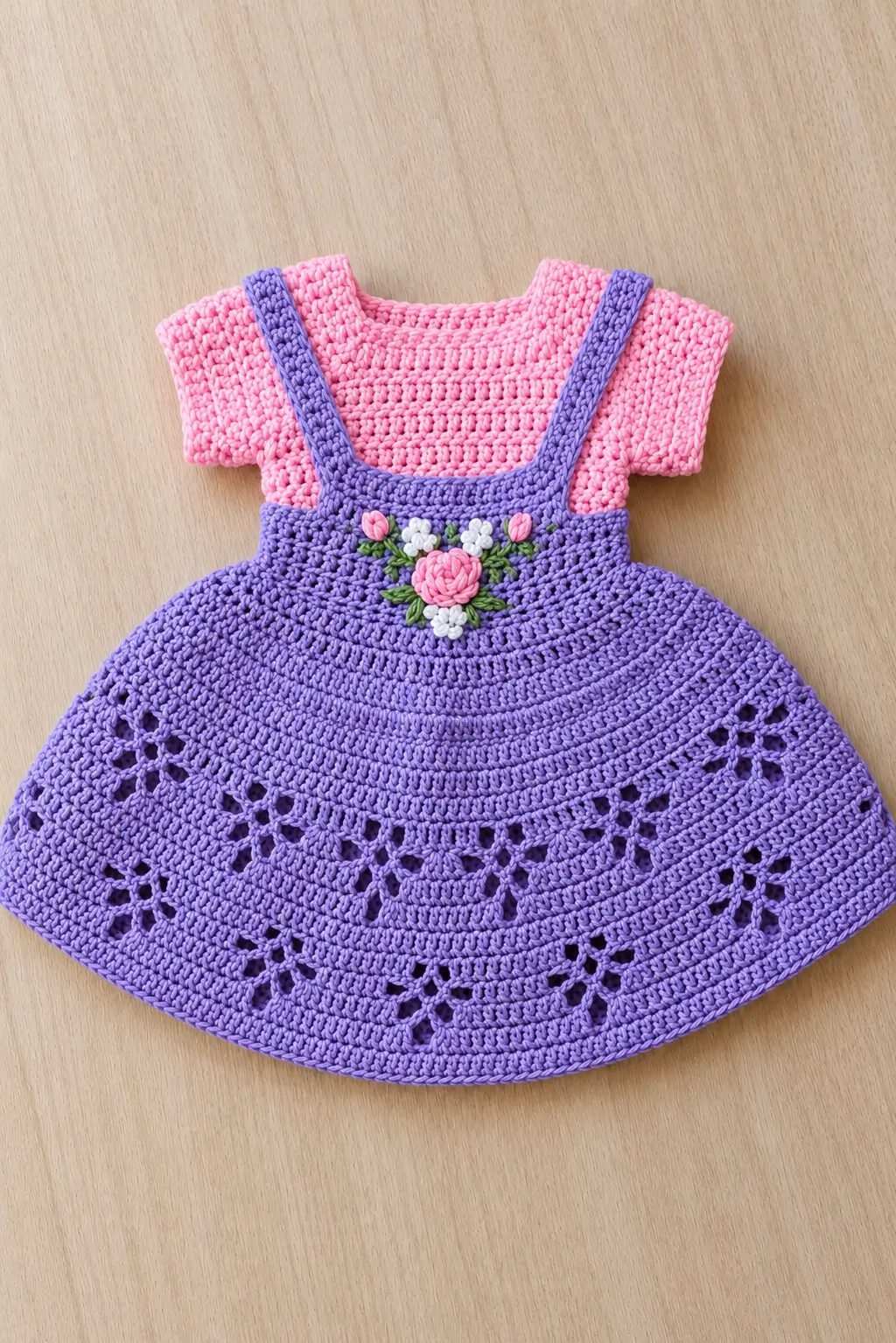
The central pink rose sits directly beneath the two purple straps, so the bib proportions have to be set before the skirt flare is planned. This crochet pinafore dress pattern uses DK yarn, a 4 mm hook and an 18–24-month reference size of about 56 cm around the chest. Intermediate crochet skills are appropriate. The layered design also leaves room for a separate short-sleeve top underneath.
The Design: What Makes This Pinafore Different
Three structural choices define the photographed garment. First, the bib is comparatively firm and rectangular; it acts as an anchor for wide shoulder straps instead of growing directly from a soft lace yoke. Second, the skirt expands below a compact waistband, keeping the upper section controlled while giving the hem substantially more circumference. Third, openwork is confined to repeated horizontal bands rather than covering the whole skirt. That arrangement preserves enough solid crochet around the waist and hem to resist stretching.
For a toddler crochet pinafore dress, strap width matters almost as much as strap length. Thin straps can twist under the weight of a wide skirt. A common error in a floral crochet dress is placing the central motif before the straps are pinned; the flower may look centered on the bib but not centered between the finished straps.
Project Info at a Glance
| Skill Level | Time | Finished Size | Hook | Best For |
|---|---|---|---|---|
| Intermediate | Approx. 8–12 hours | Reference: 56 cm chest / 40.5 cm length | 4 mm | Layered toddler pinafore |
The finished measurements are based on comparable DK toddler pinafore sizing. Check the garment against the intended wearer before finishing the straps.
Materials and Tools
Yarn
- Purple DK/light-worsted yarn — approximately 220 g — use a smooth cotton, cotton-acrylic or washable DK yarn.
- Pink DK yarn — approximately 5–10 g — for the central rose and two buds.
- White DK yarn — approximately 5–10 g — for the small five-petal flowers.
- Green DK yarn — approximately 5–10 g — for leaves and short stems.
- Matching purple yarn reserve — 10–15 g — keep this aside for edging, repairs and strap adjustments.
Tools
- 4 mm crochet hook
- 3.5 mm crochet hook for compact floral details
- Tapestry needle
- Locking stitch markers
- Dressmaker pins
- Scissors
- Tape measure
- Two optional 15 mm buttons for adjustable straps
Work a gauge swatch before sizing the waistband. A practical target for DK yarn with a 4 mm hook is approximately 18 double crochet stitches per 10 cm.
Abbreviations
- ch — chain
- sc — single crochet
- hdc — half double crochet
- dc — double crochet
- sl st — slip stitch
- inc — two stitches worked into one stitch
- sk — skip
- sp — space
- MR — magic ring
- RS — right side
- BLO — back loop only
An invisible decrease is mainly used in amigurumi and is not required for the main garment. Where narrowing is needed, crochet two stitches together using the stitch specified in the pattern.
Pattern — Step by Step
Pattern note: This is a photo-matched construction for an approximately 18–24-month toddler size. Measurements should be checked against the intended wearer because yarn fiber, gauge and tension can change the finished dimensions.
Waistband
Yarn: purple
Ch 97.
Row 1: Sc in second ch from hook and in each ch across. (96)
Row 2: Ch 1, turn, sc across. (96)
Row 3: Ch 1, turn, sc across. (96)
Row 4: Ch 1, turn, sc across. (96)
Bring the short edges together without twisting. Slip stitch through corresponding stitches to form a ring.
At an approximate gauge of 18 stitches per 10 cm, 96 stitches produce a circumference close to 53 cm before blocking. The fabric may relax toward the target measurement depending on yarn fiber and stitch tension. Add stitches in multiples of 12 if more circumference is required.
Do not fasten off.
Skirt
Yarn: purple
The skirt is worked downward from the waistband. Join each round with a slip stitch.
Rnd 1: Ch 3, dc in each stitch around. (96)
Rnd 2: Ch 3, repeat 7 dc, 2 dc in next st around. (108)
Rnd 3: Dc around. (108)
Rnd 4: Repeat 8 dc, 2 dc in next st around. (120)
Rnd 5: Dc around. (120)
Rnd 6: Repeat 9 dc, 2 dc in next st around. (132)
Rnd 7: Dc around. (132)
Rnd 8: Repeat 10 dc, 2 dc in next st around. (144)
Rnd 9: Dc around. (144)
The 144-stitch count divides evenly into twelve 12-stitch lace repeats.
First Openwork Band
Rnd 10: Repeat: dc in next 4 sts, ch 3, sk 2 sts, dc in next 4 sts, ch 3, sk 2 sts. Continue around.
Rnd 11: Dc in each dc and work 3 dc into every ch-3 space. (144)
Rnd 12: Dc around. (144)
Rnd 13: Dc around. (144)
This openwork section should remain below a substantial band of solid crochet so the upper skirt stays stable.
Second Openwork Band
Rnd 14: Repeat: dc in next 3 sts, ch 3, sk 3 sts, dc in next 3 sts, ch 3, sk 3 sts.
Rnd 15: Dc in each dc and 3 dc in each ch-3 space. (144)
Rnd 16: Dc around. (144)
Rnd 17: Dc around. (144)
Rnd 18: Repeat 11 dc, 2 dc in next st around. (156)
The increase adds more flare before the lower decorative section.
Lower Openwork Band
Rnd 19: Repeat: dc in next 4 sts, ch 2, sk 2, dc in next 4 sts, ch 2, sk 2.
Rnd 20: Dc in each dc and 2 dc into each ch-2 space. (156)
Rnd 21: Dc around. (156)
Rnd 22: Repeat Rnd 19.
Rnd 23: Repeat Rnd 20.
Rnd 24: Dc around. (156)
Rnd 25: Dc around. (156)
Measure the skirt from the waistband to the hem. Add extra solid double crochet rounds if additional length is required.
Final edging round: Sc evenly around. (156)
Fasten off and weave in the tail.
Bib
Yarn: purple
Locate the exact center front of the waistband and mark 42 consecutive stitches.
Row 1: Join purple at the first marked stitch. Ch 1, sc across 42 waistband stitches. (42)
Row 2: Ch 1, turn, hdc across. (42)
Rows 3–12: Repeat Row 2. (42)
Row 13: Ch 1, turn, sc across. (42)
Row 14: Ch 1, turn, sc across. (42)
Check the bib height before attaching the straps. The bib should finish below the upper chest rather than reaching the neckline.
Fasten off.
Shoulder Straps — Make 2
Yarn: purple
Ch 7.
Row 1: Sc in second ch from hook and across. (6)
Rows 2–32: Ch 1, turn, sc across. (6)
A six-stitch strap gives enough width to resist twisting while remaining proportional to the bib.
For fixed straps, fasten off with a 25 cm sewing tail. Pin one strap to each upper bib corner. Carry the straps over the shoulder line and attach the opposite ends evenly to the back waistband.
For adjustable straps, make a ch-3 buttonhole near the final two rows and attach one 15 mm button to each back fastening point.
Central Pink Rose
Yarn: pink. Use a 3.5 mm hook for a tighter flower.
Rnd 1: 6 sc in MR. (6)
Rnd 2: 2 sc in each stitch. (12)
Rnd 3: Repeat: sl st in next st, 3 dc in next st. Repeat six times.
Fasten off with a 20 cm sewing tail. Shape the petals slightly toward the center as the rose is stitched onto the bib.
A finished diameter of approximately 3.5–4 cm keeps the flower proportional to the narrow bib.
White Five-Petal Flowers — Make 3
Yarn: white
Make an MR.
Repeat five times: ch 2, 2 dc, ch 2, sl st into the ring.
Pull the ring closed and fasten off with a sewing tail.
Place one flower above-left of the rose, one above-right and one below or slightly beside the center motif.
Pink Buds — Make 2
Yarn: pink
Ch 4.
Row 1: Sc in second ch, hdc in next ch, 3 dc in last ch. Rotate the work. Work hdc and sc down the opposite side of the foundation chain.
Fasten off with a 15 cm sewing tail.
Pin one bud above each side of the central rose.
Green Leaves — Make 6 to 8
Yarn: green
Ch 6.
Starting in the second chain from the hook, work: sl st, sc, hdc, sc, sl st.
Fasten off with a 12 cm sewing tail.
Keep the leaves narrow so they sit between the flowers without hiding the white petals.
Floral Stems
Thread green yarn onto a tapestry needle and work short straight embroidery stitches between the rose, buds and leaves.
Keep each visible stem approximately 8–15 mm long. Short stems maintain the compact bouquet effect shown on the bib.
Bib Edging
Rejoin purple yarn at one lower bib corner.
Single crochet evenly up the first side, across the top and down the opposite side. Add one extra sc in each upper corner if the fabric begins to pull inward.
Fasten off.
The edging adds structure to the bib and keeps the strap bases square.
Pink Layering Top
The pink short-sleeve top shown beneath the purple pinafore is a separate garment rather than part of the dress construction.
Pair the finished pinafore with a fitted crochet, cotton or jersey top whose neckline remains visible above the bib. A separate layer also allows the same pinafore to be worn over different sleeve lengths.
Assembly
- Block the purple skirt and waistband to the target circumference before final assembly.
- Mark the center front and check that the bib sits squarely above the skirt.
- Pin both shoulder straps at the upper bib corners and compare their lengths.
- Attach the back ends of the straps at equal distances from the center back.
- Pin the central pink rose on the horizontal centerline of the bib.
- Arrange the three white flowers around the rose without covering the strap edges.
- Add the two pink buds above the main flower, one toward each strap.
- Place the green leaves beneath the flower edges and embroider the short stems.
- Weave each yarn tail through at least 3–4 cm of matching stitches on the wrong side.
- Block the finished dress according to the yarn label, reshaping the lace sections and checking the final strap length.
The completed dress should have a flat rectangular bib, balanced shoulder straps, a flared purple skirt and clearly separated openwork sections.
7 Technical Tips
- Mark every round transition. Missing the beginning of a round by one stitch shifts the lace repeats and can create a diagonal line down the skirt. Place the locking marker in the first actual stitch rather than the turning chain.
- Check waistband stretch before adding the full skirt. If the waistband grows by more than about 2 cm after gentle stretching, move to a smaller hook or adjust the stitch count before continuing.
- Measure both straps before sewing. A difference of only 5 mm can lift one corner of the bib and make the central rose appear off-center.
- Attach the straps before final floral placement. Centering the rose on the bare rectangle first can place it off-center once the strap lines are established.
- Keep every chain opening consistent. Tight ch-2 or ch-3 spaces can reduce the circumference of a lace round and cause the skirt to pucker.
- Distribute the flower tails across the back of the bib. A bundle thicker than about 3–4 mm behind the central rose can create a visible raised patch on the front.
- Block the skirt in separate zones. Shape the waistband, each lace band and the 156-stitch hem independently instead of pulling only on the outer edge.
Conclusion
Check the blocked waistband and strap length against the intended wearer before sewing the final floral pieces. That measurement matters because yarn fiber, hook tension and washing can alter a toddler garment by several centimeters. Once the fit is set, photograph the dress flat so the lace repeats and bib placement remain visible, then save the project to Pinterest or post the finished version on Instagram with #PurpleFloralPinafore. This crochet pinafore dress pattern can also be adapted by changing the accent colors while keeping the structural stitch counts unchanged. Would you keep the central pink rose or replace it with a larger cluster of white flowers?