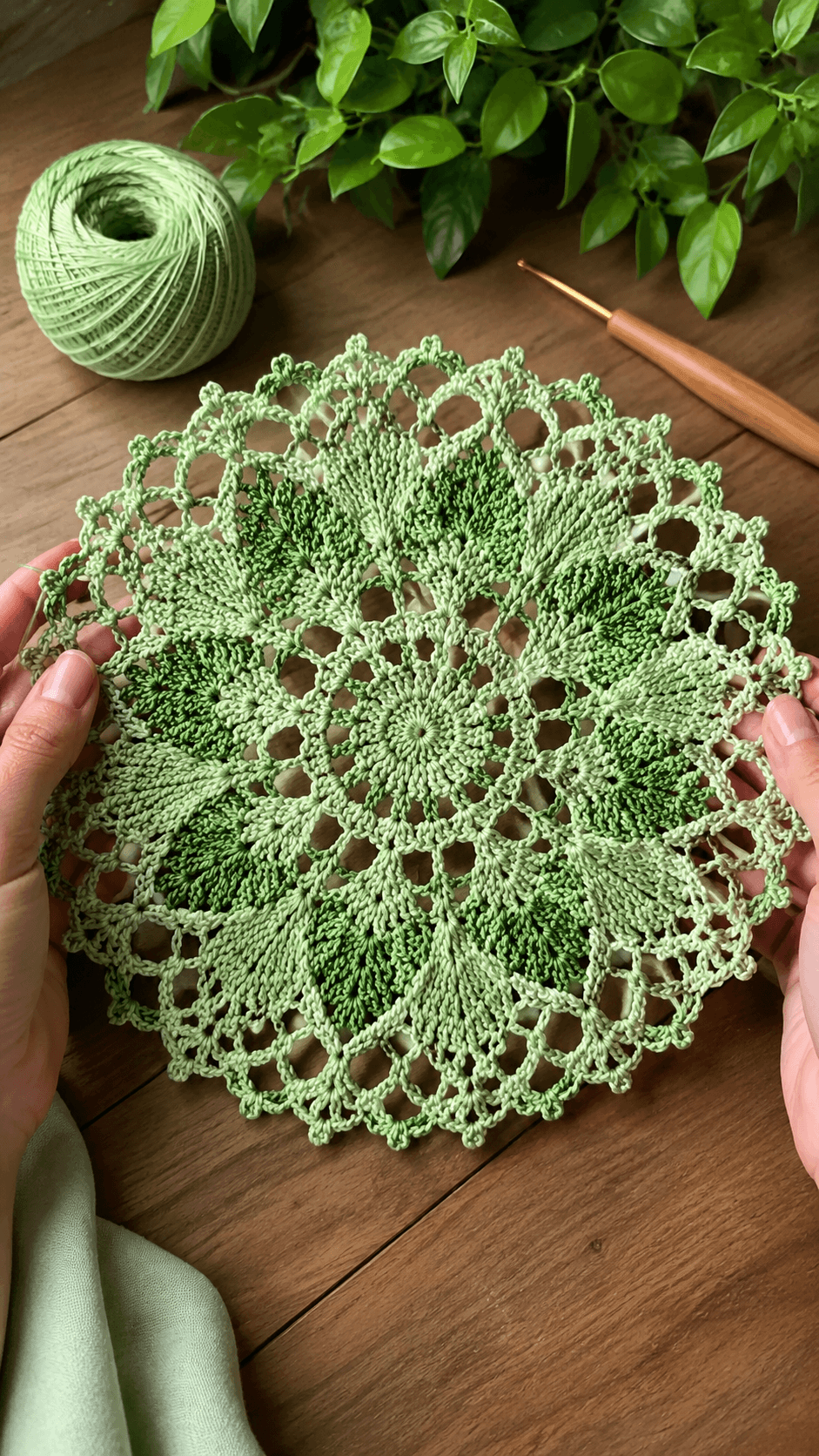
Pineapple lace depends on long, tapered sections that must open evenly from the center ring to the final edge. That structure defines this green pineapple crochet doily pattern. The sample shown here uses fine cotton thread in two shades of green, a small steel hook, and repeating lace arches to build a round doily with layered pineapple motifs and a picot-style border. It suits intermediate crocheters who can manage joined rounds, openwork spacing, and accurate repeat counts across the full circle.
The Design: What Makes This Pineapple Doily Different
This doily relies on contrast between dense stitch fans and open chain lace. The first design choice is the dark green pineapple sections. They create visual depth and break the round into distinct wedges, which keeps the center from blending into the outer mesh. Without that contrast, the motif reads as generic lace rather than pineapple lace.
The second choice is the pale green framework around each wedge. That lighter thread outlines the shape of every pineapple section and keeps the openwork readable at a distance. In a round crochet doily, clean separation between solid and open areas matters more than extra ornament.
The third choice is the outer edging. Small arches and pointed picot accents give the border a defined finish without adding too much weight. One common mistake with a pineapple crochet doily is stretching the chain arches too loosely. That distorts the points and makes the edge wave before blocking.
Project Info at a Glance
| Skill Level | Time | Finished Size | Hook | Best For |
|---|---|---|---|---|
| Intermediate | 6–10 hours | Approx. 28–36 cm / 11–14 in | 1.5–1.75 mm steel hook | Side tables, trays, shelf styling, gift sets |
Materials and Tools
Yarn
- Light sage crochet cotton thread — size 10 — approx. 50–70 g
- Dark green crochet cotton thread — size 10 — approx. 20–35 g
Tools
- Steel crochet hook 1.5 mm or 1.75 mm
- Small scissors
- Tapestry needle
- Rust-proof pins for blocking
- Blocking mat or thick towel
- Spray bottle or starch, optional
Abbreviations
- MR = magic ring
- ch = chain
- sl st = slip stitch
- sc = single crochet
- hdc = half double crochet
- dc = double crochet
- tr = treble crochet
- sp = space
- rep = repeat
- picot = chain-3 picot unless otherwise noted
In pineapple lace, even chain tension matters as much as stitch count. Uneven arches show immediately once the piece is blocked open.
Construction Overview
This doily is worked from the center outward in joined rounds. The middle begins with a compact circular motif, then expands into evenly spaced arches. Those arches develop into pineapple sections framed by lighter lace rounds. The darker green wedges are added in repeating intervals to emphasize the classic pineapple shape. The final rounds widen into open loops and finish with a pointed decorative edge.
Round-by-Round Pattern Framework
This is a practical build map for recreating the photographed look rather than a direct transcription of a published chart.
Center Ring
- Make an MR, ch 1, work 16 sc into ring. Join with sl st.
- Ch 3, work dc evenly around to establish the first solid center round.
- Add one round of chain spaces, such as (dc in next stitch, ch 2, skip 1) around, keeping the repeat count exact.
Inner Lace Wheel
- Work a round of arches into the chain spaces.
- Follow with a second round that anchors each arch with sc or hdc.
- Expand gradually so the center stays flat and balanced.
Foundation for Pineapple Sections
- Mark the repeat points evenly around the circle.
- Create taller arches at each marker to establish the future pineapple wedges.
- Keep the spaces between wedges open and symmetrical.
First Pineapple Round
- Join dark green thread.
- Work long fan groups into each marked wedge, using tall stitches to form the narrow base of the pineapple.
- Separate each wedge with light chain arches in the background color.
Pineapple Expansion Rounds
- Continue building the dark green wedges with decreasing side spacing so each motif tapers toward its tip.
- Surround each wedge with pale green arches to preserve the outline.
- Check every repeat before closing the round. A missed anchor shifts the next wedge immediately.
Outer Lace Rounds
- Return fully to the light green thread.
- Work broad arches around the completed pineapple sections.
- Add small connector stitches between arches to stabilize the edge.
- Repeat until the doily reaches the intended diameter.
Picot Border
- Work a foundation round of sc around the outer arches if needed for balance.
- Create pointed edging with a repeat such as sc, ch 3 picot, ch 3, sc across each outer loop.
- Adjust only at the final repeat to keep the border flat and even.
Color Placement Notes
Use the darker green only for the pineapple wedges. Keep the center, framing rounds, and border in the lighter green. That color placement matches the photographed sample and makes the tapered motifs stand out clearly. For a softer look, use two close shades from the same family. For stronger contrast, pair sage with forest green or olive with moss.
Blocking and Finishing
- Weave in all thread tails before wet blocking.
- Soak or mist the doily until evenly damp.
- Lay it flat on a blocking board or towel.
- Pin the center first.
- Pin opposite sides of the outer round to keep the circle balanced.
- Open each pineapple section so the tapered shape is visible.
- Pin every border point individually.
- Apply light starch if a firmer finish is needed.
- Allow the doily to dry completely before removing the pins.
This type of lace often looks compressed before blocking. The pineapple definition appears only after the arches are opened and the border points are set.
Common Failure Points
- Center rippling: Too many stitches were added too early. Reduce one increase round or shorten the first arch round.
- Pineapple wedges leaning: Anchor points are misaligned between rounds. Recount the repeat before continuing.
- Outer edge waving: Chain arches are too long for the number of joining points. Remove one chain from each repeated arch.
- Border pulling inward: Too few stitches were worked before the picot round. Add a balancing foundation round.
- Motif contrast disappearing: The two greens are too similar in value. Increase shade contrast to keep the pineapple sections readable.
Where This Doily Works Best
This style works well on small tables, under planters, on entry consoles, and as a decorative tray liner. The green palette suits botanical decor and spring table settings without requiring extra embellishment. It also scales well for seasonal variations. Worked in cream and gold, it becomes more formal. Worked in two greens, it keeps the leaf-like look shown in the sample.
Conclusion
A green pineapple crochet doily works when the wedges stay crisp and the outer lace stays controlled. Focus on repeat accuracy, stable chain tension, and careful blocking. Those three factors define the finished shape more than speed. For the closest match to the photographed sample, use fine cotton thread in two greens, keep the center compact, and let each pineapple section expand cleanly before the final border. Once the last round is complete, block each point separately so the lace opens fully and the motif remains clear.