Introduction
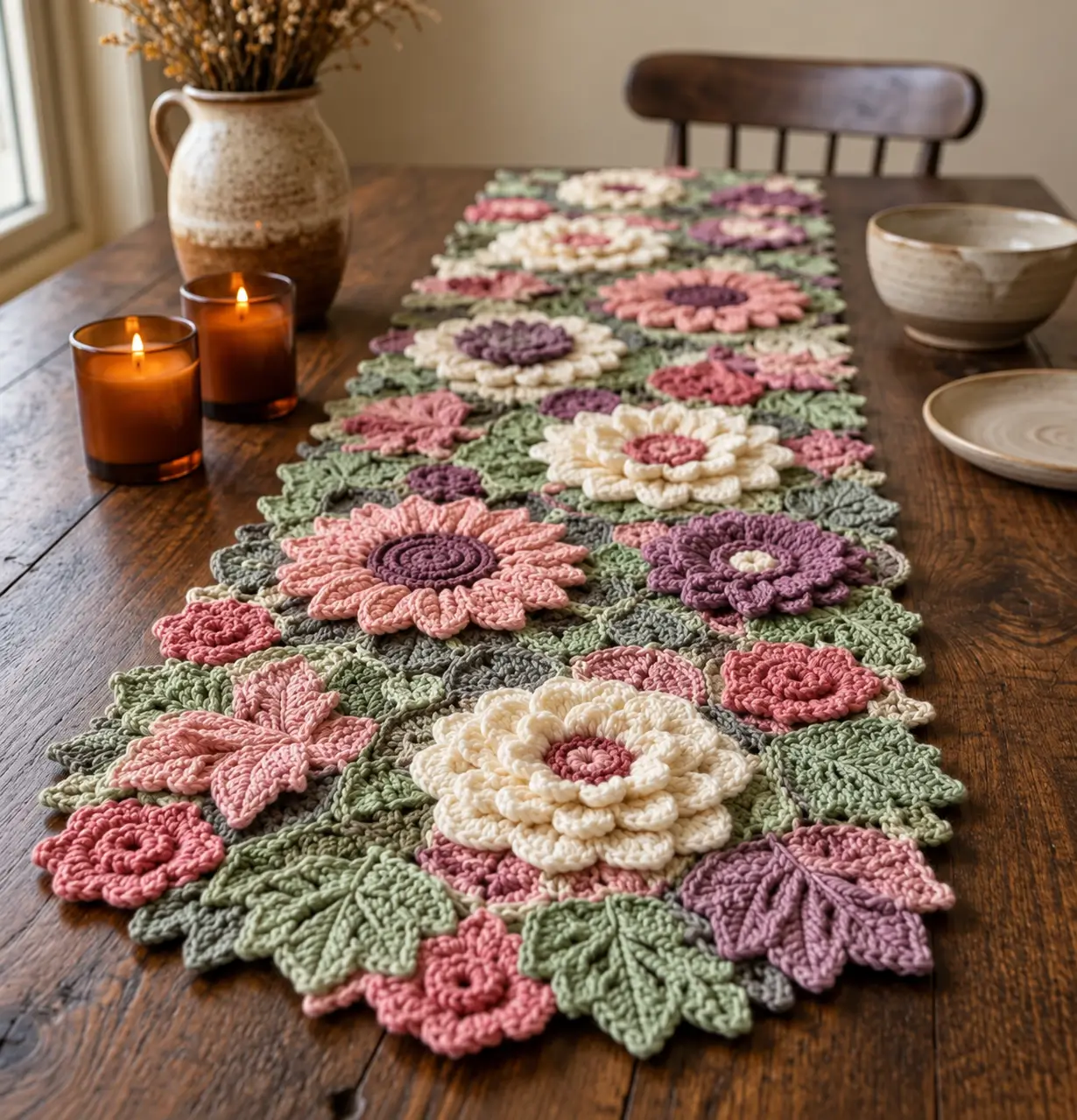
A large blush daisy, layered ivory blooms, plum flowers, and dozens of overlapping sage leaves replace the rectangular fabric normally found beneath a runner. This 3D crochet flower table runner pattern uses worsted cotton, a 4 mm hook, separate botanical motifs, and concealed joins. The intermediate reconstruction targets approximately 38 × 140 cm and works especially well where an irregular botanical edge is preferred over conventional lace.
The instructions below are an original photo-inspired reconstruction based on visible structure; published patterns cited later are used only for sizing, gauge, and material benchmarks.
The Design: What Makes This Botanical Runner Different
The photograph has no obvious continuous background panel. Overlapping flowers and leaves form the runner itself, which changes how the piece must be engineered. Large blush and ivory flowers establish the center line, medium plum blooms interrupt that repetition, and sage leaves bridge gaps between motifs while creating the irregular perimeter. Smaller dusty-pink flowers fill exposed openings without adding another heavy focal point. For this 3D crochet flower table runner pattern, every major bloom therefore receives a flat rear foundation that can be sewn to several leaves rather than hanging from one narrow connection. A common maker error is joining motifs only at their outermost points. Those tiny connections stretch under the weight of layered cotton flowers, so overlapping leaves need several concealed attachment stitches.
Project Info at a Glance
| Skill Level | Time | Finished Size | Hook | Best For |
|---|---|---|---|---|
| Intermediate | Reconstruction estimate: 20–28 hours | Reconstruction target: 36–40 × 135–145 cm | 4 mm | Dining tables, sideboards, botanical centerpieces |
For comparison, Jessie Rayot’s published Floral Motif Table Runner measures 11 × 37 inches, uses worsted Lion Brand 24/7 Cotton, a 4 mm hook, approximately 250 g total, and lists a single-crochet gauge of 17 stitches × 20 rows per 10 cm. The Stitch Studio Design Team’s Spring Flower Table Runner measures approximately 12 × 32 inches, uses Aran-weight hemp yarn and a 4 mm hook, and lists 796 yards. Those published projects support the hook and medium-weight fiber choice; the larger dimensions below remain reconstruction targets derived from the photograph.
Materials and Tools
Yarn
- Sage green — worsted #4 cotton — reconstruction estimate: 300–350 g
- Dusty blush pink — worsted #4 cotton — reconstruction estimate: 180–220 g
- Warm ivory — worsted #4 cotton — reconstruction estimate: 160–200 g
- Muted plum — worsted #4 cotton — reconstruction estimate: 100–130 g
- Dusty rose — worsted #4 cotton — reconstruction estimate: 90–120 g
- Gray-green — worsted #4 cotton — reconstruction estimate: 100–140 g
Purchase by meterage rather than relying solely on gram totals when mixing brands. Jessie Rayot’s comparable motif runner uses 24/7 Cotton, a worsted 100% cotton listed at 186 yards per 100 g. Different cotton constructions can produce substantially different yardage for the same weight.
Tools
- 4 mm crochet hook
- Tapestry needle
- Locking stitch markers
- Scissors
- Blocking mats
- Rust-resistant pins
- Measuring tape
Abbreviations
- MR — magic ring
- ch — chain
- sl st — slip stitch
- sc — single crochet
- hdc — half double crochet
- dc — double crochet
- tr — treble crochet
- inc — two stitches in one stitch
- sp — space
- st/sts — stitch/stitches
- RS — right side
An invisible decrease works through the front loops of two adjacent stitches before completing one single crochet; decreases are not required in these flat botanical motifs.
Motif Plan
The photograph contains more small motifs toward the distant end than can be counted with complete certainty because leaves overlap flowers. The reconstruction therefore uses a controlled repeat rather than claiming an exact photographic inventory.
- Large blush daisy ×2
- Large layered ivory flower ×3
- Medium plum layered flower ×3
- Medium blush five-petal flower ×4
- Small dusty-rose flower ×10
- Large sage leaf ×28
- Medium sage/gray-green leaf ×24
Make the flowers first. The exact number of leaves can then be adjusted before assembly because foliage functions as both background and connector.
Pattern — Step by Step
Large Blush Daisy — Make 2
Yarn: muted plum center and dusty blush petals. Hook: 4 mm. Reconstruction target: 17–19 cm diameter.
Center Disc
R1: With plum, 6 sc in MR. Join. (6)
R2: Inc ×6. (12)
R3: (Sc, inc) ×6. (18)
R4: (2 sc, inc) ×6. (24)
R5: (3 sc, inc) ×6. (30)
R6: (4 sc, inc) ×6. (36)
Fasten off plum.
Petals — Make 18 Around the Disc
Join blush in any stitch.
Each petal consumes two center stitches.
Petal repeat: Sl st in next st, ch 9. Starting in second ch from hook work sc, hdc, dc, tr, tr, dc, hdc, sc along the chain. Sl st in next center stitch.
Repeat the petal sequence 18 times. The 18 repeats consume all 36 center stitches exactly.
Fasten off with a 40 cm tail.
Pin the petals radially before blocking. Do not overlap them heavily; the photographed blush flowers show individually readable elongated petals.
Large Layered Ivory Flower — Make 3
Yarn: dusty-rose center and warm ivory petals. Reconstruction target: 15–17 cm diameter.
Center
R1: With dusty rose, 6 sc in MR. (6)
R2: Inc ×6. (12)
R3: (Sc, inc) ×6. (18)
R4: (2 sc, inc) ×6. (24)
Fasten off the center color.
First Ivory Petal Layer
Join ivory.
R5: *Sl st in next st, (ch 3, 3 dc, ch 3, sl st) in next st* ×12.
This produces 12 small petals from the 24 center stitches.
Second Petal Layer
Working behind R5, create 12 ch-4 loops, anchoring one loop behind each petal.
Into every loop work:
Sc, hdc, 3 dc, hdc, sc.
Third Petal Layer
Create 12 ch-6 loops behind Layer 2.
Into each loop work:
Sc, hdc, 2 dc, 3 tr, 2 dc, hdc, sc.
Fasten off with a 40 cm tail.
Fold the innermost petals slightly upward. The outer layer should lie much flatter so the finished flower transitions gradually into the foliage.
Medium Plum Layered Flower — Make 3
Reconstruction target: 11–13 cm.
R1: With ivory, 6 sc in MR. (6)
R2: Inc ×6. (12)
Change to plum.
Layer 1: *Sl st in next st, (ch 3, 3 dc, ch 3, sl st) in next st* ×6.
Create six ch-4 loops behind the first petals.
Layer 2: In each loop work sc, hdc, 3 dc, hdc, sc.
Create six ch-6 loops behind Layer 2.
Layer 3: In each loop work sc, hdc, 2 dc, 3 tr, 2 dc, hdc, sc.
Fasten off.
Medium Blush Five-Petal Flower — Make 4
The image includes several broad star-like flowers with five distinct points.
R1: With blush, ch 4 and join into a ring. Work 10 sc into ring. Join. (10)
R2: *Sl st in next st, (ch 3, 3 dc, ch 3, sl st) in next st* ×5.
Five petals complete.
R3: Working behind each petal, create five ch-5 loops.
R4: Into each loop work sc, hdc, 2 dc, 3 tr, 2 dc, hdc, sc.
Fasten off with a 30 cm tail.
Small Dusty-Rose Flower — Make 10
Target: approximately 6–7 cm.
R1: Ch 4, join to form ring, work 10 sc into ring. (10)
R2: *Sl st in next st, (ch 3, 3 dc, ch 3, sl st) in next st* ×5.
Fasten off.
These five-petal motifs occupy gaps between large flowers and are not intended to carry structural tension by themselves.
Large Sage Leaf — Make 28
Target: approximately 10–12 cm long.
Ch 22.
Starting in the second chain, work into the next 20 chains, leaving the final foundation chain untouched for the tip:
Sl st in 1, sc in 2, hdc in 3, dc in 4, tr in 7, dc in 2, hdc in 1. (20)
Work 5 sc in the final foundation chain.
Continue along the opposite side with the exact mirrored sequence:
Hdc in 1, dc in 2, tr in 7, dc in 4, hdc in 3, sc in 2, sl st in 1. (20)
Fasten off with a 35 cm tail.
The finished leaf has exactly 45 stitches: 20 + 5 + 20.
Large Leaf Definition Round
Join gray-green or the same sage at the leaf base.
Work one surface slip stitch along the visible foundation-chain ridge toward the tip.
Stop one stitch before the tip group.
Fasten off loosely.
The center ridge should remain flat. Pulling it tight shortens the leaf and makes both sides curl upward.
Medium Leaf — Make 24
Use sage, gray-green, or a mixture of both.
Ch 14.
Beginning in the second chain, work into the next 12 chains, leaving the final chain for the tip:
Sl st in 1, sc in 2, hdc in 2, dc in 3, tr in 2, dc in 1, hdc in 1. (12)
Work 5 sc in the final chain.
Mirror the 12-stitch sequence along the opposite side.
Fasten off with a 25 cm tail.
Each medium leaf contains exactly 29 stitches: 12 + 5 + 12.
Optional Pointed Gray-Green Leaf — Make 8
For additional color variation, repeat the medium-leaf instructions in gray-green.
Use these darker motifs primarily beneath blush and ivory flowers. The contrast separates pale petals from the surrounding sage foliage.
Building the Runner Without a Fabric Background
The assembly surface is created from overlapping leaves rather than a rectangular crochet panel.
Draw or tape a temporary rectangle measuring approximately 38 × 140 cm onto the blocking surface. This is a layout guide, not a piece of the finished runner.
Arrange large leaves along the center line first. Alternate their tips left and right and overlap neighboring leaves by approximately 2–3 cm.
Add medium leaves between them until no unsupported gap in the structural center exceeds approximately 3 cm.
Pin everything before sewing.
First End Cluster
Place one large ivory flower approximately 12 cm inward from the end.
Arrange five to six large sage leaves beneath it in a radial pattern.
Add one small dusty-rose flower toward each side and one medium leaf between neighboring large leaves.
The outline should remain irregular. Avoid forcing all leaf tips onto one straight transverse line.
Second End Cluster
Use one large ivory flower again, but rotate the surrounding foliage arrangement.
Add a plum flower or five-petal blush flower close to one side of the primary bloom.
The two ends need comparable visual weight without becoming exact mirror images.
Central Flower Placement
Place the two large blush daisies approximately one-third and two-thirds of the way along the runner.
Position the third large ivory flower near the center.
Distribute the three plum flowers between the larger motifs.
Add the remaining blush and dusty-rose flowers only after the dominant flowers are pinned.
This sequence prevents small motifs from occupying the space required by a 15–19 cm focal flower.
Structural Leaf Joins
Thread a tapestry needle with matching sage yarn.
Where two leaves overlap by 2–3 cm, make three concealed attachment points: one near the bases, one at the center of the overlap, and one approximately 1 cm before the overlap ends.
Do not sew around the complete leaf perimeter.
The unsewn tips create the layered botanical outline visible in the photograph.
Attaching Large Flowers
Place each large flower over at least three overlapping leaves.
Sew the flower’s center foundation to all three leaves.
Add approximately six to eight concealed attachment points around the foundation.
Do not sew through the outer half of the petals.
A large cotton flower attached to only one leaf can rotate or pull that leaf away from the runner.
Attaching Medium Flowers
Position each medium flower over a leaf intersection whenever possible.
Attach at four points around its center.
If the flower overlaps two leaves, catch both leaves in at least one attachment stitch.
Leave every outer petal free.
Attaching Small Flowers
Use the small dusty-rose flowers to cover visible junctions rather than placing them at fixed intervals.
Sew each flower through two opposite sections of its center.
Where a small flower sits at the outer edge, support it with a medium leaf beneath at least half its diameter.
This prevents isolated flowers from folding underneath the runner.
Creating the Irregular Perimeter
The perimeter is formed by foliage and petals, not a separate crochet border.
Allow large leaf tips to project approximately 3–6 cm beyond the central structural line.
Alternate large and medium leaves to avoid a repetitive sawtooth edge.
Turn some leaves 20–30 degrees toward the runner ends.
The final width can vary slightly along the length; the reference itself uses a free botanical silhouette rather than parallel sides.
Blocking the Individual Motifs
Block all leaves before assembly.
Pin the foundation ridge straight and place the pointed end on the same axis.
For large flowers, pin only the outermost petal layer. Leave inner dimensional petals uncompressed.
Small flowers can be blocked flat because their purpose is to fill junctions rather than provide substantial height.
Final Blocking
After assembly, place the runner flat without stretching it lengthwise.
Pin only the leaves and any outer petals that have twisted during sewing.
Measure the finished length through the central axis.
Target approximately 135–145 cm long and 36–40 cm across the widest foliage sections.
Allow the piece to dry fully before lifting it from the mat.
Assembly
- Crochet two large blush daisies, three layered ivory flowers, three plum flowers, four medium blush flowers, and ten small dusty-rose flowers before starting the final layout.
- Make 28 large sage leaves and 24 medium sage or gray-green leaves, then block each leaf with its foundation ridge positioned on a straight center axis.
- Mark a temporary 38 × 140 cm layout area and arrange the largest leaves along its center, overlapping adjacent motifs by approximately 2–3 cm.
- Add medium leaves between the first layer until the center forms a continuous flexible textile with no unsupported structural opening larger than approximately 3 cm.
- Pin the two large blush daisies and three ivory flowers along the runner’s center line, leaving enough clearance for their outer petals to remain free.
- Place the plum and medium blush flowers between the dominant blooms, then use the ten small flowers to cover selected leaf junctions and perimeter gaps.
- Sew overlapping leaves together at three concealed points per junction, keeping the outer third of each leaf free from the neighboring motif.
- Attach each large flower through at least three underlying leaves and six to eight center-foundation points, without sewing its outer petals to the foliage.
- Attach the remaining flowers through their centers, inspect the reverse for loose spans, and reinforce any junction carrying more than two overlapping motifs.
- Weave every tail through at least 5 cm of matching crochet, lightly block the assembled foliage, and reshape the dimensional flower layers after the runner is completely dry.
The completed runner is a joined botanical textile rather than a flower appliqué panel: leaves carry the lengthwise structure while the dimensional flowers remain largely free above them.
7 Technical Tips
- The runner stretches between flowers: keep structural leaf overlaps at approximately 2–3 cm and secure each overlap at three points. A single stitch at the leaf tips creates a hinge instead of a stable connection.
- The large blush daisy develops uneven gaps: use exactly 18 petals around the 36-stitch center, consuming two center stitches per petal. Skipping an extra center stitch in one repeat shifts every remaining petal around the disc.
- The leaf twists to one side: verify 20 stitches on each side of a large leaf plus five stitches in the final chain. Consuming the tip chain before turning shortens one side and removes the leaf’s central point.
- The ivory flowers collapse flat: attach only their center foundations and leave the outer petal layers unsewn. Stitching more than the inner 4–5 cm of a 15–17 cm flower removes most of its dimensional profile.
- The runner becomes wider at one end: check the overall width after every 25–30 cm of assembled foliage. Keep the maximum variation within approximately 4 cm unless an intentionally projecting flower creates the difference.
- A perimeter flower folds under the runner: support at least half its diameter with an underlying leaf. A 6 cm flower attached only through a narrow edge junction lacks enough backing to remain face-up.
- The assembled runner will not lie flat: block leaves individually before sewing and keep the center vein loose. A surface-slip-stitch vein shortened by even 5 mm can cup a leaf and transfer that distortion into several neighboring motifs.
Why a Motif Foundation Fits This Photograph
A conventional table runner normally begins with one long rectangle. This design behaves differently. Green leaves occupy almost every visible space between the flowers, and the wooden tabletop remains visible through occasional openings.
That makes a modular construction practical. Individual leaves can overlap enough to carry tension while maintaining the irregular botanical edge.
The method also lets you change the length before permanent assembly. Add another flower cluster for a longer table, or overlap the existing motifs more heavily for a shorter centerpiece.
Published Floral Motif Runner Benchmark
Jessie Rayot’s Floral Motif Table Runner is documented at 11 × 37 inches. It uses Lion Brand 24/7 Cotton, 250 g total, a 4 mm hook, and a published single-crochet gauge of 17 stitches × 20 rows per 4 inches / 10 cm.
The pattern also states that the ends can be lengthened for a longer runner or retained for a shorter table topper. Those specifications make it a useful benchmark for the yarn category, hook size, gauge, and modular nature of this reconstruction.
Published Spring Flower Runner Benchmark
The Stitch Studio Design Team’s Spring Flower Table Runner uses Aran-weight hemp yarn and a 4 mm hook. Ravelry lists 796 yards / 728 m and finished dimensions of approximately 32 × 12 inches.
Its listed flower measurement is approximately four inches excluding the leaf. That is a useful medium-flower reference, although the dominant blooms visible in the supplied image are intentionally reconstructed considerably larger.
Published Retro Flower Runner Benchmark
Annamarie Esterhuizen’s Retro Flower Table Runner uses fingering-weight cotton/bamboo, a 3.5 mm hook, and approximately 850–875 m. It consists of 14 octagonal motifs joined into a runner with a lacy border.
The project demonstrates another method for turning independent floral motifs into a continuous table textile. This reconstruction instead hides most of its connections beneath overlapping leaves because no obvious geometric octagons appear in the photograph.
Published Puffy Flower Benchmark
Meladoras Creations’ Flower Table Runner uses YarnArt Dolce and a 6 mm hook, with individual flowers measuring approximately 8 cm / 3 inches. The yarn is super-bulky polyester, so its fabric behaves very differently from cotton.
That comparison is useful for scale rather than fiber choice. The reference image has crisp leaf veins and defined petal stitches, which are better reconstructed with smooth cotton or cotton-blend yarn than plush velvet.
Changing the Runner Length
For a shorter centerpiece, remove one large focal flower and approximately six large leaves.
Reassemble the remaining motifs inside a 100–110 cm layout guide.
For a longer dining table, add one focal flower for roughly every additional 22–28 cm of runner length and surround it with four to six large leaves.
Do not simply pull the existing leaf network farther apart. Larger gaps place excessive load on the remaining junctions.
Changing the Width
To reduce the runner to approximately 30–32 cm, use medium leaves around the outer perimeter and reserve the 22-chain leaves for the center structure.
For a wider version, turn selected large leaves almost perpendicular to the center line.
Measure before sewing. Because the perimeter is irregular, width should be evaluated across several points rather than from one projecting leaf tip.
Making the Flowers Flatter
For a runner that will sit beneath serving dishes, omit the third petal layer from the large ivory flowers.
Block the blush daisy petals almost flat and attach their inner 3–4 cm to the underlying leaves.
Keep dimensional flowers away from the precise locations where hot serving dishes or heavy bowls will sit.
The leaf foundation itself remains relatively low and can continue through those areas.
Making the Flowers More Dimensional
Use a hook 0.5 mm smaller for the inner petal layer while retaining the 4 mm hook for the outer petals.
The denser inner fabric will stand more readily.
Do not add random extra petals to completed layers. Controlled layer counts keep the flower balanced and prevent one side from becoming disproportionately heavy.
Color Substitution
The reference palette depends on value differences as much as hue. Ivory flowers sit against medium sage, while plum centers separate blush petals from surrounding greens.
For an autumn version, replace blush with terracotta, ivory with oatmeal, plum with burgundy, and sage with olive.
For a cooler palette, substitute dusty blue and lavender flowers while retaining two green values for the foliage.
Maintain one pale, one medium, and one dark flower color so adjacent motifs remain visually distinct.
Yarn Planning by Weight
Make one large leaf, one medium leaf, one small flower, and one large focal flower before purchasing supplemental yarn.
Weigh each completed sample.
Multiply the leaf weights by their planned quantities and the flower weights by the number of matching motifs. Add approximately 15% for joining tails, tension differences, swatching, and replacement motifs.
This method is more reliable than applying the 250 g consumption of an 11 × 37 inch published runner directly to a much larger, densely layered reconstruction.
Care and Storage
Follow the yarn manufacturer’s laundering instructions. Cotton motifs become substantially heavier when saturated, so support the runner from underneath rather than lifting it by one flower or leaf.
Dry the piece flat. Reshape leaf tips and outer petals while damp, then allow the inner dimensional layers to dry without compression.
For storage, roll the runner loosely around a wide tube or place it flat in a shallow container. Folding directly through the large flowers can crease their petal layers and strain the concealed joins.
Sources
Ravelry — Floral Motif Table Runner by Jessie Rayot — worsted cotton, 4 mm hook, 250 g total, 17 × 20 stitch/row gauge, and 11 × 37 inch finished-size benchmark.
Ravelry — Spring Flower Table Runner — Aran-weight hemp, 4 mm hook, 796 yards, approximately 12 × 32 inch dimensions, and a four-inch flower benchmark.
Ravelry — Retro Flower Table Runner by Annamarie Esterhuizen — fingering cotton/bamboo, 3.5 mm hook, 850–875 m, and a 14-motif joined construction.
Ravelry — Flower Table Runner by Meladoras Creations — 6 mm hook, super-bulky velvet yarn, and approximately 8 cm individual flower benchmark.
Ravelry — Flower Table Runner by Jackie Carreira — published floral table-runner reference from Inside Crochet Issue 52.
Mayer Crochet — Crochet Flower Table Runner Tutorial — current step-by-step motif joining and adjustable-length floral-runner reference.
Conclusion
The leaf network determines whether this runner behaves like a textile or a collection of loose appliqués, so build and pin the complete foliage foundation before sewing down the focal flowers. Start with one large leaf and verify its 20 + 5 + 20 stitch construction, then use that motif as the size standard for the remaining foliage. Your next step is to block the first ten leaves and test a 30 cm section of the layout. Save this 3D crochet flower table runner pattern to Pinterest or share the finished runner on Instagram with #BotanicalFlowerRunner. For the central focal bloom, would you retain the blush daisy shown here or substitute another layered ivory flower? “`0