Introduction
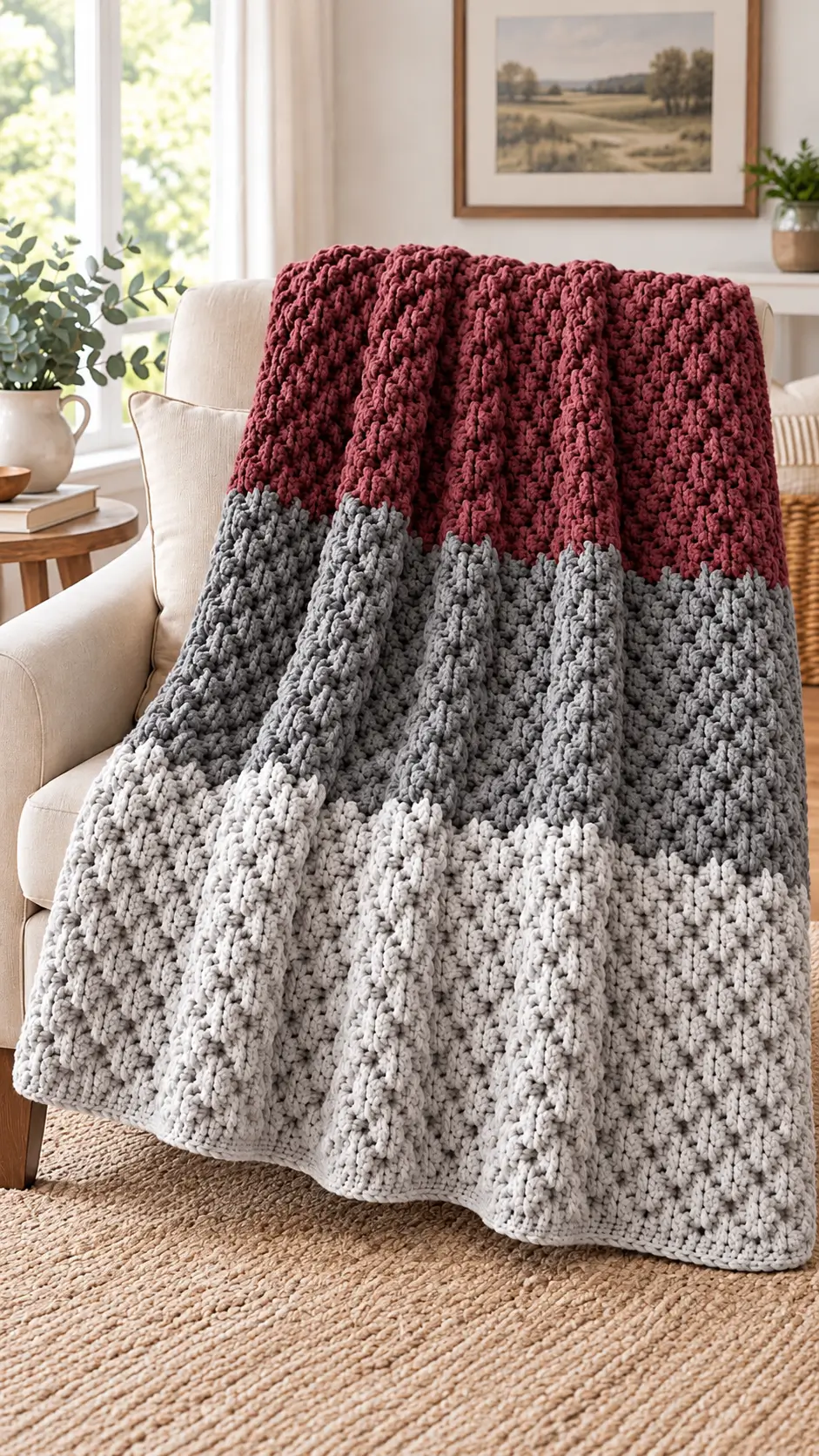
Three horizontal bands of burgundy, gray, and ivory give this blanket its distinctive appearance, while raised stitch columns provide the surface structure. This chunky crochet blanket pattern uses super-bulky yarn, an 11.5 mm starting hook, and a repeated textured stitch sequence to create a proposed 120 × 150 cm throw. The project suits an advanced beginner familiar with double crochet and post stitches. Its rectangular construction avoids shaping and separate panels.
The Design: What Makes This Three-Color Blanket Different
The defining feature of this three color crochet blanket is its combination of broad color blocks and prominent vertical stitch texture. Instead of alternating narrow stripes, the design allocates approximately one-third of its length to each color, with ivory at the lower end, gray in the center, and burgundy at the opposite end.
The second structural decision concerns the stitch pattern. Front-post double crochet produces raised columns that interrupt the flatter double crochet background. These columns add definition without requiring separate cables or joined panels.
Finally, the blanket is constructed as one rectangle. This reduces seams and helps maintain consistent width throughout the project.
A frequent mistake with a textured crochet throw is changing yarn in the middle of a textured row. That produces an uneven transition. Complete each color section before starting the next.
Project Info at a Glance
| Detail | Specification |
|---|---|
| Skill Level | Advanced beginner |
| Estimated Time | 12–20 hours (estimate) |
| Target Size | 120 × 150 cm (47 × 59 inches) |
| Starting Hook | 11.5 mm |
| Yarn Weight | Super bulky #6 |
| Construction | Worked flat in rows |
| Main Stitches | Double crochet and front-post double crochet |
| Colors | Burgundy, gray, ivory |
| Best For | Sofa throw or decorative bed layer |
Note: This is an original, photo-inspired pattern, not a tested reconstruction of the photographed blanket. Finished dimensions and yarn consumption depend on gauge.
Materials and Tools
Yarn
Choose three colors from the same super-bulky yarn line. Mixing different yarn thicknesses can produce uneven color blocks and inconsistent stitch definition.
- Ivory / oatmeal: Super bulky #6, approximately 450–550 yards. Suggested yarn: Bernat Blanket.
- Medium gray: Super bulky #6, approximately 350–475 yards. Suggested yarn: Bernat Blanket.
- Muted burgundy: Super bulky #6, approximately 350–475 yards. Suggested yarn: Bernat Blanket.
The estimated total yarn budget is 1,200–1,500 yards. These are planning quantities, not measured consumption for a completed sample. Buy according to your swatch measurements and yarn label yardage.
Tools
- 11.5 mm crochet hook, or size needed to achieve gauge
- Large-eye tapestry needle for weaving ends
- Scissors for cutting yarn
- Locking stitch markers for marking edge stitches
- Measuring tape for checking width and length
- Row counter for tracking the color sections
Gauge and Swatch
Before making the full blanket, crochet a swatch measuring at least 20 × 20 cm using the textured stitch repeat described below.
Measure the center 10 cm after the fabric has relaxed. Record the number of stitches and rows.
For a 120 cm target width, a 90-stitch foundation requires approximately 7.5 stitches per 10 cm.
If your swatch differs, adjust the foundation chain in multiples of three. Do not assume the proposed measurements will match every yarn and hook combination.
Crochet Abbreviations
| Abbreviation | Meaning |
|---|---|
| ch | Chain |
| sc | Single crochet |
| dc | Double crochet |
| FPdc | Front-post double crochet |
| sl st | Slip stitch |
| st / sts | Stitch / stitches |
| rep | Repeat |
| RS | Right side |
| WS | Wrong side |
| FO | Fasten off |
| BLO | Back loop only |
All instructions use US crochet terminology. Turning chains do not count as stitches unless specifically stated.
Chunky Crochet Blanket Pattern – Step by Step
The blanket is worked flat in rows, beginning with the ivory section, continuing through gray, and finishing with burgundy.
Step 1: Foundation Chain
Yarn: Ivory
Ch 92.
Row 1: Dc in the third chain from the hook and in each remaining chain across. (90 dc)
Turn. The two skipped chains do not count as a stitch.
Place a stitch marker in the first and last stitch. Check that Row 1 contains exactly 90 stitches before continuing.
Step 2: Raised Texture Stitch
This pattern uses a two-row raised texture repeat. The front-post stitches form a prominent surface texture while ordinary double crochet stitches provide the background.
Row 2: Ch 2, turn. Dc in the first st. Repeat [FPdc around the next st, dc in the next 2 sts] 29 times. FPdc around the next st, dc in the last st. (90 sts)
Row 3: Ch 2, turn. Dc in the first st. Repeat [dc in the next st, FPdc around the next st, dc in the next st] 29 times. Dc in the last 2 sts. (90 sts)
Repeat Rows 2–3 throughout the blanket.
Technical note: The two-row repeat produces an alternating raised texture rather than an exact replica of the photographed stitch. Each front-post double crochet counts as one stitch. The repeat should be checked on a swatch before beginning the full blanket.
Step 3: Ivory Color Section
Yarn: Ivory / oatmeal
Continue repeating Rows 2 and 3 until the ivory section measures approximately 50 cm from the foundation edge.
Measure along the side edge without stretching the fabric. Finish at the end of a complete two-row repeat so the next section continues the same texture sequence.
To change color, work the final double crochet until two loops remain on the hook. Yarn over with gray and pull through both loops.
Cut the ivory yarn, leaving a tail approximately 15 cm long.
Do not tie the two yarn colors together with a knot. The tails will be woven into the fabric during finishing.
Step 4: Gray Color Section
Yarn: Medium gray
Continue the established two-row textured stitch repeat.
Maintain 90 stitches across each row. Check the stitch count periodically, especially at the first and last stitches.
Work until the gray section measures approximately 50 cm.
The combined ivory and gray sections should now measure approximately 100 cm, assuming the target gauge has been achieved.
Check the width near the foundation edge, at the first color transition, and near the working edge. A noticeable difference may indicate changing tension or an incorrect stitch count.
At the end of a complete texture repeat, change to burgundy using the same color-change method.
Leave a 15 cm gray yarn tail.
Step 5: Burgundy Color Section
Yarn: Muted burgundy
Continue repeating the established texture pattern.
Work until the burgundy section measures approximately 50 cm or until the entire blanket reaches the desired 150 cm length.
Complete the final two-row repeat for a consistent upper edge.
An optional leveling row can be added:
Final leveling row: Ch 1, turn. Sc in each stitch across. (90 sc)
This row can help reduce irregularities along the top edge, although it may create a slightly firmer finish.
Fasten off and leave a 15 cm yarn tail.
Step 6: Optional Single Crochet Border
Yarn: Ivory or gray
The reference blanket does not clearly show a contrasting border. This step is optional and may be omitted if the edges are already even.
Join the yarn at any corner.
Work one round of single crochet evenly around the blanket, placing 3 sc in each corner.
Along the foundation and final edges, work approximately one single crochet per stitch.
Along the side edges, distribute stitches according to the row height and the way the fabric lies flat.
If the border ripples, too many stitches may have been added. If it pulls inward, add more stitches along the affected edge.
Join with a slip stitch, fasten off, and weave in the tail.
Step 7: Finishing and Blocking
Lay the blanket flat on a clean surface and check the overall shape.
Both long edges should be approximately equal in length, and the color transitions should remain level.
Thread each yarn tail through a large-eye tapestry needle. Weave it through several stitches on the wrong side, reverse direction, and weave through a different path.
Avoid pulling the yarn ends tightly enough to distort the textured stitches.
If using polyester chenille yarn, follow the care instructions printed on the yarn label. Do not place a hot iron directly against the fabric.
Allow the blanket to relax before taking its final measurements.
How to Resize the Blanket
The proposed design uses a 90-stitch working width. To make a narrower or wider blanket, choose a working stitch count divisible by three and add two chains for the foundation.
| Working Stitches | Foundation Chains |
|---|---|
| 60 | 62 |
| 75 | 77 |
| 90 | 92 |
| 105 | 107 |
| 120 | 122 |
These stitch counts preserve the three-stitch grouping. Actual blanket width depends on yarn thickness, hook size, and gauge.
For a longer throw, add rows evenly to all three sections. For a smaller lap blanket, reduce each color section to approximately 35–40 cm.
You can also modify the color proportions. A longer ivory section creates a larger neutral area, while equal sections produce a more balanced color-block appearance.
Assembly and Finishing Checklist
- Lay the blanket flat with the ivory section nearest you.
- Check the foundation edge for the correct stitch count.
- Inspect both long edges for missing or added stitches.
- Confirm that the three color sections are aligned.
- Measure the width at three different points.
- Measure the total length without stretching the fabric.
- Inspect the raised stitches for accidental ordinary double crochets.
- Weave in all color-change yarn tails securely.
- Add the optional border if the edges need stabilization.
- Record the finished dimensions, yarn consumption, and hook size.
The blanket is complete when all yarn ends are secured and the finished measurements have been recorded.
7 Technical Tips for a Better Chunky Blanket
- Use stitch markers at both edges. Missing the final stitch is a common cause of narrowing, especially when thick yarn obscures the top loops.
- Check the width every 10 rows. A change greater than approximately 2 cm can indicate inconsistent tension or an incorrect stitch count.
- Keep the turning-chain rule consistent. The ch-2 turning chain does not count as a stitch in this pattern, so counting it creates accidental increases.
- Complete color changes at row ends. Changing yarn midway through a textured row interrupts the color boundary and can make the transition appear uneven.
- Avoid excessive post-stitch tension. A tightly worked FPdc can shorten the row and pull the fabric inward, particularly with chenille yarn.
- Lay the blanket flat before measuring. Pulling on one corner while measuring can overstate the finished length by several centimeters.
- Leave at least 15 cm for weaving tails. Short ends are difficult to secure in thick, slippery polyester yarn and may work loose during washing.
Common Crochet Blanket Problems
Why are the edges becoming narrower?
The most likely cause is a missed first or last stitch. Count all 90 stitches at the end of each row and keep the edge markers in place.
Why does the gray section look wider than the ivory section?
Different yarn lots or colors can behave differently, even within the same product line. Compare gauge after each color change and adjust hook size only if the difference is significant.
Why is the blanket stiff?
The hook may be too small for the yarn and stitch structure. Make a second swatch using a larger hook and compare flexibility before continuing.
Can this blanket be made with velvet yarn?
Yes, but velvet yarn can make stitch identification more difficult. Work a larger swatch and inspect the front-post stitches under good lighting.
Can I use a different color combination?
Yes. The construction works with any three compatible yarn colors. Keep the yarn weight and gauge consistent across the sections to avoid changes in width.
Can I make the blanket without a border?
Yes. The border is optional. If the foundation edge, final row, and side edges are even, the blanket can be finished by weaving in the yarn tails.
Can I wash the finished blanket?
Follow the care instructions for the exact yarn used. Many polyester blanket yarns are machine washable, but washing temperature and drying recommendations differ by product.
Conclusion
This chunky crochet blanket pattern uses three large color sections and a repeating raised-stitch structure to produce a substantial rectangular throw. The ivory, gray, and burgundy arrangement can be changed without modifying the basic construction, provided the yarn weight and gauge remain consistent.
Before making a second blanket, record the actual stitch gauge, row count, finished measurements, and total yarn consumption. Those measurements will make resizing more accurate and help determine the quantity of yarn needed for another project.
Save this pattern to Pinterest or share your completed blanket on Instagram using #ThreeColorChunkyBlanket.
Would you keep the burgundy section at one end, as shown in the photograph, or place it between the ivory and gray sections?