Introduction
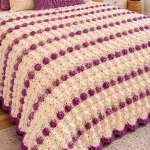
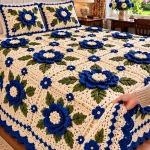
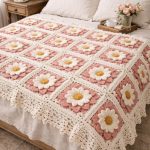
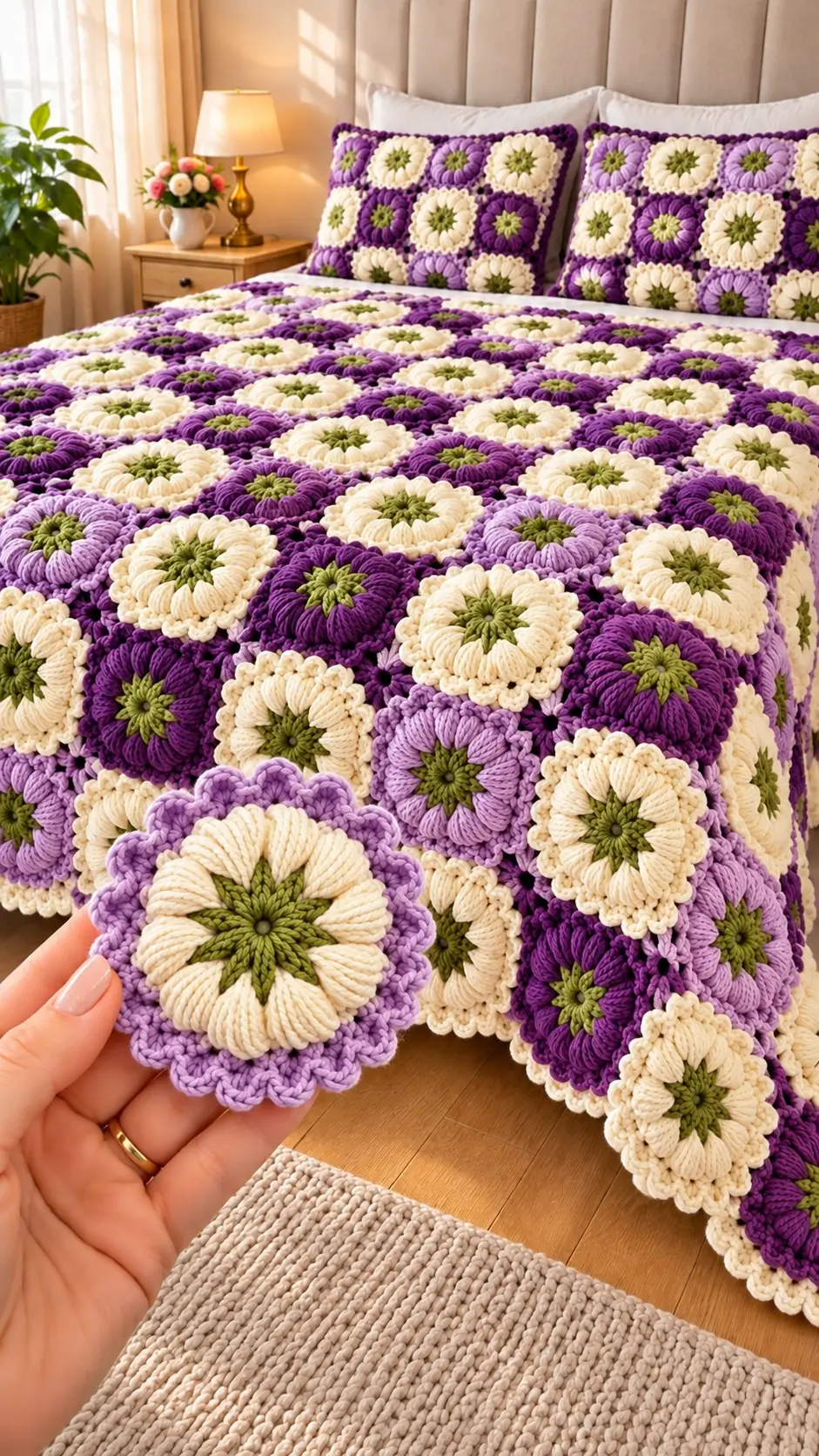
Olive flower centers carry twelve raised petals, while deep-purple, cream, and lilac squares form the bedspread’s alternating grid. This purple flower granny square blanket uses worsted-weight yarn, a 5 mm hook, and a planned 12-by-14 motif layout. The finished target is approximately 186 by 216 cm if each blocked square reaches 15 cm. Intermediate crochet skills are needed. Separate motifs allow damaged sections to be repaired without remaking the bedspread.
The Design: What Makes This Floral Bedspread Different
The olive center is deliberately small: two single-crochet rounds create twelve attachment stitches without a wide green disc. Raised puff petals sit on those twelve stitches, so every flower keeps a defined radial outline. Unlike a flat floral print, each bloom stands above the surrounding fabric. The frame assigns one corner to each third petal gap. This construction turns a twelve-point circular flower into four evenly spaced corners, then adds three flatter rounds that supply the edges needed for joining. The alternating cream, deep plum, and lilac arrangements prevent large blocks of one color from dominating the crochet floral bedspread. A frequent error in a 3D flower granny square is tightening the closing chain of each puff until the petal collapses. Keep loop height consistent; the frame should remain flatter than the bloom.
Project Info at a Glance
| Skill Level | Time | Finished Size | Hook | Best For |
|---|---|---|---|---|
| Intermediate | Record one sample motif and multiply by 168; no tested time | Planned 186 × 216 cm at 15 cm per square, including a 3 cm border | 5 mm starting hook | A bed topper or draped decorative blanket |
The 15 cm square measurement is a target, not an achieved gauge. Another published worsted blanket reports 14.5 cm blocked squares and approximately 17 g per square, but its stitch structure is different. Do not treat those figures as a measured result for this design. For a smaller throw, use fewer squares while keeping the same round instructions.
Materials and Tools
Yarn
- Deep plum or royal purple — worsted #4 — budget 1,550 g — suggested range: an acrylic blanket yarn such as Stylecraft Special Aran. The dark yarn forms plum petals, many square frames, and optional seams.
- Ivory cream — worsted #4 — budget 1,200 g — suggested range: the same yarn line. This shade supplies pale flowers, cream frames, and the scalloped outside edge.
- Lilac — worsted #4 — budget 550 g — suggested range: the same yarn line. Lilac supplies light-purple petals and occasional seam accents.
- Olive green — worsted #4 — budget 300 g — suggested range: the same yarn line. Olive creates the small flower centers.
These are purchase allowances for the 168-square bedspread, not independently measured consumption. Together they total 3,600 g, including a practical reserve. A published 14.5 cm blanket motif uses about 17 g; multiplying that comparison by 168 gives 2,856 g before edging and spare yarn. Puffs may take more yarn than flatter square designs. Crochet one full sample, weigh it separately by color if possible, and update the quantities before buying the remaining balls. Matching pillow covers need additional yarn.
Tools
- 5 mm crochet hook, with 4.5 mm and 5.5 mm available if gauge needs correction.
- Stitch markers for the first petal and each of four corners.
- Tapestry needle with a blunt tip for seaming and woven ends.
- Scissors, a tape measure, digital kitchen scale, and blocking pins or mats.
- Two 45 × 45 cm cushion inserts and optional 40 cm zippers for the matching covers.
- No safety eyes or stuffing are used in the bedspread motifs; cushion inserts provide the pillow volume.
A washable acrylic or acrylic-blend yarn suits a regularly handled blanket. The photographed yarn looks thicker than some common worsted yarns, but photographs alone cannot establish fiber content, category, or meterage. Keep every color in the same yarn family to reduce gauge differences.
Abbreviations
MR = magic ring; sc = single crochet; inc = two sc in one stitch; dec = decrease; sl st = slip stitch; ch = chain; BLO = back loop only; dc = double crochet; sp = space; st/sts = stitch/stitches; puff = raised puff stitch; RS = right side. This pattern uses US crochet terms; dec and BLO are reference abbreviations and are not required in the standard motif.
An invisible decrease is made through the front loops of two adjacent stitches, but this blanket motif does not use decreases.
Pattern — Step by Step
Work the center in joined rounds rather than a continuous amigurumi spiral. Join each round with a slip stitch where directed, and keep the RS of the petals facing upward. The bracketed stitch numbers count worked stitches; corner chains are identified separately because they do not count as dc or sc. Make one complete sample and block it before committing to the full layout.
Flower Center and Raised Petals (Make 168)
Yarn: olive green for R1–R2; cream, deep plum, or lilac for R3. Source: original motif arithmetic, informed by standard puff-stitch construction.
R1: In olive, work 6 sc into MR; close the ring and join to first sc. (6 sc)
R2: Ch 1, inc in each sc around, and join to first sc. Fasten off green with a 12 cm tail. (12 sc)
Special puff: Yarn over, insert hook into the indicated stitch, yarn over and pull up a long loop. Repeat this draw-up four times in the same stitch, leaving nine loops on the hook; yarn over and pull through all nine loops. The following ch 1 closes the puff and supplies its spacing loop.
R3: Join the chosen petal color in any sc. [Puff in next sc, ch 1] twelve times; join with a sl st to the top of the first puff, avoiding the ch-1 gap. Fasten off with a 12 cm tail. (12 puffs; 12 ch-1 spaces)
Place a marker in the first ch-1 space. Verify twelve separate petal tops and twelve intervening spaces before proceeding. Do not stuff the flower; its relief comes from the long loops, not filling.
Square Frame (Make 168)
Yarn: deep plum for cream and lilac flowers; ivory cream for deep-plum flowers. Source: original square conversion and stitch-count arithmetic.
R4: Join the frame yarn in the marked first ch-1 space. [Work (2 dc, ch 2, 2 dc) in the next space, then 1 dc in each of the following two spaces] four times; join with sl st to the first dc. (24 dc; four ch-2 corners)
R5: Sl st across to the next corner ch-2 space. [In corner work (2 dc, ch 2, 2 dc), then work 1 dc in each of the next six dc] four times; join to first dc. (40 dc; four ch-2 corners)
R6: Repeat the corner treatment, placing 1 dc in each of the ten side dc between consecutive corner spaces. Join to first dc. (56 dc; four ch-2 corners)
R7: Ch 1. [In corner work (sc, ch 2, sc), then work 1 sc in each of the fourteen dc along the next side] four times; join to first sc. (64 sc; four ch-2 corners)
Fasten off and leave a 20 cm tail if the square will be sewn directly to its neighbor; otherwise weave the frame tail into the wrong side. The completed square has sixteen sc between successive corner gaps. Flatten and measure it without stretching the puff petals. If it does not reach 15 cm, use the actual blocked measurement in the blanket-size equation rather than assuming the planned dimensions.
Color Distribution (168 Motifs)
Yarn: three petal/frame combinations; source: original layout.
A: Olive center, cream petals, deep-plum frame — 56 squares.
B: Olive center, deep-plum petals, cream frame — 56 squares.
C: Olive center, lilac petals, deep-plum frame — 56 squares.
Arrange twelve columns by fourteen rows. For the first row repeat A–B–C four times; for the second repeat B–C–A; for the third repeat C–A–B. Continue this three-row rotation across all fourteen rows. Because each row contains twelve motifs, every row contributes four of each type. Fourteen rows therefore require exactly 56 of each type, with no shortage caused by the rotation.
Use the same frame-round count on every square. Do not increase the petal count for larger blooms: that would change the twelve-gap corner placement and make joining inconsistent.
Join the Bedspread
Yarn: deep plum or cream for joining; source: standard mattress-stitch seaming.
Block all 168 squares to the same measurement before sewing. Lay the pieces RS up in their planned arrangement, then work with two adjacent edges facing each other. Thread a yarn needle and pick up the matching edge loops on each of the sixteen side sc, moving from one corner gap to the next. Snug the seam after several stitches, rather than pulling each stitch tight. Join twelve squares into each row, then join fourteen rows into one rectangle. Catch the junctions where four corner spaces meet so a hole does not open at the crossing.
There are 154 joins between adjacent squares within rows (11 joins × 14 rows) and 13 long seams between rows. Mark each long seam at every square boundary before sewing so a one-stitch shift cannot accumulate down the bedspread. Leave the raised flowers on the public face; seams should not cover the puff tops.
Scalloped Blanket Border
Yarn: ivory cream. Source: standard single-crochet and five-double-crochet shell construction; counts calculated for this exact 12-by-14 layout.
B1: Work 1 sc into each of the sixteen exposed edge stitches on all outer square sides, 1 sc into each of the 48 outer seam junctions, and 3 sc into each of the four outside corner spaces. Finish with sl st. (892 sc: 832 edge sc + 48 junction sc + 12 corner sc)
B2: Work 1 sc in each B1 stitch, except make 3 sc in the middle sc of each outer corner group. Close with sl st. (900 sc)
B3: [Skip 2 sc, 5 dc in next sc, skip 2 sc, sl st in next sc] 150 times around. Fasten off with a 20 cm tail. (150 shells = 750 dc and 150 sl st)
The math assumes exactly sixteen exposed side stitches per square and one added stitch at each outer seam junction. If you add seam stitches during joining, recount B1 before using the shell repeat. The border need not place a shell summit at all four corners; what matters is a flat perimeter with no forced increases.
Matching Floral Pillow Covers (Make 2)
Yarn: the four bedspread colors. Source: original layout extension.
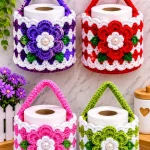
Each pictured pillow has a floral front made from square motifs. For a separate matching project, make eighteen additional squares per pillow: nine for its front and nine for its back. Arrange each face as a 3-by-3 grid, join using the same sixteen-edge-stitch seam method, then join front and back on three sides. Install a zipper along the fourth side or use a removable sewn closure before inserting a cushion.
At a measured 15 cm square gauge, each assembled face is approximately 45 × 45 cm before seaming. Test fit against the insert, since a thick puff square can shorten the usable internal opening. Two reversible covers consume 36 extra motifs, increasing the combined project to 204 squares; the bedspread yarn allowance above excludes them. For a smoother pillow back, replace the nine rear motifs with a correctly sized fabric panel rather than inventing a second crochet gauge.
Assembly
- Complete one olive-centered flower sample and check that all twelve petals are distinct.
- Add the square frame through R7, counting four corner spaces and sixteen side sc between each pair of corners.
- Block the sample, record its width, height, and weight, and correct the project measurements if required.
- Make the remaining 167 blanket squares in the stated A, B, and C quantities.
- Arrange the completed motifs into twelve columns and fourteen rows, keeping every flower face upward.
- Join the squares into fourteen individual rows, matching their corner gaps and side stitch positions.
- Sew the thirteen long row seams and secure every four-square intersection.
- Crochet border rounds B1 through B3, recounting the outside edge before starting the shell round.
- Assemble the two optional floral cushion covers from thirty-six additional squares, then fit their closures.
- Weave in every loose tail for at least 5 cm in one direction and 5 cm back through a different route, then wash and dry according to the yarn label.
The resulting blanket consists of 168 joined flower squares with a continuous scalloped border.
7 Technical Tips
- Missing stitch marker: A misplaced first ch-1 space shifts every intended square corner by one petal. Mark the first petal gap immediately after R3 and compare corner spacing after R4.
- Overfilled petals: Stuffing a puff makes the flower bulky and distorts its frame. Use zero filling inside the motifs and reserve a cushion insert only for the pillow covers.
- Unplanned decreases: Using an invisible dec to flatten a buckled square changes the intended side count. Keep all sixteen sc on each completed side and correct hook size or loop tension instead.
- Eye-placement confusion: Safety eyes do not belong in a blanket with raised yarn flowers. Keep hard plastic components out of the bedspread surface, particularly if children might use it.
- Variable puff tension: Pulling the four draw-ups to different heights creates uneven petal diameters. Match each loop to roughly the height of the adjacent double-crochet stitches and check twelve petals per flower.
- Unpinned seaming: Joining unblocked squares can shift a 14-row blanket out of alignment by several centimeters. Pin each seam at every corner gap and confirm equal edge counts before the needle passes through.
- Loose tails: A 2 cm woven end may emerge after laundering and loosen a join. Weave at least 5 cm forward and 5 cm back through a different set of wrong-side stitches without catching the petal face.
Size and Yarn Calculations
Use finished blanket width = number of columns × blocked motif width + twice the border width. For the proposed twelve columns, 15 cm motif width, and 3 cm border, this is 12 × 15 + 6 = 186 cm. The same calculation across fourteen rows gives 14 × 15 + 6 = 216 cm. If the sample blocks to 13 cm rather than 15 cm, the expected blanket becomes approximately 162 × 188 cm using the same border allowance.
For yarn, weigh one completed motif after its tails are trimmed. If the sample weighs 19 g, then 168 × 19 = 3,192 g for motifs alone. Add the measured border consumption, seaming yarn, and a reserve for matching dye lots. A kitchen scale is more reliable than estimates based on a photograph. To compare color needs, make and weigh one A, one B, and one C motif, then multiply each color’s usage by 56. This procedure accounts for the fact that deep plum is used in more frames than lilac.
A 186 cm blanket may serve as a topper on a wide mattress but will not necessarily provide the long side drop shown in the image. Measure mattress width, mattress length, and desired drop on each side; choose a larger grid when those measurements require it. Keep a note of the final square count for reordering yarn.
Care, Blocking, and Repair
Check the ball band before washing any assembled section. Some acrylic yarns tolerate a gentle machine cycle, while wool blends may need cooler water and flat drying. Thick textured petals retain moisture longer than flat granny rounds, so allow the entire blanket to dry before folding it. A mesh laundry bag is useful for an individual cushion cover; the full bedspread may be too heavy for a household washer.
To repair a single damaged square, release only the seams bordering that motif, crochet a replacement in the same colors, and mattress-stitch it into place using its sixteen side stitches. The border can remain attached unless the damaged piece touches the outside perimeter. Record the hook size, yarn names, color codes, and blocked square measurement with the finished project so future replacement motifs match.
Conclusion
The central decision in this purple flower granny square blanket is not the petal color; it is keeping twelve puff stitches aligned with four square corners across 168 repeated motifs. Start by making one full square, blocking it, and weighing the finished sample. Those three measurements establish the practical blanket size, yardage, and hook adjustments before the larger batch begins. When the joined bedspread is finished, photograph the full surface for Pinterest and share a close view of the petal texture on Instagram with #PurpleFlowerGrannySquareBlanket. Keep the color order and motif measurements with the project notes. Which arrangement gives the clearest contrast around the olive centers: cream petals on plum frames or plum petals on cream frames?