Introduction
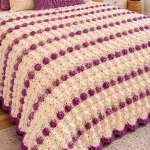
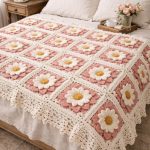
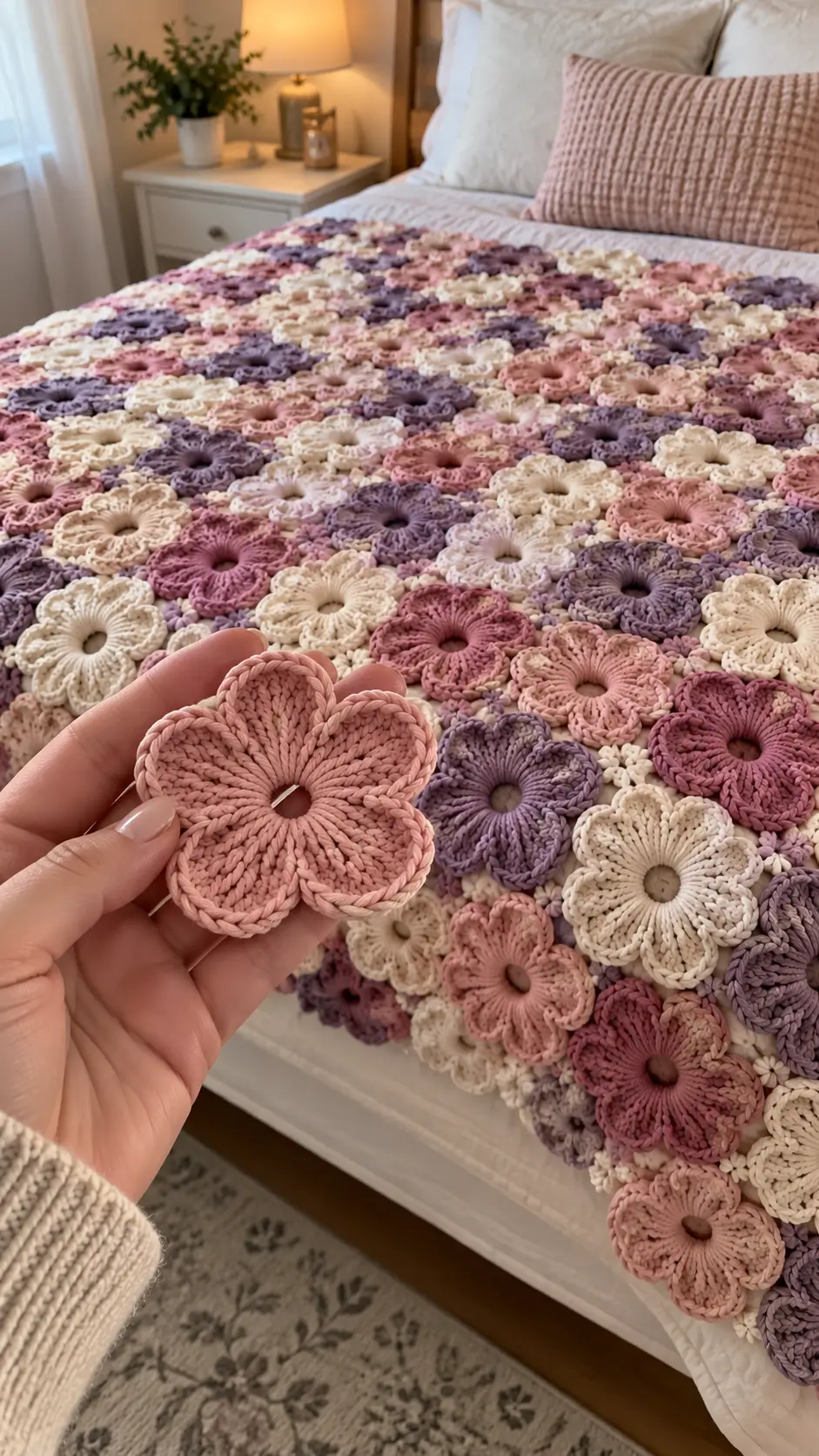
Five petals around an open center create the repeating geometry of this bedspread. This five-petal crochet flower blanket uses worsted-weight yarn, a 5 mm hook, and separate blush, mauve, lavender, and ivory motifs linked by smaller cream flowers. The proposed size is approximately 120 × 165 cm, subject to a measured sample. Intermediate crochet skills are appropriate because the main challenge is positioning irregular motifs in a stable fabric.
The Design: What Makes This Flower Blanket Different
Each large flower uses a thirty-stitch circular base divided into five groups of six. Two treble-stitch fans form each petal. An edging round holds the fan stitches in place and adds a restrained ridge.
The second decision concerns the joins. Five-petal flowers do not tessellate into a rectangular surface without gaps; forcing every petal to meet produces bunching. Small ivory rosettes bridge selected openings while leaving some lace-like spaces visible. The textured floral crochet throw remains flexible.
Finally, the pastel crochet bedspread uses a staggered layout. The usual mistake is attaching a complete row before checking how the next row nests into it. Pin two rows, examine the gaps, and then sew the connections. The maker should not assume that five petals will align with four sides.
Project Info at a Glance
| Skill Level | Time | Finished Size | Hook | Best For |
|---|---|---|---|---|
| Intermediate | Sample-dependent | Approx. 120 × 165 cm target | 5.0 mm | Decorative throw or bed topper |
Note: The size and hook are proposed specifications for this original photo-inspired pattern. The photographed blanket’s exact measurements and construction have not been verified.
Materials and Tools
Yarn
Choose smooth worsted-weight (#4) cotton-blend or acrylic yarn in a consistent product line. Lion Brand Pound of Love is one possible option. Test the yarn and hook together before purchasing all colors.
- Dusty blush pink — worsted #4 — approximately 420 g for 35 large flowers.
- Muted rose — worsted #4 — approximately 420 g for 35 large flowers.
- Dusty lavender — worsted #4 — approximately 420 g for 35 large flowers.
- Warm ivory — worsted #4 — approximately 770 g for 35 large flowers, small connectors, joins, and finishing.
These quantities are planning estimates based on approximately 12 g per large flower and 350 g for the connectors and finishing. Actual yarn consumption must be determined by weighing completed samples.
Tools
- 5.0 mm crochet hook
- Tapestry needle with a blunt tip
- Stitch markers, at least five
- Measuring tape
- Digital kitchen scale
- Scissors
- Rustproof blocking pins
- Flat blocking surface
No safety eyes, stuffing, wire, or plastic parts are required.
Abbreviations
- MR: Magic ring
- sc: Single crochet
- inc: Two single crochets in one stitch
- dec: Single-crochet decrease
- hdc: Half double crochet
- dc: Double crochet
- tr: Treble crochet
- sl st: Slip stitch
- ch: Chain
- BLO: Back loop only
- st/sts: Stitch/stitches
- R: Round
An invisible decrease takes the front loops of the next two stitches before the final pull-through, but decreases are not used in this blanket.
Five-Petal Crochet Flower Blanket Pattern — Step by Step
Pattern notes: This is an original, photo-inspired interpretation rather than the authenticated pattern used in the photograph. Stitch counts have been checked mathematically, but the pattern has not been physically tested. Instructions use US crochet terminology.
Work the flower center in a continuous spiral. Petal and connector rounds are joined as indicated. Joining slip stitches are not included in the stitch count unless stated.
Large Five-Petal Flower (Make 140)
Yarn: one pastel color per flower.
R1: Work 6 sc in MR. Leave the central opening approximately 8–10 mm wide. (6)
R2: Inc × 6. (12)
R3: (Sc 1, inc) × 6. (18)
R4: (Sc 2, inc) × 6. (24)
R5: (Sc 3, inc) × 6. (30)
Mark five groups of six stitches. Join to the first stitch with a sl st. The joining stitch does not count as an additional stitch.
R6: Across each six-stitch group, work:
- Sl st in stitch 1
- Sc in stitch 2
- 4 tr in stitch 3
- 4 tr in stitch 4
- Sc in stitch 5
- Sl st in stitch 6
Repeat the sequence across all five groups. (60 worked stitches, including 10 slip stitches; five petals)
R7: Work in BLO of R6: repeat (sc in next 2 sts, hdc in next st, dc in next 6 sts, hdc in next st, sc in next 2 sts) × 5. Join to first sc. (60)
Fasten off, leaving a 20 cm yarn tail for assembly.
Each petal has twelve worked stitches around its outer edge. If the flower curls upward after blocking, test a hook 0.5 mm larger for the petal rounds before producing the remaining motifs.
Optional Raised Texture
For radial texture similar to the photographed blanket, add two short surface-slip-stitch lines to each petal. Start near the base of the petal and stop before its outer curve. Test the placement on a single flower.
The decorative surface stitching does not change the sixty-stitch perimeter count.
Small Cream Connector Flower (Make Approximately 100–130)
Yarn: warm ivory.
R1: Work 6 sc in MR. Tighten the center. (6)
R2: Inc × 6. (12)
R3: Repeat (sl st in next st, then hdc, dc, hdc in the following st) × 6. (24 worked stitches, including 6 slip stitches)
R4: Sc into each of the 24 stitches, including the slip stitches. Join to first sc. (24)
Fasten off, leaving a 20 cm sewing tail.
These small six-lobed flowers bridge the larger spaces between the five-petal motifs. The final number of connectors depends on the spacing and arrangement of the finished blanket.
Optional Tiny Edge Flower
Yarn: ivory or leftover pastel yarn.
R1: Work 6 sc in MR. (6)
R2: Inc × 6. (12)
R3: Repeat (sl st in next st, 3 hdc in the following st) × 6. (24 worked stitches, including 6 slip stitches)
Fasten off, leaving a 15 cm yarn tail.
Use these smaller flowers only where narrow gaps appear at the edge. A perfectly straight border is unnecessary because the intended silhouette is scalloped.
Color Distribution and Blanket Layout
For the proposed 140-flower blanket, arrange ten flowers across and fourteen rows down. Make approximately 35 flowers in each of the four main colors.
Distribute the colors irregularly rather than making solid stripes. Avoid placing more than three matching flowers directly beside each other.
Position odd-numbered rows in a straight line and shift even-numbered rows by approximately half a flower width. This stagger helps reduce long openings between the five-petal shapes.
Lay out twenty flowers before joining the full blanket. Measure their combined width and height without stretching the petals.
Use this sample arrangement to calculate the likely dimensions. Add or remove rows to match the desired bed or throw size.
Important: The target size of 120 × 165 cm is not guaranteed. The flower diameter, yarn, hook, joining tension, and blocking method determine the finished measurement.
How to Join the Large Crochet Flowers
Use a matching pastel yarn or the long tails left on each flower.
- Place two flowers with their right sides facing upward.
- Move the motifs until neighboring petals meet naturally.
- Thread the yarn tail through a tapestry needle.
- Sew through three corresponding stitches along the outer petal curves.
- Repeat the seam through the same area for additional strength.
- Avoid sewing the complete curved edges together.
- Check that both flowers still lie flat.
- Weave in the yarn securely on the wrong side.
Join the neighboring flowers in the first row. Position the second row in a staggered arrangement and pin the natural contact points.
Attach the second row at two or three suitable petal contacts per flower. Leave small gaps where pulling the petals together would distort their shape.
Continue joining one row at a time, checking the fabric after every completed section.
Installing the Cream Flower Connectors
Place a small ivory rosette into each larger space between the surrounding pastel flowers.
Use the 24-stitch outer edge of the connector to attach it at three or four nearby petal points. Sew through approximately two stitches at each connection.
The connector should bridge the gap without pulling the large motifs inward.
For an opening that exceeds the rosette diameter, add a relaxed chain of three to five stitches between the connector and the nearest large flower.
Keep some smaller spaces open to preserve the lace-like appearance.
Stop after every ten connectors and place the blanket on a flat surface. If wrinkles begin forming around a junction, remove and reposition that connector before continuing.
Optional Scalloped Edge Reinforcement
The flower petals create a naturally irregular edge. This appearance is a defining feature of the design.
Where adjacent border petals touch, reinforce their connection using three small stitches.
Across wider gaps, create a relaxed chain of three to five stitches and anchor it into the neighboring petal.
If the joining chains sag when the blanket is lifted, work a single-crochet pass over those chains.
A fixed border stitch count is not appropriate because the perimeter changes according to the number and orientation of the assembled motifs.
Block the complete blanket before deciding whether additional edging is necessary.
Assembly Instructions
- Complete one full-size flower, measure its diameter, and weigh it to determine actual yarn consumption.
- Make three additional large flowers and test their orientation in a staggered arrangement.
- Produce the remaining flowers in batches, recording the number completed in each color.
- Arrange the motifs in a ten-column and fourteen-row layout, adjusting the grid if the measurements require it.
- Pin the connection points with all flowers facing upward.
- Join neighboring flowers using three corresponding stitches along each natural petal contact.
- Attach the next staggered row without stretching the flower edges.
- Position and sew cream rosettes into the larger openings between motifs.
- Add optional small edge flowers, reinforce loose joins, and examine the border for uneven tension.
- Weave the remaining yarn tails through at least three neighboring stitches, reverse the needle direction, trim the ends, and block the blanket.
The completed blanket consists of individual flat crochet flowers connected into a flexible fabric with a scalloped floral border.
7 Technical Tips for a Better Flower Blanket
- Prevent marker drift: A missing marker can shift the six-stitch divisions and produce an incorrect number of petals. Confirm five groups of six stitches before beginning R6.
- Preserve the center opening: Closing the magic ring completely removes the small opening visible in the photographed flowers. Leave approximately 8–10 mm and secure the tail on the wrong side.
- Control petal curling: Eight treble crochets worked into two neighboring stitches can produce a cupped petal if the hook is too small. Test a hook 0.5 mm larger when the blocked sample refuses to lie flat.
- Count joining stitches correctly: An additional joining slip stitch can shift the next petal. R6 contains exactly 60 worked stitches, including ten slip stitches.
- Avoid uneven joins: Sewing the entire curved edge of a petal can create stiff ridges. Limit ordinary flower-to-flower seams to approximately three corresponding edge stitches.
- Maintain connector tension: A connector pulled tightly at every lobe can gather the surrounding flowers. Attach the small rosette at three or four points and leave its remaining edge free.
- Secure yarn tails: A short, one-direction weave can loosen during washing. Leave approximately 20 cm for assembly and reverse the needle path at least once before trimming.
Related Crochet Flower Patterns
- Five-Petal Flower Appliqué: A small worsted-weight flower suitable for testing color combinations. View the free pattern.
- Five-Petal Flower Granny Square: A floral square for projects requiring straight joining edges. View the Ravelry pattern.
- Puff Flower Joining Method: A reference for connecting individual flower motifs. See the joining tutorial.
- Chunky Flower Blanket: A textured floral blanket with information about yarn quantities per square. View the free pattern.
Conclusion
Check the dimensions of a blocked four-flower test panel before producing all 140 main motifs. The amount of yarn depends on measured consumption, and the final layout depends on how the five petals overlap or separate at each join. Keep a record of the actual motif diameter, weight, and number of cream connectors; those three figures make resizing the design practical.
After finishing the five-petal crochet flower blanket, photograph one complete section and one close-up showing the central holes and petal seams.
Share the result on Pinterest and Instagram with #FivePetalFlowerBlanket, including the finished dimensions. Which connector arrangement kept the lavender and rose flowers flattest at the four-motif junctions?