Introduction
Each overlapping scale on this bedspread creates a separate shadow line, turning a flat crochet surface into a dimensional textile. This crochet crocodile stitch bedspread pattern uses cream yarn, terracotta edging, and staggered scale rows to recreate the layered appearance. The project is intended for intermediate crocheters familiar with double crochet and working around stitch posts. A matching pillow cover can extend the same texture across the bedroom.
The Design: What Makes This Bedspread Different
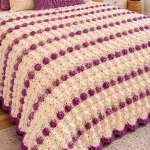
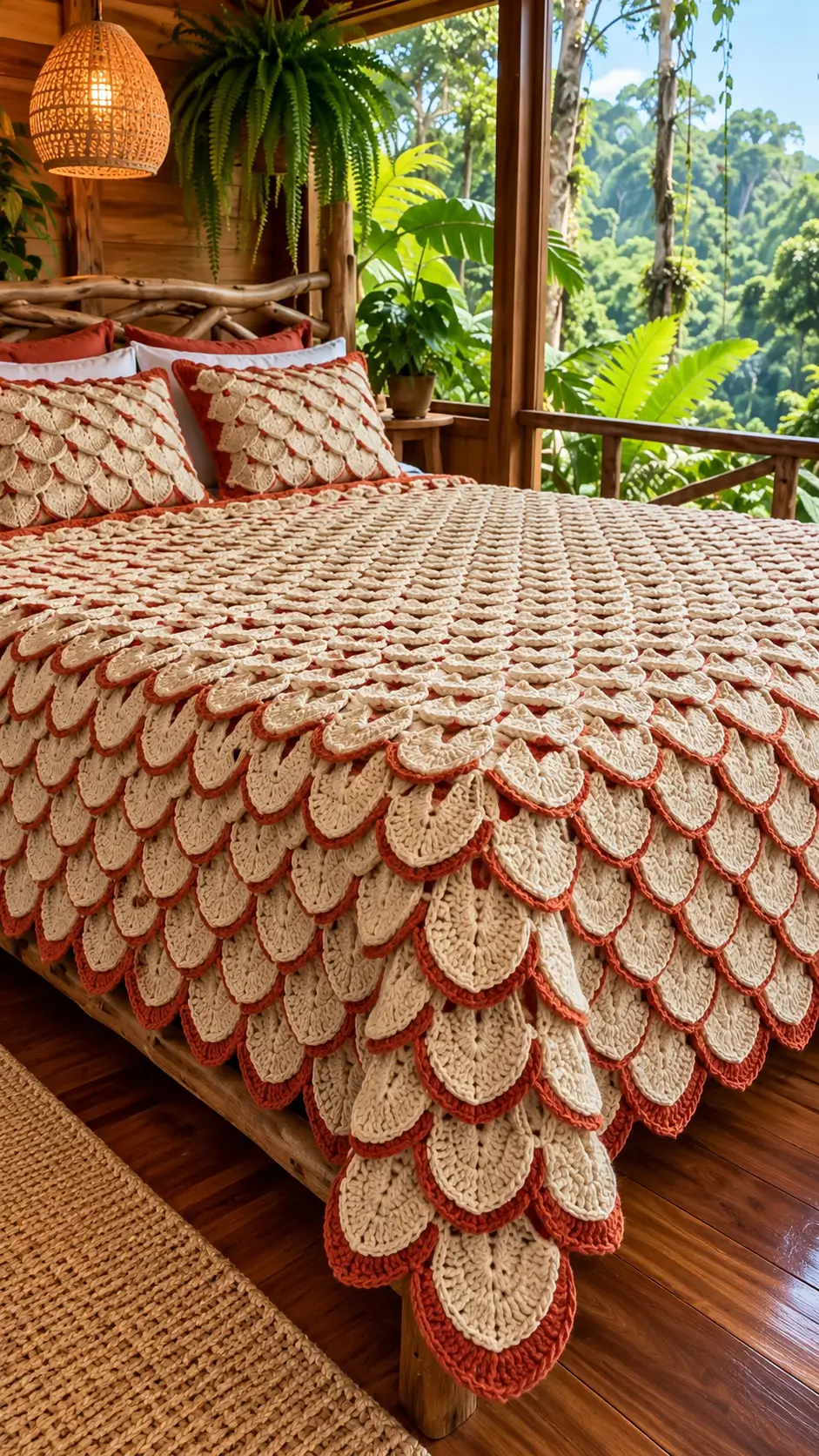
The photographed bedspread features hundreds of overlapping, leaf-shaped crochet scales arranged in horizontal tiers. Each scale has a cream center and a contrasting terracotta edge. The lower tiers extend over the sides of the bed, creating a substantial decorative drape.
The central construction principle is overlap. Instead of placing textured stitches side by side, each new row partially covers the supporting row beneath it. This produces the characteristic appearance associated with a crocodile stitch crochet blanket.
The second feature is the elongated scale shape. Traditional crocodile stitches create relatively broad, rounded scales. The reference uses longer pointed forms, so a modified scale or individually attached motif would be required for a closer reproduction.
A common mistake is choosing yarn quantities based on ordinary double crochet. Layered scales consume considerably more yarn than flat fabric.
Project Info at a Glance
| Skill Level | Estimated Time | Target Size | Hook | Best For |
|---|---|---|---|---|
| Intermediate | Long-term project; calculate from a sample | Custom bed dimensions | 5.5 mm reference hook | Decorative bedspread and matching pillows |
The 5.5 mm hook is documented for a published DK-weight crocodile-stitch blanket. The finished dimensions in the photograph cannot be established accurately without measuring the original bedspread.
Materials and Tools
Yarn
- Cream yarn: DK or light worsted weight for the main scale fabric.
- Terracotta yarn: matching yarn weight for the contrasting scale edges.
- Optional cream backing yarn: for a separate flat backing panel.
For a bed-sized project, purchase yarn only after making and weighing a representative sample. The total requirement depends on scale density, mattress dimensions, desired overhang, and whether a backing is added.
Tools
- 5.5 mm crochet hook
- Stitch markers
- Tapestry needle
- Scissors
- Digital kitchen scale
- Measuring tape
- Blocking mats
- Rust-resistant pins
Abbreviations
- ch: Chain
- sc: Single crochet
- dc: Double crochet
- sl st: Slip stitch
- st: Stitch
- sp: Space
- V-st: V-stitch
- RS: Right side
- WS: Wrong side
- FO: Fasten off
All instructions use US crochet terminology. A standard V-stitch consists of one double crochet, one chain, and another double crochet worked into the same stitch or space.
Understanding the Crocodile Stitch
The crocodile stitch is constructed in two stages.
First, crochet a foundation row containing pairs of double crochet posts.
Second, work multiple double crochet stitches around those posts rather than into their top loops.
One side of the scale is worked down the first post. The second side is worked upward around the neighboring post.
The resulting fabric projects forward from its foundation.
Successive rows are offset so the scales overlap instead of forming rigid vertical columns.
This construction is different from a conventional shell stitch, where several stitches are worked into a single chain space.
How to Crochet a Crocodile Scale
Step 1: Prepare a Practice Foundation
Begin with a small practice swatch rather than the full bedspread.
Use cream yarn and a 5.5 mm hook.
Work a foundation row containing several V-stitches or paired double crochet posts, following a consistent crocodile-stitch setup.
The purpose of the swatch is to establish the width of one completed scale and the vertical distance between scale rows.
Mark the first and last supporting posts.
Step 2: Work the First Side of the Scale
Rotate the work so the first double crochet post is accessible horizontally.
Work five double crochet stitches around the post.
Insert the hook around the body of the post rather than through the loops at its top.
Move from the upper end of the post toward its base.
The stitches should form one rounded half of the scale.
Step 3: Work the Second Side
Chain one to create the turning point.
Rotate the work to access the neighboring double crochet post.
Work five double crochet stitches around that post, moving from the base toward the top.
The two groups of five stitches form one complete scale.
Check that the scale projects toward the right side of the fabric.
Step 4: Secure the Scale
Work a slip stitch into the next designated foundation position.
This anchors the completed scale and separates it from the next one.
Continue across the practice row according to the spacing established by the chosen foundation method.
Do not add scales to every available post pair unless the foundation instructions specifically require that arrangement.
Step 5: Build the Next Supporting Row
After completing the first scale row, work another supporting row behind the existing scales.
Position the new V-stitches so the next tier will sit between the scales below.
Keep the previous scales facing outward.
Work the next set of scales around the newly created posts.
The staggered placement establishes the overlapping texture.
Creating the Cream and Terracotta Color Combination
The photographed bedspread uses cream as the dominant color and terracotta as a narrow outline.
For a standard crocodile-stitch blanket, changing to terracotta for an entire scale row creates a colored tier rather than a fine outline around each individual scale.
To reproduce the outlined appearance more closely, work the scales in cream and add a separate edging treatment.
Possible methods include surface crochet around accessible scale edges or individually crocheted motifs with terracotta final rounds.
Test the edging on one scale before applying it to a larger panel.
Additional border stitches can increase the scale’s circumference and cause its edge to curl.
How to Make Elongated Leaf-Shaped Scales
The reference photograph contains scales that are noticeably longer than standard crocodile stitches.
A conventional scale uses two groups of five double crochet stitches around supporting posts.
For a longer scale, the underlying structure must provide additional length.
Simply increasing the number of double crochet stitches around short posts often creates a wider, ruffled scale instead of a longer one.
A more controlled alternative is to crochet individual elongated leaf motifs and attach them to a supporting fabric in overlapping rows.
This method requires more assembly but gives greater control over length, pointed tips, and contrasting edges.
Alternative Construction: Individual Crochet Scale Motifs
For a closer visual match to the photograph, make a small collection of leaf-shaped motifs before deciding on the complete construction.
Each motif should have a narrow attachment end, a wider central section, and a pointed lower tip.
Work the main motif in cream.
Add a narrow terracotta border around the exposed edges.
Leave the upper attachment section available for sewing.
Arrange the motifs in overlapping rows on a flat supporting panel.
The attachment points should be covered by the next tier, leaving the lower portions free.
This creates a scale-like surface while allowing the individual motifs to retain their elongated shape.
Important: This is a construction alternative, not a tested stitch-by-stitch reproduction of the photographed bedspread.
Planning the Bedspread Dimensions
Measure the mattress before calculating the project.
Record the mattress width and length.
Next, decide how far the finished bedspread should hang over each side.
The total target width equals the mattress width plus twice the desired side drop.
The total target length equals the mattress length plus any additional drop at the foot of the bed.
For example, a mattress measuring 150 cm wide with a 35 cm drop on each side requires a finished bedspread width of approximately 220 cm.
This is a planning calculation, not a measurement taken from the photograph.
Calculating the Number of Scales
Make a representative sample containing at least three scale rows.
Measure the sample after allowing the fabric to relax.
Record:
- The average visible width of one scale.
- The horizontal spacing between neighboring scale centers.
- The vertical distance between successive scale rows.
- The sample’s total weight.
Divide the target bedspread width by the horizontal spacing between scale centers to estimate the number of scales required per row.
Divide the target length by the vertical distance between rows to estimate the number of tiers.
These calculations provide a more useful starting point than choosing a foundation-chain length without checking gauge.
Estimating Yarn Consumption
Layered crochet requires substantially more yarn than ordinary flat stitches.
Each standard crocodile scale contains ten double crochet stitches, in addition to the supporting foundation stitches.
For a realistic estimate, crochet and finish a sample measuring approximately 20 × 20 cm.
Weigh the sample using a digital scale.
Calculate its area in square centimeters.
Divide the weight by the sample area to determine the approximate yarn consumption per square centimeter.
Multiply that figure by the planned bedspread area.
Add an allowance for borders, color changes, joining, and gauge differences.
If a separate backing panel is planned, calculate its yarn requirement independently.
Working the Main Bedspread Panel
Once the sample measurements are established, begin the full-width foundation.
Work the first supporting row according to the chosen crocodile-stitch method.
Check the foundation width before continuing.
Complete the first scale row.
Work the next supporting row behind the scales.
Offset the next tier so the new scales sit between those of the previous row.
Repeat the supporting-row and scale-row sequence until the required length is reached.
Measure the fabric periodically because its weight may affect the way the scales hang.
A large panel should be supported on a table or lap while working to avoid stretching the active row.
Creating the Layered Side Drape
The most prominent feature of the reference bedspread is the long layered section hanging over the sides and foot of the bed.
For a standard crocodile-stitch blanket, the side drape forms naturally when the textured panel extends beyond the mattress edges.
For an individually attached scale design, additional rows can be positioned around the outer sections of the backing panel.
Overlap each tier enough to conceal the attachment points above it.
Keep the spacing consistent around corners.
Check the drape while the project is placed over the intended mattress.
The corner scales should hang independently rather than bunching into a thick knot.
Adding the Terracotta Border
Terracotta creates a narrow contrast against the cream scales.
For a conventional crocodile-stitch panel, work a simple outer border around the structural foundation rather than forcing stitches through every projecting scale.
Single crochet is a practical starting stitch.
Work evenly around the accessible panel edges.
At square corners, add enough stitches to prevent pulling.
For individually attached leaf motifs, apply the terracotta edging before attaching each motif to the backing.
This allows the colored outlines to remain visible between overlapping tiers.
Making Matching Crochet Pillow Covers
The photograph includes two matching decorative pillows.
Their fronts repeat the cream scales and terracotta accents from the bedspread.
Measure the pillow inserts before starting.
Make a textured front panel using the same stitch method as the blanket.
For the back, crochet a flatter fabric using single crochet or half double crochet.
A flat backing reduces bulk and makes the pillow easier to insert.
Join the front and back panels around three sides.
Add an envelope opening, buttons, or another removable closure to the remaining side.
Check that the scales point downward when the pillow is upright.
Assembly and Finishing
- Measure the bed. Record the mattress dimensions and desired overhang.
- Choose the construction method. Decide between integrated crocodile stitches and individually attached elongated motifs.
- Make a sample. Crochet enough rows to measure the scale spacing accurately.
- Calculate materials. Weigh the sample and estimate yarn requirements for the full area.
- Work the main panel. Maintain the chosen scale spacing and row alignment.
- Check the drape. Place the growing project over the mattress periodically.
- Add the terracotta accents. Apply edging using the method appropriate to the construction.
- Finish the corners. Correct crowded or uneven scale placement before securing ends.
- Make the matching pillows. Repeat the scale texture on the front panels.
- Weave in ends and finish. Follow the yarn’s care instructions and allow the fabric to relax before final measurements.
The completed project should show consistent overlapping tiers, visible cream scale centers, and terracotta accents across the bedspread and pillows.
7 Technical Tips for Crocodile Stitch Blankets
- Measure the complete scale, not only the foundation. Crocodile stitches project beyond their supporting posts and can change the visible fabric width. Measure at least three completed rows before calculating the bedspread foundation.
- Watch the post placement. Working into the top loops instead of around the double crochet posts prevents the scale from projecting outward. Insert the hook around the post for each group of five double crochet stitches.
- Check the staggered rows. Scales placed directly above one another create rigid vertical columns instead of an overlapping pattern. Offset successive tiers according to the supporting-row construction.
- Account for the extra yarn. Ten double crochet stitches form one standard scale before counting its supporting stitches. Weigh a finished sample rather than estimating consumption from an ordinary blanket pattern.
- Test the contrasting edge. Too many terracotta border stitches can produce a ruffled scale. Add the edging to one sample motif and check whether its tip remains flat.
- Control corner bulk. Overlapping several elongated motifs at the same corner creates a thick cluster. Stagger the attachment positions so neighboring scales can hang separately.
- Support the project while crocheting. A large layered blanket can pull downward under its own weight and stretch the active foundation row. Keep most of the fabric resting on a table while working.
Choosing the Best Yarn
DK yarn is a documented choice for crocodile-stitch blankets.
A published baby blanket uses DK yarn with a 5.5 mm hook, demonstrating that this combination can support the layered texture.
For a bedspread, consider how the yarn behaves after washing and how much the completed fabric will weigh.
Cotton offers visible stitch definition but can become heavy in a large layered project.
Acrylic may reduce the overall weight, depending on the specific yarn.
Use yarns of comparable thickness for the cream and terracotta sections.
Different yarn weights can cause contrasting edges to pull or flare.
How to Make the Scales More Pointed
The photographed scales have elongated lower tips.
Standard crocodile stitches usually form broader shapes.
To achieve a sharper appearance, test a modified motif before committing to the full bedspread.
A separate leaf-shaped scale allows more control over the tip than a conventional two-post crocodile stitch.
For an integrated stitch, small changes in the center turning chain may alter the tip, but they will not automatically reproduce the long shape in the reference.
Compare several samples side by side and choose the version that hangs correctly.
How to Make the Blanket Less Heavy
A full-size crocodile-stitch bedspread can become substantial because the scales add a second layer of fabric.
Choose a lighter yarn if weight is a concern.
Use a gauge sample to confirm that the scales still hold their shape.
Another option is to reserve the deepest layered texture for the sides and foot of the bed while working a flatter central panel.
This changes the construction but can reduce yarn consumption and bulk.
Do not reduce the number of stitches within each scale without testing the result.
Cleaning and Storage
Follow the washing instructions for the selected yarn.
Large layered pieces may become considerably heavier when wet.
Support the fabric during washing and drying to prevent the scale rows from stretching.
Dry flat when required by the yarn’s care instructions.
Avoid hanging a wet bedspread from a narrow line because the concentrated weight can distort the foundation rows.
For storage, fold the bedspread loosely so the projecting scales are not compressed into sharp creases.
Styling the Finished Bedspread
The cream and terracotta combination works particularly well with natural wood furniture, woven accessories, and neutral bedding.
The photograph pairs the textured bedspread with matching pillows, warm-toned cushions, and a wooden bed frame.
To keep the scale texture visible, avoid covering the bedspread with several additional blankets.
Position the matching pillows upright so their scales face downward.
For a coordinated arrangement, use the same terracotta shade on the pillow edges and the exposed bedspread tiers.
Conclusion
The defining feature of this bedspread is its dense arrangement of overlapping cream scales with terracotta accents. Standard crocodile stitches provide a documented technique for building layered crochet fabric, while individually attached elongated motifs offer a closer route to the long, pointed scales in the photograph. Before starting a bed-sized project, make a representative sample, measure its scale spacing, and calculate yarn consumption by weight. Use the same sample measurements when planning the matching pillow fronts. Save this crochet crocodile stitch bedspread pattern guide to Pinterest and share your completed project on Instagram using #LayeredCrochetBedspread. Would you choose integrated crocodile stitches or individually attached leaf-shaped scales for the long decorative drape?