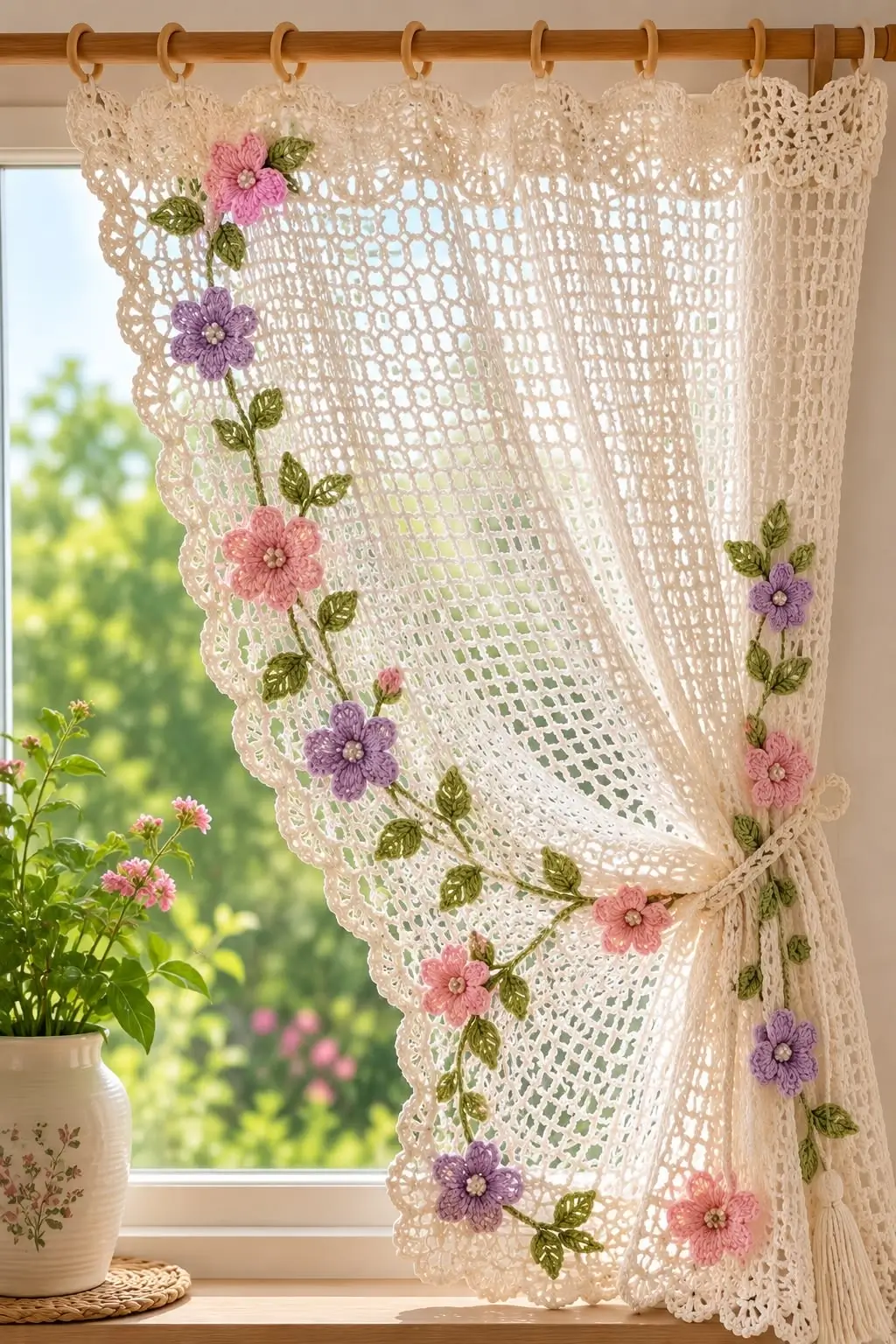
Five-petal flowers climbing across an ivory mesh panel create the defining structure of this curtain. This crochet flower curtain pattern uses size-10 cotton thread, a 2.0 mm hook and an adjustable foundation for a window-size panel around 70 × 100 cm. Intermediate crochet skills are appropriate because the project combines mesh, edging and appliqué. Adjustable width makes the construction practical for non-standard windows.
The Design: What Makes This Floral Curtain Different
The curtain uses three separate structural layers: an open mesh field, a denser decorative perimeter and raised botanical appliqué. Keeping the center predominantly mesh reduces weight while allowing daylight through the finished crochet lace curtain.
Flowers and leaves are added after blocking. Sewing dimensional motifs into an unfinished panel can pull individual mesh cells out of square and create diagonal distortion.
The top edge needs additional stability because every rod loop transfers load into it. A compact single-crochet reinforcement row therefore sits behind the decorative edging.
The most common error with a floral crochet curtain is treating flowers as structural stitches. They should remain appliqués. The panel carries the load; the vines supply decoration.
Project Info at a Glance
| Skill Level | Time | Finished Size | Hook | Best For |
|---|---|---|---|---|
| Intermediate | 15–25 hours, size dependent | Adjustable; sample approx. 70 × 100 cm | 2.0 mm | Windows, doors, decorative panels |
Materials and Tools
Yarn
- Ivory/cream — size-10 100% cotton crochet thread — approximately 180–250 g depending on dimensions.
- Dusty pink — size-10 cotton — small quantity.
- Lavender — size-10 cotton — small quantity.
- Olive/sage green — size-10 cotton — small quantity for leaves and vines.
- Pearl/cream — size-10 cotton — small quantity for flower centers.
Tools
- 2.0 mm crochet hook
- Tapestry needle
- Sharp embroidery needle
- Blocking pins
- Rust-resistant blocking surface
- Scissors
- Tape measure
- Stitch markers
- Optional small pearl beads for flower centers
Abbreviations
- ch — chain
- sc — single crochet
- hdc — half double crochet
- dc — double crochet
- tr — treble crochet
- sl st — slip stitch
- sp — space
- st/sts — stitch/stitches
- rep — repeat
- RS — right side
- WS — wrong side
Invisible decreases are not required because this project is constructed primarily in flat rows rather than stuffed spiral rounds.
Crochet Flower Curtain Pattern — Step by Step
The curtain is constructed as a rectangular mesh panel. Stitch counts are calculated from the required window dimensions, allowing the width and length to be modified without changing the overall design.
Gauge Swatch
Yarn: ivory size-10 cotton.
Make a 15 × 15 cm mesh swatch before calculating the foundation.
Foundation: Ch 43.
Row 1: Dc in 7th ch from hook, *ch 2, skip 2 ch, dc in next ch* across.
Rows 2–14: Ch 5, turn. Dc in next dc, *ch 2, dc in next dc* across.
Block the swatch without aggressively stretching it. Measure a central 10 cm section.
The curtain width should be based on the number of mesh repeats per 10 cm after blocking rather than the unblocked foundation-chain measurement.
Main Lace Panel
Yarn: ivory.
For the sample curtain, work a foundation sufficient to measure approximately 70 cm after blocking. The mesh repeat uses a multiple of 3 plus the turning-chain allowance.
Row 1: Dc in the appropriate foundation chain, *ch 2, skip 2 ch, dc in next ch* across.
Row 2: Ch 5, turn, dc in next dc, *ch 2, dc in next dc* across.
Repeat Row 2 until the panel measures approximately 96 cm, leaving about 4 cm for the lower decorative border.
The resulting field consists of regular rectangular mesh cells. Check the curtain width every 15–20 rows. A gradual width increase indicates that the chain spaces are being worked too loosely.
Do not attach the flowers or leaves yet.
Top Reinforcement
Yarn: ivory.
Turn the panel so the top foundation edge is accessible.
Row 1: Join yarn at one corner. Work sc evenly across, placing approximately 3 sc into each mesh repeat.
Row 2: Ch 1, turn, sc in every sc across.
Fasten off.
This compact strip carries the rod-loop load rather than asking the open mesh section to support the full curtain weight.
Scalloped Side and Bottom Border
Yarn: ivory.
Join the yarn at an upper corner.
Edge 1: Work sc evenly down the first side, across the bottom and up the second side. Keep the stitch distribution identical on both vertical edges.
Edge 2: Ch 1 and turn where necessary. *Skip 2 sts, 5 dc in next st, skip 2 sts, sl st in next st.* Repeat along the decorative perimeter.
At corners, place an additional shell only when required to keep the fabric flat.
Fasten off and weave the tail through at least 4 cm of dense edging.
Rod Loops
Yarn: ivory. Make enough loops to place one approximately every 9–11 cm.
The curtain uses individual crocheted loops rather than a continuous rod pocket.
Row 1: Ch 22, or enough chains to pass comfortably around the intended curtain rod.
Row 2: Starting in the second ch from the hook, sc across.
Fasten off with a 20 cm sewing tail.
Fold each strip into a loop. Position the first and last loops close to the panel corners, then distribute the remaining loops evenly across the top.
Sew both ends of every loop securely through the reinforced top strip. For a curtain approximately 70 cm wide, 7–8 loops generally provide balanced suspension.
Large Five-Petal Crochet Flowers
Yarn: dusty pink or lavender. Make approximately 8–12.
R1: Work 6 sc in a magic ring and sl st to the first sc. (6)
R2: Form five petals around the center. For each petal, ch 5, work 2 tr into the petal base, ch 5 and sl st back into the base.
Distribute five petals evenly around the center. Adjust the final petal spacing visually so the flower remains balanced.
For thicker petals, work each petal using sl st, sc, dc, 2 tr, dc, sc, sl st around its chain loop.
Fasten off with a 15 cm sewing tail.
Small Flower Centers
Yarn: pearl or cream.
Ch 2.
Work 6 sc into the second ch from the hook.
Fasten off and leave a sewing tail.
Sew one small center over the middle of each flower. Small pearl beads can be substituted for the crocheted centers when a more dimensional finish is required.
Pointed Crochet Leaves
Yarn: olive or sage green. Make approximately 20–30.
Ch 9.
Working down the first side of the chain:
Row 1: Sl st in second ch, sc in next ch, hdc in next ch, dc in next 3 ch, hdc in next ch, 3 sc in final ch.
Rotate the work and continue along the opposite side of the foundation chain.
Hdc in next ch, dc in next 3 ch, hdc in next ch, sc in next ch and sl st at the base.
Fasten off with a 15 cm sewing tail.
For a visible central vein, surface-slip-stitch from the base toward the leaf tip using a slightly lighter green thread.
Crochet Vine Stems
Yarn: olive green.
The floral arrangement uses thin wandering stems rather than thick crocheted cords.
Chain to the required length. For short branches, make approximately 15–25 cm sections. For the main diagonal vines, prepare sections approximately 35–55 cm long.
Starting in the second chain from the hook, sl st into every chain.
Fasten off.
Pin the stems to the blocked curtain before sewing. Position curves so they cross mesh intersections whenever possible. These intersections provide stronger attachment points than the center of an open mesh space.
Small Flower Buds
Yarn: dusty pink. Make 2–4.
R1: 6 sc in magic ring. (6)
R2: Sc around. (6)
R3: *Sc, dec* twice. (4)
Fasten off. Do not stuff.
Sew each bud to the end of a short green stem. Add a small leaf immediately beneath selected buds to integrate them into the vine.
Crochet Curtain Tieback Cord
Yarn: ivory.
Chain until the cord measures approximately 55–70 cm, adjusting the length according to the amount of fabric being gathered.
Row 1: Sl st in each chain across.
For a thicker tieback, make three matching cords and braid them together. Leave approximately 10 cm free at each end for finishing.
The tieback should remain a separate functional component rather than being permanently sewn to the curtain panel.
Tieback Tassel
Yarn: ivory.
Wrap the cotton around a 10 cm piece of card approximately 35–45 times.
Thread a 25 cm strand beneath the wraps and tie firmly at the top. Cut the wraps along the opposite edge.
Wrap another strand around the tassel approximately 1.5 cm below the top. Knot securely and pass the loose ends into the body of the tassel.
Trim the completed tassel to approximately 8 cm.
Attach the tassel to the visible end of the curtain tieback. A second tassel can be made when a symmetrical tieback is preferred.
Assembly
- Block the completed ivory mesh panel to its intended rectangular dimensions before attaching any decoration.
- Sew the rod loops to the reinforced top band at equal 9–11 cm intervals.
- Lay the main green vine diagonally across the panel and pin it at mesh intersections.
- Add secondary vine sections, maintaining an asymmetrical rather than mirrored arrangement.
- Position the dusty-pink flowers first because they establish the main repeated color points.
- Add lavender flowers between the pink motifs without forming rigid horizontal or vertical rows.
- Place leaves in pairs and singles along the vines, keeping most leaf tips oriented away from their stems.
- Sew flowers and leaves through structural mesh intersections rather than pulling the sewing thread across large open spaces.
- Make and finish the separate tieback, then attach its tassel after checking the required circumference around the gathered curtain.
- Steam or wet-block the decorated curtain lightly, keeping the dimensional petals raised instead of pinning them completely flat.
The finished curtain should hang square from the reinforced upper edge while the floral appliqué remains decorative rather than load-bearing.
7 Technical Tips for a Better Crochet Lace Curtain
- Control mesh widening. Measure the panel every 15 rows. If its width grows by more than approximately 1 cm per 50 cm, shorten the chain spaces slightly rather than relying on blocking to correct the difference.
- Prevent top-edge sagging. Keep the rod loops approximately 9–11 cm apart. Wider spacing concentrates the curtain weight at fewer attachment points and can produce visible dips.
- Avoid flower distortion. Sew each flower through its center and one or two petal bases only. Stitching every petal edge to the mesh can pull the surrounding cells out of shape.
- Stop leaves from rotating. Anchor each leaf at the base and approximately 5 mm below the tip. A leaf attached only at its base can turn sideways when the curtain moves.
- Prevent vine puckering. Do not pull the sewing thread tightly between mesh intersections. A vine attached under tension effectively shortens the fabric diagonally and can pull the rectangular panel out of square.
- Correct border ruffling. When the shell edging begins to flare, increase the number of skipped base stitches instead of adding additional shells. Too many decorative stitches create a wavy edge that blocking may not correct.
- Hide yarn tails. Weave ivory tails through at least 4 cm of dense stitches. Avoid carrying colored flower or leaf tails across open mesh because those strands become visible when daylight passes through the curtain.
Finishing the Floral Crochet Curtain
Measure the actual curtain rod width before committing to the final foundation chain. Window dimensions matter more than copying a fixed stitch count from a curtain designed for another space.
Make and block the mesh swatch first, calculate the required repeats, then complete the entire ivory panel before positioning the botanical elements. This construction sequence prevents the vines and flowers from interfering with dimensional corrections during blocking.
After assembly, hang the curtain for several hours and inspect the top edge. Adjust individual rod loops if the weight distribution creates uneven folds.
Photograph the completed crochet flower curtain pattern against the window after final blocking. Save the project to Pinterest or share the flower and vine placement on Instagram with #FloralLaceCurtain.
For a second version, record the blocked mesh gauge beside the exact window measurements before changing the floral arrangement. Which detail would you modify first: the pink-to-lavender flower ratio or the direction of the main climbing vine?