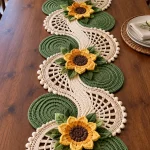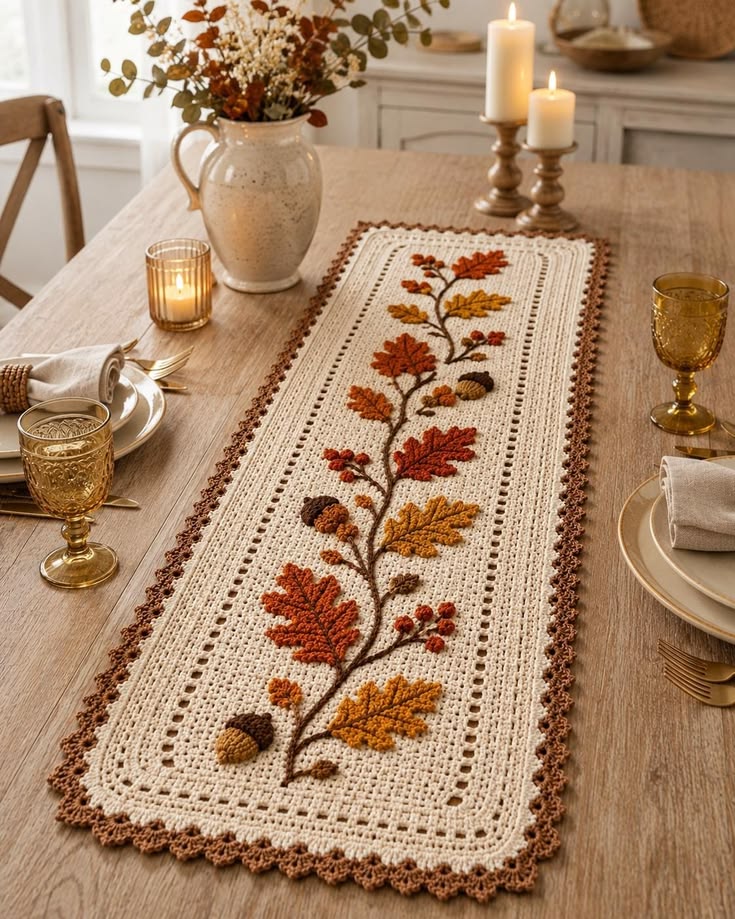
Oak leaves need deep side lobes and a strong center vein or they lose their identity when translated into crochet. This autumn leaves crochet table runner pattern uses an ivory rectangular base with openwork borders, raised brown branches, rust and golden leaves, berry clusters, acorns and a brown scalloped edging. Worked mainly in cotton yarn, the runner is designed for intermediate crochet skills and can be lengthened for different dining tables.
The Design: What Makes This Autumn Table Runner Different
The central decoration is built separately from the runner base. That decision matters because trying to create detailed oak leaves inside ordinary filet crochet would flatten the lobes and restrict color placement. Individual appliqués can instead be positioned along a branching stem after the rectangular foundation is blocked.
A second structural decision is the double openwork frame. Rows of small square openings separate the botanical center from the denser outer bands, making the cream background look lighter without weakening the middle of the runner. The final brown scalloped border adds contrast and controls the long edges.
The main failure point in an autumn crochet table runner is appliqué tension. Leaves or branches sewn down too tightly pull the rectangular base inward and produce waves along the perimeter.
Project Info at a Glance
| Skill Level | Time | Finished Size | Hook | Construction |
|---|---|---|---|---|
| Intermediate | 10–14 hours | Approx. 25 × 94 cm / 10 × 37 in | 4 mm | Flat runner with sewn appliqués |
A 25 × 94 cm finished size is a practical reference for this format. Published fall foliage runner patterns use approximately 10 × 37 inches with DK cotton and a 4 mm hook, making those specifications suitable for the long, narrow proportions shown here.
Materials and Tools
Yarn
- Ivory or natural cotton — DK weight — approximately 180–220 g for the runner base.
- Dark brown cotton — DK weight — approximately 30–40 g for branches, acorn caps and border.
- Rust orange cotton — DK weight — approximately 20–25 g for leaves and berries.
- Golden mustard cotton — DK weight — approximately 20–25 g for leaves and acorns.
- Burnt orange cotton — DK weight — approximately 15–20 g.
- Tan or camel cotton — DK weight — approximately 10–15 g for acorn bodies.
Use yarns with similar fibre content and thickness. Different yarn diameters can make one leaf noticeably heavier than another even when the same stitch sequence is used.
Tools
- 4 mm crochet hook
- 3.5 mm crochet hook for smaller appliqués if required
- Tapestry needle
- Scissors
- Stitch markers
- Measuring tape
- Blocking pins
- Blocking mat
Abbreviations
- MR — magic ring
- ch — chain
- sc — single crochet
- hdc — half double crochet
- dc — double crochet
- tr — treble crochet
- sl st — slip stitch
- st/sts — stitch/stitches
- sp — space
- sk — skip
- inc — increase
- rep — repeat
An invisible decrease is useful only when shaping dimensional acorns; the flat runner, leaves and branches do not require amigurumi-style invisible decreases.
Autumn Leaves Crochet Table Runner Pattern
The runner is constructed in stages. Crochet and block the ivory rectangle first, add its openwork and outer borders, then make the colored leaves, acorns and berries separately. The brown branch is attached before the other appliqués so every leaf can overlap it naturally.
Ivory Center Panel
Yarn: ivory or natural DK cotton.
Ch 51.
Row 1: Dc in 4th ch from hook and in each ch across. Turn.
Row 2: Ch 3, dc in each st across. Turn.
Rows 3–68: Repeat Row 2.
Measure the rectangle without stretching it. The center should remain long and narrow. Continue repeating the row if additional table coverage is required.
The finished runner length can therefore be adjusted before the decorative border is added. Record the number of extra rows because the appliqué arrangement will also need additional leaves or berries on a substantially longer runner.
First Openwork Border
Continue with ivory yarn.
Work around the complete center panel.
Round 1: Ch 1, sc evenly around all four edges, placing 3 sc into each corner. Join with sl st.
Round 2: Ch 4, *skip 1 st, dc in next st, ch 1* around. At each corner, work enough additional chain space to turn without pulling. Join.
This creates the first line of small square openings.
Round 3: Ch 1, sc in each dc and 1 sc in every ch-1 sp around. Work 3 sc at each corner. Join.
The openwork must remain rectangular after this round. If the corners curl upward, add a little more spacing at each corner before continuing.
Solid Ivory Border
Round 4: Ch 3, dc in each st around, placing 3 dc in each corner st. Join.
Round 5: Ch 3, dc in each st around. Work 3 dc at each corner. Join.
Round 6: Ch 1, sc in each st around, placing 3 sc at each corner. Join.
This solid section stabilizes the open squares and creates the broad cream frame visible between the two openwork areas.
Second Openwork Border
Round 7: Ch 4, skip 1 st, *dc in next st, ch 1, skip 1 st* around. Adjust the corner spaces so the fabric remains flat.
Round 8: Ch 1, sc in every dc and ch-1 sp around. Work 3 sc in each corner.
Round 9: Ch 3, dc in every st around, placing 3 dc at each corner.
Fasten off ivory yarn.
Brown Scalloped Outer Border
Yarn: dark brown.
Attach yarn at one corner.
Round 1: Ch 1, sc in each st around. Place 3 sc at each corner. Join.
Round 2: *Skip 1 st, 5 dc in next st, skip 1 st, sl st in next st* around.
At the corners, adjust the spacing so one full shell sits close to each corner rather than forcing a partial shell into the turn.
Fasten off and weave the tail through the brown border.
Crochet Oak Leaves
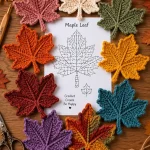
The reference uses several leaf sizes in rust, orange and mustard. A pointed center vein gives the motif its structure while short side branches form the characteristic lobed oak silhouette.
Large Oak Leaf
Make approximately 6–8 in mixed autumn colors.
Ch 16.
Side 1: Sl st in second ch from hook, sc in next ch, hdc in next 2 ch, dc in next 2 ch.
Ch 3, sl st in second ch from hook, sc in next ch, sl st back into the main foundation. This forms the first pointed lobe.
Work dc in next 2 foundation ch.
Ch 4, sl st in second ch from hook, sc in next ch, hdc in next ch, sl st into the foundation. This forms a larger central lobe.
Dc in next 2 ch.
Ch 3, sl st in second ch, sc in next ch, sl st into foundation.
Continue toward the end with hdc, sc and sl st to taper the leaf.
Work 3 sc into the final foundation chain to turn.
Side 2: Work back along the opposite side of the foundation, mirroring the lobes created on Side 1.
Finish with sl st at the base.
Ch 5 for the stem, sl st back down the chain and join to the leaf base.
Fasten off, leaving approximately 25 cm for sewing.
Small Oak Leaf
Make approximately 4–6.
Ch 11.
Sl st in second ch, sc in next ch, hdc in next 2 ch.
Ch 3, sl st in second ch, sc in next ch, sl st into the main chain.
Dc in next 2 ch.
Ch 3, sl st in second ch, sc in next ch, sl st into the foundation.
Taper toward the tip with hdc, sc and sl st.
Work around the end and mirror the shaping along the second side.
Ch 4 at the base for a short stem. Sl st back down the chain.
Fasten off with a sewing tail.
Crochet Acorn Appliqués
Several acorns are placed between the leaves. The body and cap use separate colors so the cap remains visually distinct from the nut.
Acorn Body
Make 3–4 using tan, mustard or burnt orange.
Ch 7.
Row 1: Sc in second ch from hook and across. Turn. (6)
Row 2: Ch 1, sc2tog, sc in next 2 sts, sc2tog. Turn. (4)
Row 3: Ch 1, sc in each st across. Turn. (4)
Row 4: Ch 1, sc2tog twice. Turn. (2)
Row 5: Sc2tog. (1)
Fasten off.
Acorn Cap
Yarn: dark brown.
Attach brown yarn across the wide upper edge of the acorn.
Row 1: Ch 1, work hdc evenly across the upper edge. Turn.
Row 2: Ch 1, decrease at the beginning and end of the row.
Row 3: Sl st toward the center, ch 3, sl st back down the chain to form the stem.
Fasten off, leaving a sewing tail.
Shape the cap over the upper part of the acorn body. Keep the lower point exposed.
Autumn Berry Clusters
Make approximately 8–12 individual berries in rust, burnt orange and dark red.
R1: 6 sc in MR. (6)
R2: Inc ×6. (12)
Fasten off for a flat berry appliqué.
For a smaller berry, stop after R1 and close the magic ring firmly.
Arrange berries in groups of three rather than distributing them individually. Clustered placement makes them readable against the cream background and follows the branching botanical structure.
Raised Brown Branch
Yarn: dark brown.
The central branch should run lengthwise through the runner with gentle directional changes rather than forming a perfectly straight line.
Ch approximately 90–110, depending on the finished runner length.
Row 1: Sl st in second ch from hook and in each ch across.
Fasten off, leaving a long sewing tail.
This narrow cord forms the main stem.
Side Branches
Make 8–12 short cords in different lengths.
For short branches, ch 8–12 and sl st back across the chain.
For longer branches, ch 14–18 and sl st back across.
Fasten off with sewing tails.
Variation in branch length is important. Identical side branches create a geometric tree shape rather than the irregular botanical line visible in the design.
Planning the Botanical Layout
Block the complete cream runner before placing any appliqués. Its final dimensions must be established first because wet blocking after attachment can distort the colored leaves.
Position the main brown stem down the center. It should begin several centimetres above one short edge and finish before reaching the opposite border.
Curve the stem slightly to the left and right. Pin it every 4–5 cm.
Next, place the largest oak leaves. Alternate sides rather than arranging every leaf in matching pairs. Rust, orange and mustard should also be distributed along the entire length instead of grouped into separate color zones.
Add the smaller leaves between them. Place acorns close to side branches, then use berry clusters to fill smaller spaces.
Photograph the complete arrangement before sewing. That reference makes it easier to restore the intended positions if motifs shift during attachment.
Assembly
- Block the ivory table runner to a rectangular shape and allow it to dry completely.
- Pin the long dark-brown branch along the center, leaving clear space between its ends and the short borders.
- Sew the branch down with small matching stitches every 1–2 cm, allowing gentle curves to remain.
- Position and attach the shorter side branches at irregular intervals along the central stem.
- Arrange the large rust, orange and mustard oak leaves, then sew through their center veins and selected outer points.
- Add the smaller leaves between the large motifs without creating symmetrical pairs.
- Position the crochet acorns beneath or beside selected branches and secure both body and cap.
- Arrange berries in clusters of approximately three and attach them close to branch tips.
- Check that the runner still lies flat, then loosen and resew any appliqué that pulls the cream foundation inward.
- Weave all remaining tails through stitches of the same color and lightly block the completed runner to its final dimensions.
The finished runner should remain flat with a continuous raised branch, alternating autumn leaves, berry clusters, acorns, two openwork frames and a contrasting brown scalloped perimeter.
7 Technical Tips for a Flat Autumn Table Runner
- Measure the width every 10 rows. A difference greater than about 5 mm usually indicates changing tension. Correct the tension while crocheting the foundation rather than relying on aggressive blocking later.
- Use markers at all four corners. Missing a corner increase can pull one edge diagonally and turn the rectangle into a slight parallelogram. Move each marker to the new center corner stitch after every border round.
- Do not stretch the branch while sewing. A stretched crochet cord contracts after release and gathers the ivory fabric underneath it. Pin the branch in its relaxed state every 4–5 cm before stitching.
- Leave the outer leaf lobes partly free. Sewing around the complete perimeter flattens the appliqué and can create puckering. Anchor the center vein and two or three strategic points instead.
- Check appliqué clearance from the border. Keep the outer tips of leaves approximately 2–3 cm inside the first openwork line. Leaves crossing that line interrupt the rectangular frame and can catch on plates or serving pieces.
- Control the scalloped edge at the corners. Forcing a five-dc shell into insufficient space creates a curled corner. Shift the repeat by one stitch when required so a complete shell can turn the corner cleanly.
- Weave dark tails only through dark stitches. A brown tail carried through the ivory foundation can remain visible from the front. Change direction twice inside the branch, leaf or border before trimming the yarn.
How to Adjust the Table Runner Length
A table runner does not need to match one fixed measurement. For a shorter centerpiece, stop the ivory center panel earlier. For a long dining table, continue the basic rows before starting the perimeter rounds.
Measure the usable tabletop first. A runner intended to remain entirely on the tabletop can be considerably shorter than the table. Another version can extend toward or beyond both ends.
Length changes affect the botanical composition. Adding 20–25 cm to the base without adding motifs creates a visibly empty section. As a working ratio, add one large leaf, one small leaf and one berry or acorn feature for approximately every additional 15–20 cm of central branch.
Width adjustments require more planning because they change the proportions of the openwork frame. Add foundation stitches in pairs when widening the center so the mesh spacing remains balanced.
Choosing Autumn Colors
The reference depends on a restrained palette rather than every possible fall color. Ivory occupies most of the surface. Dark brown defines the perimeter and branches, while rust, terracotta and mustard provide the strongest contrasts.
Keep the branch darker than every leaf. If the stem and rust leaves have nearly identical values, their edges merge and the branching structure becomes difficult to read from across a dining table.
Mustard works particularly well for several leaves and acorn bodies because it separates the darker orange motifs. Tan can then be reserved for one or two acorns.
For a more neutral version, replace rust with muted brick and golden yellow with ochre. Keep the cream foundation unchanged to preserve contrast between the appliqués and background.
Blocking the Finished Runner
Blocking has a structural role in this project. The long rectangle contains solid crochet, open spaces, appliqués and a scalloped perimeter, all of which react differently to tension.
Lay the finished runner on a blocking surface and measure both long edges. Pin the four corners first. Continue pinning along each long edge at regular intervals, keeping the openwork squares aligned.
Shape the brown scallops individually without pulling them into long points. Arrange each oak leaf so its lobes remain separated, then straighten the acorns and berry clusters.
Dampen the cotton according to the yarn manufacturer’s care instructions and allow the piece to dry completely before removing the pins.
Do not hang the wet runner. The weight of damp cotton can increase its length and distort the square openings.
Using the Runner on a Dining Table
The raised appliqués make placement important. Keep serving dishes, hot cookware and candle holders off the dimensional leaves and berries. Flat plates can sit beside the decorated center rather than directly on top of it.
If the runner will be used beneath a large centerpiece, position the main flower vase or bowl between major leaf clusters during the layout stage. This prevents the most detailed motifs from being permanently hidden.
Cotton is a practical fibre for table linens because it creates defined stitches and can generally tolerate more frequent cleaning than highly textured novelty yarns. Follow the care instructions for the specific yarn used, especially when combining several colors.
Conclusion
This autumn leaves crochet table runner pattern combines a long ivory foundation with filet-style openings, a brown scalloped frame and separately constructed botanical appliqués. The raised branch determines the composition, so block the runner and position that element before attaching a single leaf. After the branch is secured, distribute rust and mustard oak leaves, acorns and berry clusters along its length while keeping the outer frame clear. Save the finished runner to Pinterest or share the table setting on Instagram with #AutumnOakRunner. For your version, would you place more acorns along the lower branches or make the large rust-colored oak leaves the dominant feature? “`0