Introduction
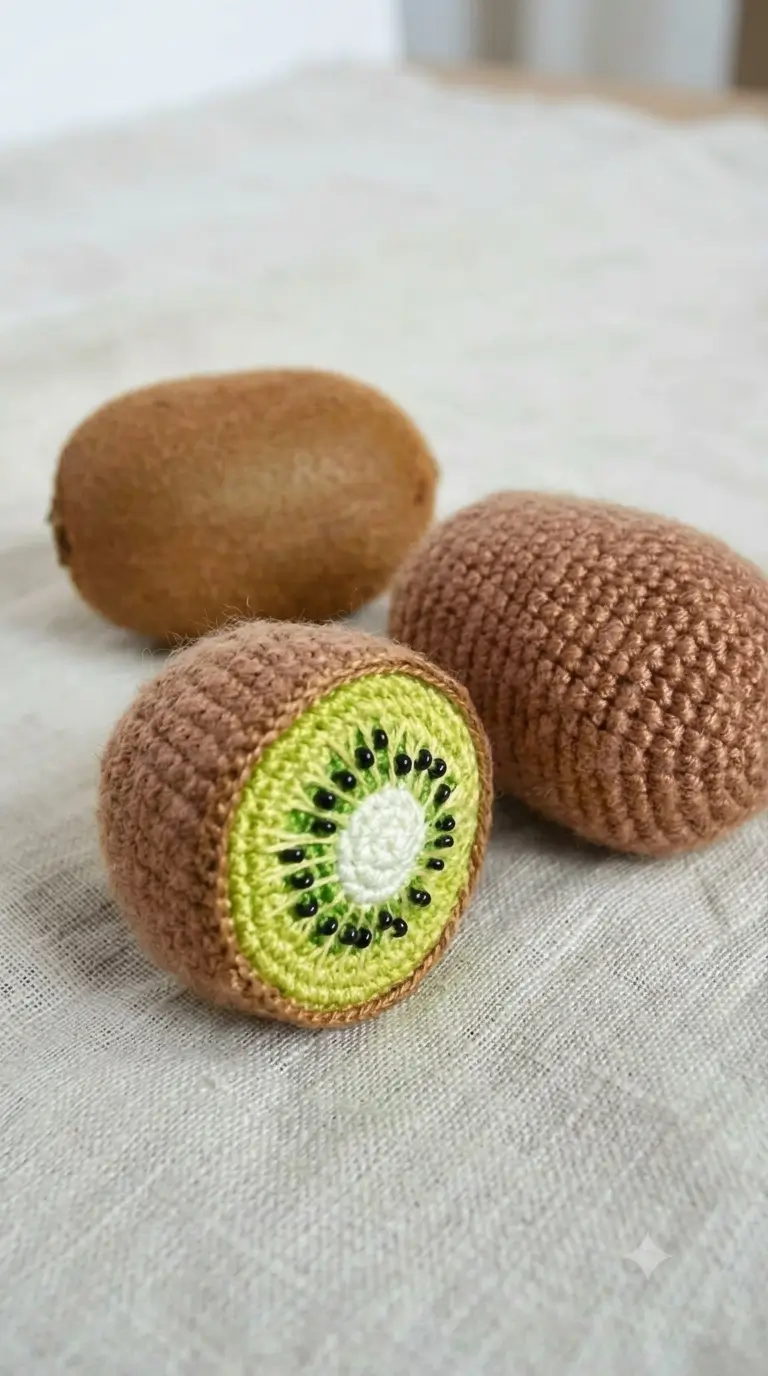
Kiwi fruit has a pale central core surrounded by a ring of dark seeds, so the crochet version fails if that radial structure is flattened into one green disc. This kiwi fruit amigurumi crochet pattern uses brown cotton, lime and white accents, black seed details, a 2.5 mm hook, and firm stuffing to make a fruit about 5.7 cm across. Skill level: easy. The compact scale suits play-food sets and scrap-yarn projects.
The Design: What Makes This Kiwi Different
The photo depends on three structural choices. First, the brown outer shell is elongated rather than perfectly spherical; extra plateau rounds create the kiwi’s short oval profile without increasing its circumference. Second, the cut piece is built as a shallow stuffed shell with a separate flat crochet kiwi slice attached across the opening. That method keeps the green face flat instead of allowing stuffing to dome it outward. Third, the center is divided into white core, lime flesh, pale radial stitches and dark seeds rather than treated as one color block. A frequent error in a realistic crochet fruit pattern is placing the seeds in a rigid circle. Real kiwi seeds vary slightly in distance and angle, so the crochet kiwi slice looks more accurate when the black details form an irregular ring.
Project Info at a Glance
| Skill Level | Time | Finished Size | Hook | Best For |
|---|---|---|---|---|
| Easy | Not published in the benchmark sources | Approx. 5.5–5.7 cm | 2.5 mm | Play food, fruit sets, small decor and scrap yarn |
Size and hook benchmark: the Ravelry Kiwi Fruit listing by Yarn Blossom Boutique gives a finished measurement of 2 1/4 inches, approximately 5.7 cm, with a 2.5 mm hook. Current whole-and-half kiwi designs also document 2.5 mm hooks with 8/4 cotton.
Materials and Tools
Yarn
- Brown — 8/4 cotton or similar fine cotton — approximately 9 g for one whole fruit plus one half — suggested type: smooth mercerized or matte cotton.
- Lime green — 8/4 cotton — approximately 1–2 g — choose a clear kiwi-flesh green rather than a dark leaf green.
- Natural white — 8/4 cotton — approximately 1 g — used for the central core and pulp lines.
- Black — fine cotton or embroidery thread — less than 1 g when the seeds are embroidered.
The gram figures follow current whole-and-half kiwi material benchmarks using 8/4 cotton. Prepare a little extra brown if your tension is loose or if you want two whole fruits to match the composition in the photograph.
Tools
- 2.5 mm crochet hook
- Polyester fiberfill
- Yarn needle
- Locking stitch marker
- Scissors
- 20–24 black beads, approximately 2–3 mm, optional for the seed effect shown in the photo
- Sewing thread and a fine needle if beads are used
No safety eyes are required for the realistic version. For an item intended for a young child, embroider the seeds with black thread rather than attaching beads or other small hard pieces.
Abbreviations
- MR — magic ring
- sc — single crochet
- inc — 2 sc in the same stitch
- dec — decrease over the next 2 stitches
- sl st — slip stitch
- ch — chain
- BLO — back loop only
- st/sts — stitch/stitches
For an invisible decrease, insert the hook through the front loops of the next two stitches, pull up a loop, then complete one single crochet through the remaining loops.
Pattern — Step by Step
Work the three-dimensional pieces in a continuous spiral unless another method is stated. Place a stitch marker in the first stitch of every round. The small fruit uses a 30-stitch plateau, keeping the diameter compact while the repeated even rounds supply the kiwi’s oval length.
Whole Kiwi Body — Make 1
Yarn: brown — construction based on standard 6-stitch amigurumi math.
R1: 6 sc in MR (6)
R2: inc ×6 (12)
R3: (1 sc, inc) ×6 (18)
R4: (2 sc, inc) ×6 (24)
R5: (3 sc, inc) ×6 (30)
R6: sc around (30)
R7: sc around (30)
R8: sc around (30)
R9: sc around (30)
R10: sc around (30)
R11: sc around (30)
R12: sc around (30)
R13: sc around (30)
R14: sc around (30)
R15: (3 sc, dec) ×6 (24)
R16: (2 sc, dec) ×6 (18)
Stuff firmly at this point. Add stuffing in thin layers rather than inserting one large wad, because a dense center can produce a pointed end.
R17: (1 sc, dec) ×6 (12)
R18: dec ×6 (6)
Fasten off. Leave a 15 cm tail, thread it through the front loops of the final six stitches, pull the opening closed and bury the yarn tail through the stuffed body.
Roll the completed fruit gently between the palms to shift stuffing toward the sides. The finished profile should be a short oval, not a ball and not a long cylinder.
Cut Kiwi Brown Shell — Make 1
Yarn: brown — this piece remains open at the front for the fruit-face disc.
R1: 6 sc in MR (6)
R2: inc ×6 (12)
R3: (1 sc, inc) ×6 (18)
R4: (2 sc, inc) ×6 (24)
R5: (3 sc, inc) ×6 (30)
R6: sc around (30)
R7: sc around (30)
R8: sc around (30)
R9: sc around (30)
R10: sc around (30)
Fasten off and leave a 35 cm sewing tail. Do not close the opening.
Place stuffing inside the shell, concentrating most of it against the rounded back. Stop when the open edge holds a circular shape without spreading beyond 30 stitches. Overfilling this part pushes the green disc outward and removes the flat cut-fruit appearance seen in the reference photo.
Kiwi Flesh Disc — Make 1
Yarn: natural white, pale lime and lime green — worked as a flat circle.
R1: With natural white, 6 sc in MR (6)
R2: inc ×6 (12)
Change to pale lime or light green.
R3: (1 sc, inc) ×6 (18)
Change to the