Introduction
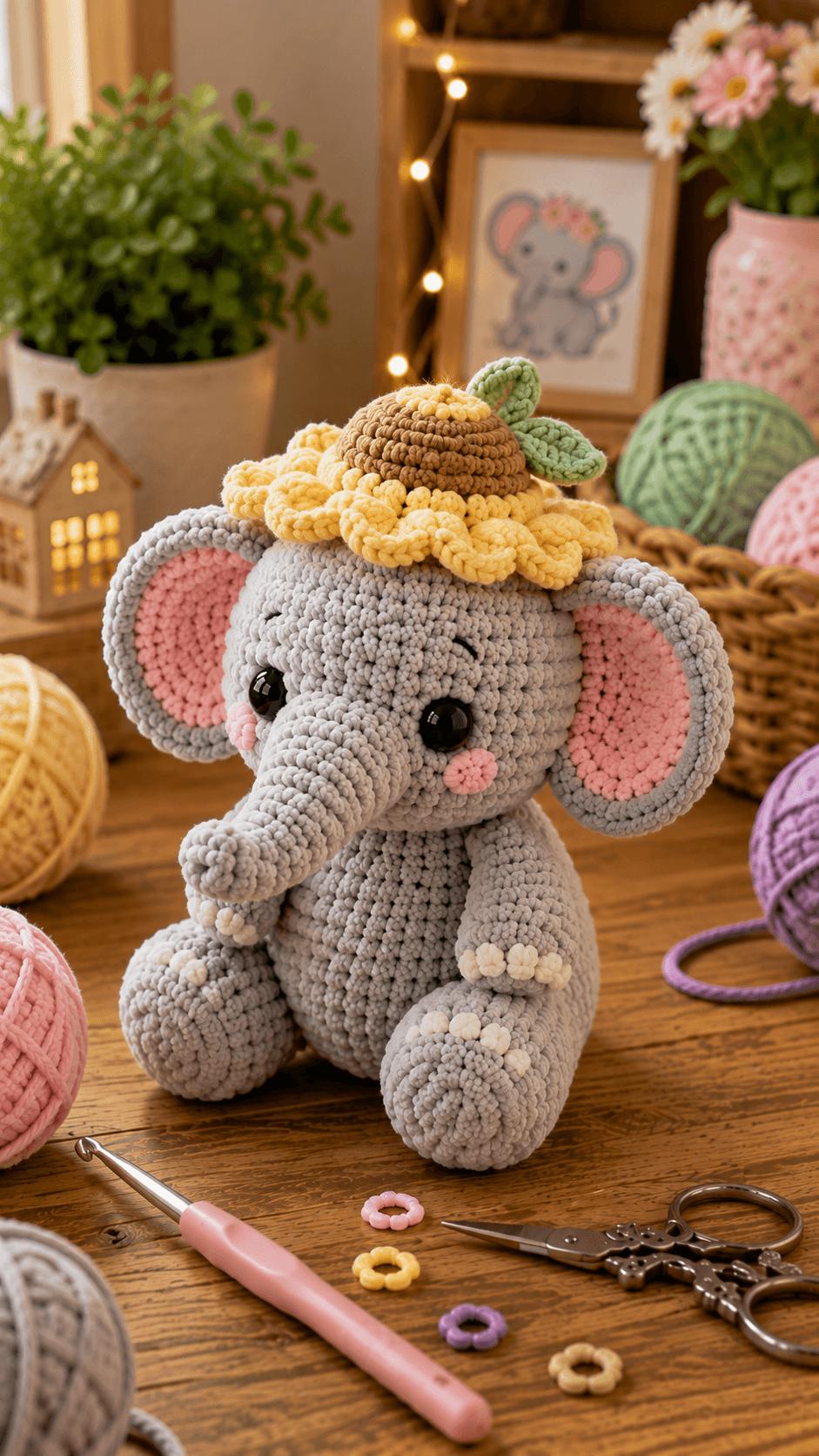
An elephant wearing a sunflower needs petals wide enough to clear both ears without turning the flower into a flat disk. This sunflower elephant amigurumi crochet pattern uses chunky chenille, a 4.5 mm hook and 10–12 mm safety eyes for an approximately 27–31 cm plush. A long trunk, oversized pink-lined ears, four limbs, white toes and a dimensional sunflower hat form the intermediate construction.
The Design: What Makes This Sunflower Elephant Different
The elephant uses a 42-stitch head because the ears, trunk and oversized flower all need enough facial width to remain separate. A smaller 36-stitch pear-shaped torso keeps the head dominant while still supporting two large seated hind legs. The trunk grows from six stitches at the tip to eighteen at the face, giving it a gradual taper rather than a cylindrical shape. Each ear combines a 30-stitch gray outer panel with a smaller pink insert. Above them, twelve yellow petals surround a padded brown sunflower centre, while two sage leaves break the otherwise circular silhouette. The plush elephant amigurumi depends heavily on accessory placement. A common failure is sewing the sunflower too far forward; its lower petals should overlap the crown slightly without touching the safety eyes.
Project Information at a Glance
| Skill Level | Time | Finished Size | Hook | Best For |
|---|---|---|---|---|
| Intermediate | 12–16 hours | Approx. 27–31 cm including flower | 4.5 mm | Nursery decor, floral plush collections and handmade markets |
Materials and Tools
Yarn
- Dove gray — chunky chenille — approximately 170–210 g — head, body, trunk, ears and limbs
- Blush pink — chunky chenille — approximately 25–35 g — inner ears and cheeks
- Sunflower yellow — chunky chenille — approximately 35–45 g — petals
- Warm brown — chunky chenille — approximately 20–30 g — sunflower centre
- Sage green — matching chenille — approximately 10–15 g — leaves
- White — chenille or smooth bulky yarn — approximately 10–15 g — toe bumps
- Black embroidery yarn — small amount — optional eyebrow or mouth accents
Tools
- 4.5 mm crochet hook
- Two 10–12 mm black safety eyes
- Polyester toy stuffing
- Large-eye yarn needle
- Locking stitch markers
- Dressmaking pins
- Scissors
Current large chenille elephant patterns can use around 180 g of the main color with a 5 mm hook, while worsted constructions commonly move to smaller hooks and lighter material totals. The amount listed here includes extra allowance for the oversized ears and photo-matched proportions.
Abbreviations
- MR — magic ring
- sc — single crochet
- inc — two single crochet stitches in one stitch
- dec — decrease over two stitches
- sl st — slip stitch
- ch — chain
- hdc — half double crochet
- dc — double crochet
- BLO — back loop only
- FLO — front loop only
An invisible decrease is worked through the front loops of the next two stitches before completing both loops together as one single crochet.
Pattern — Step by Step
Work all stuffed pieces in continuous spirals unless a section states otherwise. Mark the first complete stitch of every round and confirm each bracketed stitch count before continuing.
Head
Yarn: dove gray.
R1: 6 sc in MR (6)
R2: inc × 6 (12)
R3: (sc, inc) × 6 (18)
R4: (2 sc, inc) × 6 (24)
R5: (3 sc, inc) × 6 (30)
R6: (4 sc, inc) × 6 (36)
R7: (5 sc, inc) × 6 (42)
R8–R13: sc around (42)
R14: (5 sc, dec) × 6 (36)
Insert the safety eyes between R10 and R11, approximately seven visible stitches apart. Compare 10 mm and 12 mm eyes before installing the washers.
R15: (4 sc, dec) × 6 (30)
R16: (3 sc, dec) × 6 (24)
R17: (2 sc, dec) × 6 (18)
R18: (sc, dec) × 6 (12)
R19: dec × 6 (6)
Stuff firmly after R14. Keep the lower centre slightly softer where the trunk will attach.
Fasten off. Pull the remaining six front loops closed.
Body
Yarn: dove gray.
R1: 6 sc in MR (6)
R2: inc × 6 (12)
R3: (sc, inc) × 6 (18)
R4: (2 sc, inc) × 6 (24)
R5: (3 sc, inc) × 6 (30)
R6: (4 sc, inc) × 6 (36)
R7–R12: sc around (36)
R13: (4 sc, dec) × 6 (30)
R14: sc around (30)
R15: (3 sc, dec) × 6 (24)
R16: sc around (24)
R17: (2 sc, dec) × 6 (18)
R18: (sc, dec) × 6 (12)
R19: dec × 6 (6)
Stuff firmly through R15. Keep the neck end slightly compressible for assembly.
Fasten off and leave a 45 cm sewing tail.
Trunk
Yarn: dove gray. Work from the tip toward the face.
R1: 6 sc in MR (6)
R2–R6: sc around (6)
R7: inc × 6 (12)
R8–R11: sc around (12)
R12: (sc, inc) × 6 (18)
R13–R15: sc around (18)
Stuff R8–R15 lightly. Leave the six-stitch tip almost empty so the end can curve downward.
Fasten off with a 35 cm sewing tail.
Gray Outer Ears — Make Two
Yarn: dove gray.
R1: 6 sc in MR (6)
R2: inc × 6 (12)
R3: (sc, inc) × 6 (18)
R4: (2 sc, inc) × 6 (24)
R5: (3 sc, inc) × 6 (30)
Fasten off with a 40 cm sewing tail. Do not stuff.
Pink Inner Ears — Make Two
Yarn: blush pink.
R1: 6 sc in MR (6)
R2: inc × 6 (12)
R3: (sc, inc) × 6 (18)
R4: (2 sc, inc) × 6 (24)
Fasten off with a 25 cm tail.
Stretch the pink circles vertically while pinning them inside the gray panels. Leave approximately 1–1.5 cm of visible gray border.
Front Arms — Make Two
Yarn: dove gray.
R1: 6 sc in MR (6)
R2: inc × 6 (12)
R3: (sc, inc) × 6 (18)
R4–R7: sc around (18)
R8: (sc, dec) × 6 (12)
R9–R11: sc around (12)
R12: dec × 6 (6)
Stuff the lower paw firmly and leave the upper section softer.
Fasten off with a 35 cm tail.
Back Legs — Make Two
Yarn: dove gray.
R1: 6 sc in MR (6)
R2: inc × 6 (12)
R3: (sc, inc) × 6 (18)
R4: (2 sc, inc) × 6 (24)
R5–R8: sc around (24)
R9: (2 sc, dec) × 6 (18)
R10: (sc, dec) × 6 (12)
R11–R12: sc around (12)
R13: dec × 6 (6)
Stuff firmly and flatten each lower section into a broad seated foot.
Fasten off with a 40 cm sewing tail.
White Toe Bumps — Make Twelve
Yarn: white. Make three for each limb end if reproducing all visible toe details.
Ch 2. Work 5 hdc into the second chain from the hook.
Join with a slip stitch and fasten off with a 10 cm tail.
Pink Cheeks — Make Two
Yarn: blush pink.
R1: 6 sc in MR (6)
Fasten off with a 12 cm tail. Flatten each circle into a small horizontal oval during attachment.
Sunflower Brown Centre
Yarn: warm brown.
R1: 6 sc in MR (6)
R2: inc × 6 (12)
R3: (sc, inc) × 6 (18)
R4: (2 sc, inc) × 6 (24)
R5: (3 sc, inc) × 6 (30)
R6–R8: sc around (30)
R9: (3 sc, dec) × 6 (24)
Add a shallow amount of stuffing to form a raised dome rather than a ball.
Fasten off and leave a 40 cm tail.
Sunflower Petals — Make Twelve
Yarn: sunflower yellow.
R1: 6 sc in MR (6)
R2: inc × 6 (12)
R3–R5: sc around (12)
R6: dec × 6 (6)
Add a trace of stuffing to the outer half only. Flatten the six-stitch attachment end.
Fasten off with a 25 cm tail.
Sunflower Leaves — Make Two
Yarn: sage green. Work around both sides of a chain.
Ch 8.
Starting in second chain from hook:
sl st, sc, hdc, 2 dc, hdc, sc; work 3 sc in final ch.
Continue along the opposite side:
sc, hdc, 2 dc, hdc, sc, sl st.
Fasten off with a 25 cm tail.
Sunflower Hat Base
Yarn: yellow or brown, depending on which color you want hidden beneath the petals.
R1: 6 sc in MR (6)
R2: inc × 6 (12)
R3: (sc, inc) × 6 (18)
R4: (2 sc, inc) × 6 (24)
R5: (3 sc, inc) × 6 (30)
R6: (4 sc, inc) × 6 (36)
Fasten off with a 45 cm attachment tail.
This flat disk stabilizes the sunflower on the elephant’s crown and prevents individual petals from pulling directly on the gray head fabric.
Optional Tail
The reference angle does not clearly show the elephant’s tail. Add this only if a complete rear view is required.
R1: 6 sc in MR (6)
R2–R7: sc around (6)
Fasten off and leave unstuffed.
Assembly
- Sew each pink inner panel onto a gray outer ear first. Keep approximately 1–1.5 cm of gray visible around most of the pink edge.
- Attach the trunk centrally below the safety eyes. Angle the narrow tip downward and slightly toward one side before finishing the lower seam.
- Sew both pink cheek patches outside the trunk and below the eye line. Keep the circles level when the head is viewed from directly in front.
- Attach the ears across broad sections of the upper sides of the head. Leave the outer halves free so both ears remain wide and slightly forward-facing.
- Sew the head to the body using a reinforced circular seam. Keep the elephant upright and angle the face only slightly downward.
- Attach the front arms to the upper torso and the larger back legs low on the body. Test the sitting position on a hard surface before tightening the hind-leg seams.
- Sew three white toe bumps across each visible foot or paw, leaving small gray gaps between neighboring pieces.
- Arrange twelve yellow petals around the 36-stitch sunflower base, overlapping their attachment ends slightly. Sew the padded brown centre over those inner ends.
- Attach the two green leaves behind the upper-right side of the sunflower, then pin the complete flower to the crown so its lowest petals remain above the eyes and between the ears.
- Sew the sunflower base to the head through a wide circular area, inspect the elephant from the front and side, then weave every structural yarn tail through several stitch directions.
The finished elephant should sit independently with the trunk projecting forward, both pink-lined ears fully visible and the sunflower centred over the crown without covering the eyes.
7 Technical Tips
- Sunflower tipping forward: A padded centre sewn directly to the head concentrates too much weight in one seam. Mount the full flower on the 36-stitch base and attach that disk across a circle at least 5–6 cm wide.
- Ear collapse: Large chenille ears attached over fewer than about six head stitches can fold under the flower. Spread each attachment seam across approximately 5 cm.
- Trunk droop: Heavy stuffing in the narrow tip makes the trunk point sharply downward. Leave the first five six-stitch rounds almost empty.
- Decrease holes: Gray stuffing shadows become visible through stretched chenille around shaping rounds. Work decreases through the front loops of the next two stitches.
- Uneven sitting pose: A hind leg attached 5 mm higher than its partner can tilt the torso. Pin both 24-stitch feet and test the elephant on a level surface before sewing.
- Petal crowding: Twelve petals attached edge-to-edge can twist into a vertical ruffle. Overlap only the flattened inner 5–8 mm while leaving each rounded outer half separate.
- Eye obstruction: A sunflower placed less than about 2 cm above the eye line can cast its petals over the face. Pin the completed hat before sewing and check the view straight on.
Shaping the Elephant Head
The head is the largest stuffed component in this sunflower elephant amigurumi crochet pattern. A 42-stitch maximum gives the face enough circumference for the long trunk, wide ear attachments and oversized floral hat.
Keep the sphere firm through the crown. The sunflower introduces additional weight, and a loosely stuffed upper head can flatten where the hat base is attached.
The lower front should remain fractionally softer. That area needs to accept the 18-stitch trunk opening without developing a pronounced hard ridge around the seam.
Constructing the Tapered Trunk
Elephant patterns commonly treat the trunk as an important separate shaping problem. Current instructions often centre it beneath the eyes after the head has been completed.
This version starts at six stitches and expands to eighteen. The change creates a narrow flexible tip and a broad facial base capable of supporting the plush chenille weight.
Stuff only the wider section. Shape the narrow end after assembly by bending it gently downward and adding one hidden anchoring stitch if the yarn repeatedly straightens.
Making the Large Pink-Lined Ears
The gray outer pieces reach 30 stitches while each inner panel stops at 24. That six-stitch difference produces a visible gray frame.
Current large-elephant tutorials attach substantial ears across broad seams rather than single points, which supports the approach used here.
Sew only the inner ear edge to the head. Leaving the remaining circumference free preserves the open circular profile visible beside the sunflower.
Building the Seated Body
The torso peaks at 36 stitches, one increase stage below the head. This produces a smaller body while retaining enough width to support the oversized hind legs.
Pack the lower body firmly. The elephant should stand on the back legs and lower torso rather than leaning against its trunk or front arms.
The upper neck area can remain slightly softer because a compressible surface makes it easier to centre the head without a visible gap.
Positioning the Front Arms
Both arms hang beside the torso and point toward the front feet. Their 18-stitch maximum keeps them narrower than the 24-stitch hind legs.
Attach them below the head seam and angle the rounded ends inward. The reference leaves a clear gray chest between the two arms.
Do not sew the full arm length to the body. Fix mainly the upper attachment section so the lower paws retain their stuffed three-dimensional form.
Constructing the Large Hind Feet
The back legs provide the base for the seated pose. Their 24-stitch maximum adds enough width to counterbalance the large head and sunflower.
Flatten the stuffed lower section slightly before pinning. A perfectly spherical hind foot gives the toy only a small contact point with the table.
Move both feet forward until the torso sits upright without rocking. Tighten the seams only after checking the figure from the front and side.
Adding the White Toes
The image uses raised white toe bumps rather than flat embroidery. Small five-half-double-crochet motifs create enough volume to remain readable against chenille.
Position three pieces across the front of each foot. Leave a strip of gray between them instead of sewing their edges together.
Pull the tails only until the white pieces sit flat. Excess tension produces visible dents across the stuffed limb.
Constructing the Sunflower Centre
The brown centre is a shallow stuffed dome rather than a flat appliqué. It expands to 30 stitches and then decreases once, giving it visible thickness above the petal ring.
Add stuffing gradually before closing. The finished height should be lower than its diameter.
A heavily packed centre places unnecessary weight at the top of the elephant and can force the petals downward over the ears.
Making the Twelve Yellow Petals
Each petal reaches 12 stitches before narrowing to six. That shape gives a rounded sunflower petal rather than a pointed daisy petal.
Add only a trace of stuffing to the outer end. The bases need to stay flat because all twelve pieces converge around the centre.
Arrange every petal before sewing any permanently. Small spacing changes accumulate quickly around a full ring of twelve pieces.
Attaching the Sunflower Hat
The sunflower is large enough to function structurally as a hat. A hidden 36-stitch disk spreads its weight across the elephant’s crown.
Complete the flower separately, then place it between the ears. Rotate it until the brown centre appears horizontal from the front.
The lower yellow petals may overlap the gray forehead slightly but should not reach the black eyes. Sew through the hidden base rather than through individual petal tips.
Adding the Green Leaves
Two leaves emerge from one side of the sunflower in the reference. Their placement interrupts the circular flower silhouette and makes the accessory look botanical rather than purely decorative.
Work both around foundation chains so each leaf develops a central axis. Pin them behind the brown centre before the complete flower is attached to the elephant.
Leave most of each leaf edge free. Only the base needs structural stitches.
Working with Chunky Chenille
Current elephant patterns demonstrate broad yarn flexibility. Little Love Everyday uses worsted yarn with a 3.5 mm hook, while a current large chenille elephant specifies super-bulky #6 yarn and a 5 mm hook. :contentReference[oaicite:18]{index=18}
The 4.5 mm hook here aims for dense plush fabric without making the large ears and sunflower too rigid.
If stuffing is visible through the first 36- or 42-stitch rounds, reduce the hook by 0.5 mm rather than changing the written stitch counts.
Choosing Safety-Eye Size
Published elephants use different eye diameters according to scale. Current examples include 8 mm safety eyes in worsted yarn and 10 mm dome-button eyes in a larger amigurumi. :contentReference[oaicite:19]{index=19}
For this chenille head, test 10 mm first and move to 12 mm if you want the stronger glossy-eye proportion visible in the supplied image.
Install the washers before the head opening becomes narrow. After they are locked, check the trunk position against the eye spacing before closing the sphere.
Planning Yarn Quantities
A current large super-bulky chenille elephant specifies about 180 g of its main gray yarn plus smaller accent amounts. :contentReference[oaicite:20]{index=20} The photo-matched project requires additional material for broad ears and a large flower.
Reserve the main gray yarn for the head, ears and hind legs before finishing the small arm pieces. Those components consume the largest individual quantities.
The sunflower also uses more yellow yarn than a flat floral appliqué because twelve petals are three-dimensional.
Adjusting Finished Size
Published elephant amigurumi ranges from palm-sized designs to figures more than 30 cm tall. A 2024 free elephant is listed at 15 cm, while a larger worsted version reaches around 36 cm. :contentReference[oaicite:21]{index=21}
To make a smaller version, retain the same counts and switch to worsted yarn with approximately a 3.5 mm hook. Scale the sunflower using the same yarn as the elephant.
For a larger plush, use thicker blanket yarn rather than expanding only the head. The body, ears, feet and flower then grow at the same rate.
Balancing the Finished Elephant
The sunflower adds meaningful weight above the centre of gravity. Complete the elephant’s sitting pose before permanently attaching the flower.
Set the toy on a level table and confirm that the two hind feet and lower body create a broad three-point base.
If the elephant tips backward after the sunflower is pinned, move the feet forward several millimetres before adding extra stuffing. Leg position corrects balance more effectively than distorting the torso.
Competition and Design Gap
Current Etsy search results show several sunflower-elephant PDFs alongside the broader elephant amigurumi market, so the flower theme itself is already commercially active. :contentReference[oaicite:22]{index=22}
The supplied design is visually differentiated by scale. The sunflower spans much of the crown, has twelve padded petals, a thick brown centre and two leaves rather than functioning as a small appliqué or handheld accessory.
Keeping both large pink-lined ears unobstructed strengthens that distinction because the elephant remains identifiable even when the flower dominates the upper silhouette.
Finishing Checks
Set the completed elephant on a hard surface and inspect the sitting base first. Both hind feet should contact the table, and the torso should stay vertical without pressure from the front arms.
View the face straight on. The eyes must remain level, the trunk should be centred and both pink inner ears need comparable visible area.
Check the sunflower last. Its petals should form a complete ring, the brown centre needs to remain raised, and the two leaves should project beyond one side without pulling the hat off centre.
Conclusion
Measure the finished elephant from the table to the highest sunflower point and record the flower diameter separately; both dimensions matter when changing chenille brands. Photograph the plush directly from the front to check trunk alignment, ear balance and petal spacing before trimming the final tails. Save this sunflower elephant amigurumi crochet pattern to Pinterest and share the finished elephant on Instagram with #SunflowerElephantPlush. Reshape all twelve petals and both ears before the final photograph. Would you keep the classic yellow sunflower shown here or make the next elephant with dusty-pink petals and a cream centre?
Sources
- Jess Huff — Esther the Elephant, updated July 2024 with revised elephant construction and assembly. :contentReference[oaicite:23]{index=23}
- Little Love Everyday — Elephant Amigurumi: worsted yarn, 3.5 mm hook and 8 mm safety eyes. :contentReference[oaicite:24]{index=24}
- Loops and Love Crochet — Elephant Amigurumi: approximately 182 m main yarn and 18 m accent yarn. :contentReference[oaicite:25]{index=25}
- Ravelry — Elwis Elephant Amigurumi: 2.5 mm hook and 10 mm dome-button eyes. :contentReference[oaicite:26]{index=26}
- Etsy — large chenille Pixie Rainbow elephant: super-bulky yarn, 5 mm hook and approximately 180 g light-gray yarn. :contentReference[oaicite:27]{index=27}
- Etsy — current Sunflower Elephant Crochet Pattern marketplace showing multiple floral elephant PDFs. :contentReference[oaicite:28]{index=28}